Within GEIPAN
Why Some UFO Reports Remain Unidentified Due to Insufficient Data
Explains how GEIPAN classifies cases as C when there is insufficient information to make an identification.
On this page
- Criteria for C classification
- Examples of low consistency cases
- Impact on public statistics
Page outline Jump by section
Introduction
France’s official space agency unit GEIPAN (Groupe d’Études et d’Informations sur les Phénomènes Aérospatiaux Non Identifiés) organises reported sightings into resolution categories that reflect the quality of evidence and the outcome of investigation, not merely their “mystery value.” Among its four main categories — A, B, C and D — Category C has a distinct role: it flags cases that cannot be meaningfully analysed because the available data or information is too weak or incomplete to support a reliable identification or explanation. This is not the same as a definitive unresolved “unknown”; it’s a judgement that the record is too sparse or inconsistent to reach a conclusion either way.[Geipan]geipan.frStatistics | GEIPANApril 28, 2026…
Criteria for C Classification
GEIPAN’s categorisation process pivots on two core measures assessed for every sighting report:
- Residual strangeness (E): how far the reported observation remains from known, plausible explanations after considering all reasonable hypotheses.
- Consistency (C): how complete, coherent and reliable the information is — including witness numbers, detail in responses, presence of photos or videos, independent confirmations, and links between witnesses.[Geipan]geipan.frmethodologie classification geipanLa méthodologie de classification au GEIPAN | GEIPANFebruary 26, 2021 — Publication date 26 February 2021 LA MÉTHODOLOGIE DE CLASSIFICATI…
For most sightings, analysts search for and evaluate hypotheses based on physical phenomena (astronomical objects, aircraft, meteorological effects) or perceptual/psychological factors, quantify how well the best hypothesis fits (yielding a strangeness score), and weigh this against the consistency of the dataset. When the data are both rich and internally consistent, the phenomenon can be classified as identified (A), probably identified (B), or — if unresolved despite strong data — a genuine “unexplained” (D). If, however, the information is too sparse or unreliable to support either explanation or meaningful residual strangeness assessment, the case is assigned Category C.[Geipan]geipan.frUNE MÉTHODOLOGIE DE CLASSIFICATION CONSOLIDÉE SUR DES DÉCENNIES La classification du GEIPAN (A/B/C/D*) a été…
The French glossary makes this distinction explicit: C cases are fundamentally “non‑analysable faute d’informations” — not analysed because of missing or insufficient information — and are categorically separate from A, B, and D cases which are backed by sufficient data to support a judgement.[Geipan]geipan.frSon histoire | GEIPANQU'EST-CE QUE LE GEIPAN?Le GEIPAN, Groupe d’Études et d’Information sur les Phénomènes Aérospatiaux Non Identifiés fait partie intégrante des missions du Centre…
How Insufficiency Plays Out
In practice, a Category C designation can arise when one or more of the following data conditions occur:
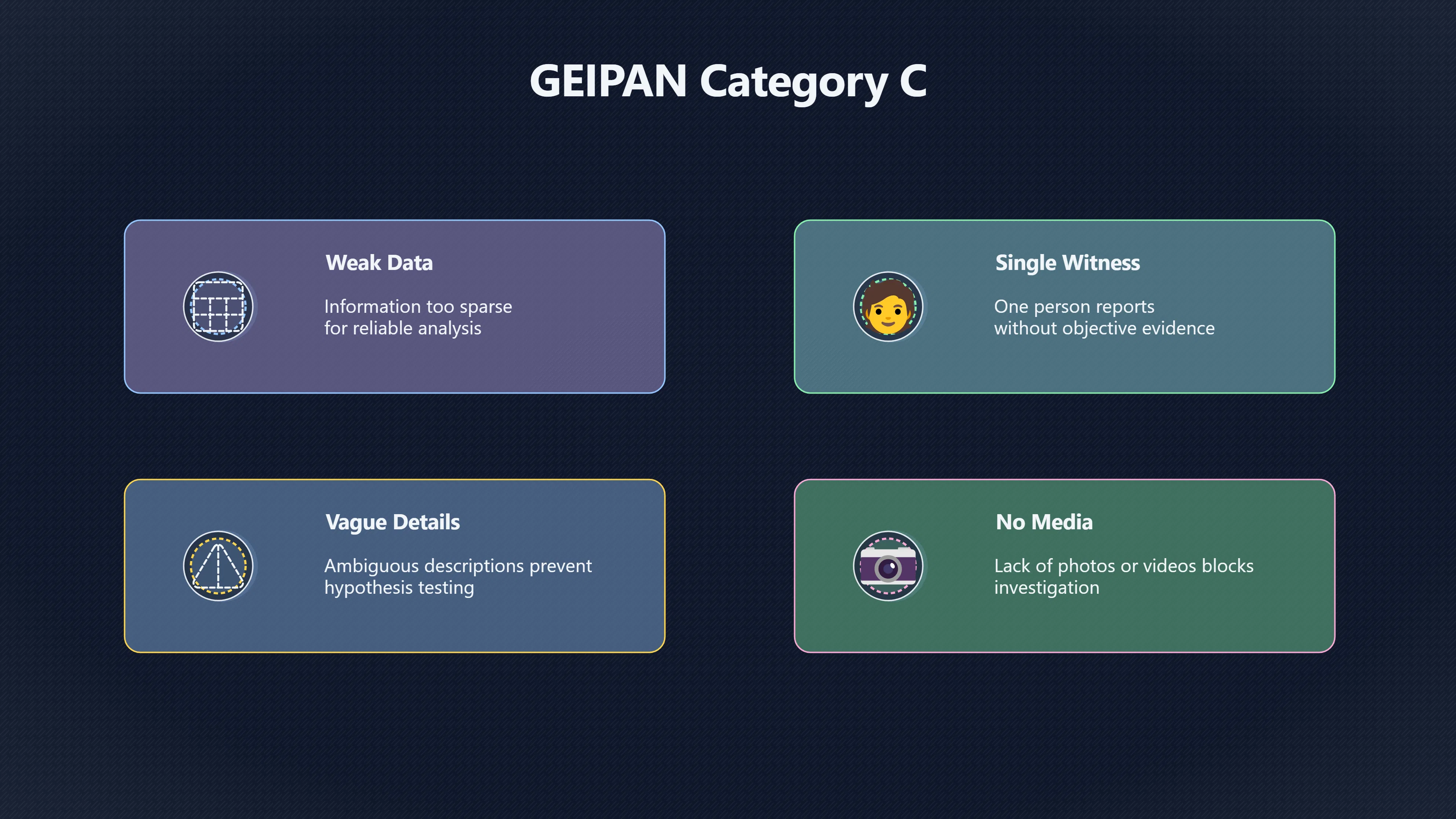
- Single, uncorroborated witness: only one person reports an event, and no additional objective evidence like photos or radar data exists.
- Vague or inconsistent testimony: key descriptive details are missing, contradictory, or ambiguous, preventing confident correlation with known phenomena.
- Lack of supporting media: without photographs, video, or instrument records, there is no material basis for further analytical steps.
- Unquantifiable conditions: the report lacks information on timing, location, motion, or environmental context needed to test explanatory hypotheses.[Geipan]geipan.frClassification | GEIPANFAQ GEIPAN 1What is GEIPAN? * GEIPAN (Group for the Study and Information of Unidentified Aerial/Aerospace Phenomena) is a technical department of th…
GEIPAN’s own method emphasises that higher strangeness (E) demands higher consistency (C) before a case can be flagged as truly unexplained; where consistency is weak, the default categorisation is C due to lack of reliable data rather than prematurely elevating the case to “unexplained.”[Geipan]geipan.frA CLASSIFICATION METHODOLOGY CONSOLIDATED OVER DECADES Since 2008, a more detailed classification (A/B/C/D1/D…
Examples of Low‑Consistency Cases
GEIPAN does not usually publish detailed lists of every Category C case with public narratives, but the statistical breakdown makes clear how common this outcome is. According to current published figures, about 30 % of classified cases are in Category C, reflecting a significant proportion of reports that lack enough information for conclusive investigation.[Geipan]geipan.frdentifiés) consiste à fournir un service opérationnel basé sur des enquêtes liées aux…
Typical low‑consistency patterns seen across these reports include:
- Reports with minimal or inconsistent witness responses to the technical questionnaire, leaving crucial parameters undefined.
- Sightings lacking any material evidence — no images, recordings, radar signatures or corroboration — that could anchor hypotheses or rule out mundane explanations.
- Ambiguous descriptions that might encompass many ordinary environmental or aerial phenomena but cannot be tied to specific known causes.[Geipan]geipan.frOVN I, UFO, PAN: QUELLE DIFFÉRENCE?GEIPANL'acronyme (Objet Volant Non Identifié) est la traduction du terme anglais UFO (Unidentified Flying Object). L'examen des témoign…
In some archived cases visible on the GEIPAN site, insufficient details such as imprecise timing, vague positional information or absence of corroborating data constrain any deeper analysis, leaving GEIPAN unable to advance beyond a Category C label.
Impact on Public Statistics
Understanding the C category is crucial when interpreting GEIPAN’s public statistics on unidentified aerospace phenomena. Because C is explicitly not a judgement of an unexplained or anomalous phenomenon, it must not be conflated with the “unknown” status that Category D signifies. GEIPAN separates these precisely to prevent weak documentation from being misrepresented as hard evidence of unexplained phenomena.[Geipan]geipan.fr1977 within the CNES: * Provides a public and official feedback to all people’s “liv…
Consequently:
- Category A and B dominate the database, representing cases explained or very likely explained based on adequate information.
- Category C reflects where the data were insufficient for analysis; these are not treated as mysteries but as cases that have not yielded enough evidence for conclusion.
- Category D — especially subcategories D1 and D2 — represents the genuine residual subset where a case remains unexplained despite robust and consistent data.[Geipan]geipan.frStatistics | GEIPANApril 28, 2026…
This distinction shapes public understanding: roughly one‑third of cases fall into C due to data issues, while only a small minority remain as solidly unexplained after investigation.[Geipan]geipan.frmethodologie classification geipanLa méthodologie de classification au GEIPAN | GEIPANFebruary 26, 2021 — Publication date 26 February 2021 LA MÉTHODOLOGIE DE CLASSIFICATI…
By distinguishing insufficient data from unresolved mystery, the GEIPAN framework aims to make its public database both scientifically credible and transparent about the limits of what the evidence supports.[Geipan]geipan.frUNE MÉTHODOLOGIE DE CLASSIFICATION CONSOLIDÉE SUR DES DÉCENNIES La classification du GEIPAN (A/B/C/D*) a été…
Amazon book picks
Further Reading
Books and field guides related to Why Some UFO Reports Remain Unidentified Due to Insufficient Data. Use these as the next step if you want deeper reading beyond the article.
The UFO Experience
Directly relevant to evidence sufficiency, case quality, and classification of incomplete UFO reports.
UFOs
Gives broader context for why credible witness data and documentation matter in official UFO reporting.
The Demon-Haunted World
Rating: 4.5/5 from 43 Google Books ratings
Addresses evidence, skepticism, and extraordinary claims, matching the logic behind insufficient-data categories.
How to Think About Weird Things: Critical Thinking for a New Age
Helps readers understand why insufficient evidence is not the same as proof of anomaly.
eBay marketplace picks
Marketplace Samples
Example marketplace items related to this page. Use the search link to explore similar finds on eBay.




Endnotes
1.
Source: geipan.fr
Link:https://geipan.fr/en/stats
Source snippet
Statistics | GEIPANApril 28, 2026...
Published: April 28, 2026
2.
Source: geipan.fr
Title: methodologie classification geipan
Link:https://geipan.fr/en/actualites/methodologie-classification-geipan
Source snippet
La méthodologie de classification au GEIPAN | GEIPANFebruary 26, 2021 — Publication date 26 February 2021 LA MÉTHODOLOGIE DE CLASSIFICATI...
Published: February 26, 2021
3.
Source: geipan.fr
Link:https://geipan.fr/fr/node/58787
Source snippet
UNE MÉTHODOLOGIE DE CLASSIFICATION CONSOLIDÉE SUR DES DÉCENNIES La classification du GEIPAN (A/B/C/D*) a été...
4.
Source: geipan.fr
Title: Son histoire | GEIPANQU’EST-CE QUE LE GEIPAN?
Link:https://geipan.fr/fr/histoire-du-geipan
Source snippet
Le GEIPAN, Groupe d’Études et d’Information sur les Phénomènes Aérospatiaux Non Identifiés fait partie intégrante des missions du Centre...
6.
Source: geipan.fr
Title: Classification | GEIPANFAQ GEIPAN 1
Link:https://www.geipan.fr/en/node/58787
Source snippet
What is GEIPAN? * GEIPAN (Group for the Study and Information of Unidentified Aerial/Aerospace Phenomena) is a technical department of th...
7.
Source: geipan.fr
Link:https://geipan.fr/index.php/en/node/58787
Source snippet
A CLASSIFICATION METHODOLOGY CONSOLIDATED OVER DECADES Since 2008, a more detailed classification (A/B/C/D1/D...
8.
Source: geipan.fr
Link:https://www.geipan.fr/index.php/fr/node/58792
Source snippet
dentifiés) consiste à fournir un service opérationnel basé sur des enquêtes liées aux...
9.
Source: geipan.fr
Title: OVN I, UFO, PAN: QUELLE DIFFÉRENCE?
Link:https://www.geipan.fr/fr/node/406
Source snippet
GEIPANL'acronyme (Objet Volant Non Identifié) est la traduction du terme anglais UFO (Unidentified Flying Object). L'examen des témoign...
10.
Source: geipan.fr
Link:https://www.geipan.fr/en/node/440
Source snippet
1977 within the CNES: * Provides a public and official feedback to all people’s “liv...
11.
Source: youtube.com
Link:https://www.youtube.com/watch?v=hn2xTieploU
Source snippet
UFOs, aliens: why is Trump declassifying? - C dans l'air - 04/25/2026...
12.
Source: youtube.com
Title: UFOs, aliens: why is Trump declassifying?
Link:https://www.youtube.com/watch?v=d1Olr4FyNbs
Source snippet
Geipan: France is also interested in UFOs...
13.
Source: youtube.com
Title: Geipan: France is also interested in UFOs
Link:https://www.youtube.com/watch?v=OLXDikL331Y
Source snippet
Governments Using AI To Decode Massive UFO Databases | WION Podcast...
14.
Source: cnes-geipan.fr
Title: Geipan Classification | GEIPAN
Link:https://www.cnes-geipan.fr/en/node/58787
15.
Source: cnes-geipan.fr
Title: Geipan Le glossaire du Geipan | GEIPAN
Link:https://www.cnes-geipan.fr/fr/glossaire
16.
Source: cnes-geipan.fr
Title: L E GEIPAN: « LE BUREAU DES OVNIS » OU DES PAN?
Link:https://www.cnes-geipan.fr/fr/node/58703
Source snippet
GEIPANJune 28, 2021 — Date de publication 28 juin 2021 LE GEIPAN: « LE BUREAU DES OVNIS » OU DES PAN? Date de publication 28 juin 202...
Published: June 28, 2021
17.
Source: cnes-geipan.fr
Title: Comment le GEIPAN classe-t-il les cas d’observations?
Link:https://www.cnes-geipan.fr/fr/node/412
Source snippet
GEIPAN* La classification repose sur une évaluation quantitative et qualitative de deux paramètres: la consistance (C) de l’observatio...
18.
Source: cnes-geipan.fr
Title: How does GEIPAN classify observation cases?
Link:https://www.cnes-geipan.fr/en/node/412
Source snippet
GEIPANThe classification process is done according a quantitative and qualitative assessment of two parameters: the consistency (C) of...
Additional References
19.
Source: cnes-geipan.fr
Link:https://www.cnes-geipan.fr/fr/faq-page
Source snippet
L’espace FAQ vous offre un accès rapide aux réponses aux questions les plus courantes concernant le rôle, les...
20.
Source: cnes-geipan.fr
Link:https://www.cnes-geipan.fr/fr/node/58791
Source snippet
[Select] [Input] [Input] [Input] Sommaire 1. Du GEPAN au GEIPAN 2. FAQ GEIPAN DU GEPAN AU GEIPAN D’aussi...
21.
Source: cnes-geipan.fr
Link:https://www.cnes-geipan.fr/fr/missions-methodes-et-resultats
Source snippet
e PAN où la présence d'un objet physique, pouvant avoir des caractéristiques de vol, e...
22.
Source: youtube.com
Title: Governments Using AI To Decode Massive UFO Databases | WION Podcast
Link:https://www.youtube.com/watch?v=adCsqd_-M94
Source snippet
UAP data released: Astrophysicist Avi Loeb breaks down declassified records | FOX 10 Talks...
23.
Source: youtube.com
Link:https://www.youtube.com/watch?v=ur0QX1eGCQI
Topic Tree