Within UFOCAT
Why UFOCAT Keeps Multiple Source Versions of UFO Events
This page explains how UFOCAT maintains different source accounts for the same UFO incident.
On this page
- Definition of source versions in UFOCAT
- Tracking original vs. secondary reports
- Impact on historical research accuracy
Page outline Jump by section
Introduction
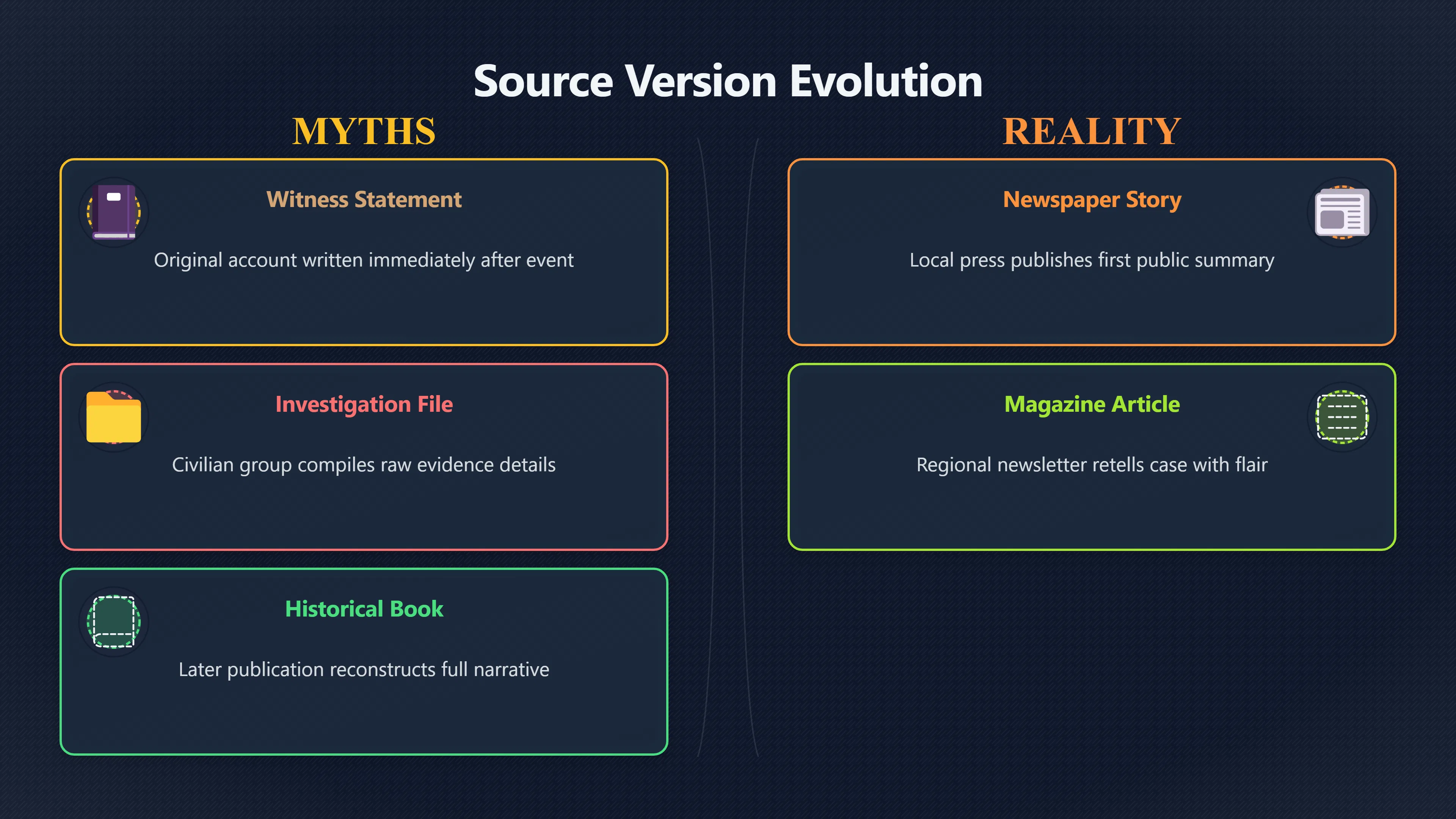
UFOCAT was designed to preserve the history of a UFO report, not merely to count sightings. One of its most distinctive features is that it deliberately keeps multiple source versions of the same event. A single sighting may appear as an original witness report, a local newspaper story, a civilian investigation file, a UFO magazine article and a later book summary. Rather than collapsing those accounts into one record, UFOCAT links them while preserving each version separately. This approach allows researchers to trace how a case evolved, identify where details were added or altered, and determine which source is closest to the original observation. CUFOS, the organisation that maintains UFOCAT, explicitly states that the catalogue often contains multiple entries for the same sighting and that this is a core part of its design rather than a database error.[Center for UFO Studies]cufos.orgCenter for UFO StudiesUFOCATUFOCAT is a catalog of published and unpublished UFO sighting reports. It often contains multiple entries for…
What UFOCAT Means by a “Source Version”
In UFOCAT, a source version is a separate record describing the same underlying event but originating from a different document, publication or investigator. The catalogue treats the source history itself as valuable data.
For example, a sighting reported to a local newspaper in 1965 might later appear in a NICAP investigation file, then in a regional UFO newsletter, and finally in a historical UFO book. Each publication may contain different details. A witness description may become more elaborate, a time may be corrected, or an explanation may be proposed years later. UFOCAT preserves these variations instead of selecting one account and discarding the others.[Center for UFO Studies]cufos.orgCenter for UFO StudiesUFOCATUFOCAT is a catalog of published and unpublished UFO sighting reports. It often contains multiple entries for…
This differs from many modern reporting databases that attempt to merge duplicate reports into a single incident record. UFOCAT assumes that later retellings are themselves part of the historical evidence trail.
How the Database Links Different Accounts of the Same Event
The mechanism for preserving source versions is built directly into UFOCAT’s record structure.
According to the UFOCAT codebook, records can be linked through fields that identify which entry is considered the primary account and which entries are secondary or derivative versions. The most important fields include:
- PRN (Primary Record Number), which points to the record judged to contain the most primary information about the event.
- X2, which indicates a record’s order of primacy within a group of records describing the same incident.
- IRN (Indirect Record Number), which links related indirect-source records.
- SOURCE and ISOURCE, which identify direct and indirect source references.
- PAGEVOL and related citation fields, which identify where the report appeared in a publication.
- LEVEL, which records the type of source involved, such as an investigation file, newspaper report, database listing or book.[Center for UFO Studies]cufos.orgCenter for UFO StudiesUFOCATUFOCAT is a catalog of published and unpublished UFO sighting reports. It often contains multiple entries for…
These fields allow UFOCAT to create clusters of related records. Instead of deleting duplicate-looking entries, the system records how they are connected and where each version originated.
The result resembles a bibliographic network more than a conventional sightings spreadsheet. Researchers can move from one version of a case to another and reconstruct the reporting chain.
Why Original and Secondary Reports Are Kept Separate
The separation between original and secondary accounts addresses a recurring problem in UFO history: information often changes as reports circulate.
A witness statement written immediately after an event may differ significantly from a summary published years later. Secondary sources sometimes compress timelines, omit uncertainties, add interpretations or repeat errors from earlier publications. By keeping both versions, UFOCAT allows users to see whether a frequently repeated claim can actually be traced to the earliest available source.
CUFOS explains that substantial effort has been devoted to identifying and linking primary and secondary references to individual cases. The organisation recommends using the catalogue as a guide to original documentation rather than treating every entry as an independent sighting.[Center for UFO Studies]cufos.orgCenter for UFO StudiesUFOCATUFOCAT is a catalog of published and unpublished UFO sighting reports. It often contains multiple entries for…
This distinction is especially important when examining famous cases. A widely discussed incident may generate dozens of later summaries, but only a handful of records may derive directly from witness interviews or contemporary investigation files. UFOCAT’s linkage system helps researchers distinguish between those levels of evidence.
Following the Evolution of a Case
Preserving multiple versions makes it possible to study how a UFO narrative develops over time.
Researchers can compare:
- The earliest known witness account.
- Subsequent investigator summaries.
- Later magazine retellings.
- Book-length reconstructions published years afterward.
- Database entries derived from earlier publications.
In some cases, dramatic details appear only in later retellings. In others, early reports contain information that later summaries omit. Because UFOCAT retains separate records for these stages, researchers can identify where a particular claim first entered the historical record.[Center for UFO Studies]cufos.orgCenter for UFO StudiesUFOCATUFOCAT is a catalog of published and unpublished UFO sighting reports. It often contains multiple entries for…
Why Multiple Versions Improve Historical Accuracy
At first glance, keeping duplicate-looking records appears inefficient. In historical research, however, preserving competing versions often improves accuracy.
A merged record can hide uncertainty by presenting one reconstructed narrative as if it were unquestionably correct. UFOCAT takes the opposite approach. It exposes the documentary trail and allows users to evaluate sources individually.
This has several advantages:
- Error detection: Conflicting dates, locations or witness numbers become visible.
- Source evaluation: Researchers can determine whether a claim comes from a contemporary document or a much later retelling.
- Transparency: The database reveals how information travelled through UFO literature.
- Reconstruction of lost material: Secondary accounts may preserve fragments of sources that are no longer available.[Center for UFO Studies]cufos.orgCenter for UFO StudiesUFOCATUFOCAT is a catalog of published and unpublished UFO sighting reports. It often contains multiple entries for…
The system therefore preserves uncertainty instead of concealing it. For historical work, that is often more valuable than producing a single simplified case summary.
The Trade-Off: Better Source Tracing, Harder Case Counting
The same mechanism that improves source tracing creates difficulties for statistical analysis.
Because UFOCAT contains multiple source versions of many incidents, a simple count of records does not equal a count of unique events. CUFOS explicitly warns that raw totals can overstate the number of sightings unless researchers filter records appropriately. The catalogue’s linking fields were created partly to address this problem by identifying which entries represent primary versions of a case.[Center for UFO Studies]cufos.orgCenter for UFO StudiesUFOCATUFOCAT is a catalog of published and unpublished UFO sighting reports. It often contains multiple entries for…
This trade-off reflects UFOCAT’s underlying philosophy. The database was built as a research archive and reference system rather than as a definitive census of UFO incidents. Preserving the source history of a report was considered more important than maintaining one clean entry per sighting.
What UFOCAT Reveals About UFO Documentation
The practice of keeping multiple source versions highlights a broader reality of UFO research: many cases survive not as single documents but as chains of retellings.
A report may pass through newspapers, private investigators, civilian organisations, books and later databases before reaching modern researchers. Each step can introduce changes. UFOCAT’s structure acknowledges that problem directly by preserving the different versions and recording how they relate to one another.
For historians, archivists and serious UFO researchers, this is one of the catalogue’s most valuable features. It transforms UFOCAT from a list of sightings into a map of how UFO information was collected, circulated and preserved across decades of investigation and publication.[Center for UFO Studies]cufos.orgCenter for UFO StudiesUFOCATUFOCAT is a catalog of published and unpublished UFO sighting reports. It often contains multiple entries for…

Amazon book picks
Further Reading
Books and field guides related to Why UFOCAT Keeps Multiple Source Versions of UFO Events. Use these as the next step if you want deeper reading beyond the article.
The Hynek UFO Report
Useful background for catalogue-based UFO research and case classification.
The UFO Experience
Analyzes different witness accounts and how reports diverge or overlap.
UFOs
Demonstrates how multiple sources cover the same UFO events, relevant to UFOCAT's multiple source tracking.

UFOs : Generals, Pilots, and Government Officials Go on the R...
First published 2011.
eBay marketplace picks
Marketplace Samples
Example marketplace items related to this page. Use the search link to explore similar finds on eBay.

Endnotes
1.
Source: cufos.org
Link:https://cufos.org/cufos-publications-databases/ufocat/
Source snippet
Center for UFO StudiesUFOCATUFOCAT is a catalog of published and unpublished UFO sighting reports. It often contains multiple entries for...
2.
Source: cufos.org
Title: UFOCAT Codebook 2023
Link:https://cufos.org/PDFs/UFOCAT%20Codebook%202023.pdf
Source snippet
Center for UFO StudiesUFOCAT 2023UFOCAT 2002 refers to a computer database of over 120,000 UFO reports and related information released i...
3.
Source: cufos.org
Link:https://cufos.org/PDFs/CUFOS_Associate_Newsletter/AN1_1.pdf
Source snippet
J. Allen Hynek, contains...Read more...
Additional References
4.
Source: youtube.com
Link:https://www.youtube.com/watch?v=lTGJt7Gho0w
Source snippet
UFO Sightings: How Scientists are Trying to Capture More Data | NOVA | PBS - YouTube UFO Sightings: How Scientists are Trying to Capture...
5.
Source: cia.gov
Link:https://www.cia.gov/readingroom/docs/DOC_0000042346.pdf
Source snippet
USSR: MEDIA REPORT MULTITUDE OF UFO SIGHTINGSOn 9 October the Soviet news agency TASS reported that a UFO had landed in a park in the cit...
6.
Source: enigmaticideas.com
Title: analyzing ufo sightings databases with generated code
Link:https://enigmaticideas.com/analyzing-ufo-sightings-databases-with-generated-code/
Source snippet
15 Mar 2026 — Using generative AI and natural language processing on multiple UFO sighting databases, we finally have the tools to answer...
7.
Source: dni.gov
Title: Prelimary Assessment UAP 20210625
Link:https://www.dni.gov/files/ODNI/documents/assessments/Prelimary-Assessment-UAP-20210625.pdf
Source snippet
Preliminary Assessment: Unidentified Aerial Phenomena...25 Jun 2021 — This report provides an overview for policymakers of the challenge...
8.
Source: youtube.com
Link:https://www.youtube.com/watch?v=ur0QX1eGCQI
Source snippet
Inside the Data: What 1,000+ [Pilot Reports]({{ 'pilot-reports/' | relative_url }}) Reveal About UAP | iConnections Webinar with Ryan Graves...
9.
Source: newspaceeconomy.ca
Title: ufocat the ufo sightings catalog by cufos
Link:https://newspaceeconomy.ca/2025/07/30/ufocat-the-ufo-sightings-catalog-by-cufos/
Source snippet
UFOCAT is an electronic database of UFO sightings maintained by the Center for UFO Studies (CUFOS), a nonprofit founded in 1973...Read more...
10.
Source: scribd.com
Link:https://www.scribd.com/document/664911255/Alien-Identities
Source snippet
h, let us consider some reports of. UFO...Read more...
11.
Source: youtube.com
Link:https://www.youtube.com/watch?v=nraHhvzdZAQ
Source snippet
Governments Using AI To Decode Massive UFO Databases | WION Podcast...
12.
Source: youtube.com
Title: UFO Sightings: How Scientists are Trying to Capture More Data | NOVA | PBS
Link:https://www.youtube.com/watch?v=qho0N3vv7Gw
Source snippet
UAP data released: Astrophysicist Avi Loeb breaks down declassified records | FOX 10 Talks...
13.
Source: usabusinessradio.com
Link:https://usabusinessradio.com/top-ufo-research-websites-to-follow-in-2026/
Source snippet
Top UFO Research Websites To Follow in 202625 Mar 2026 — Aside from UFO sightings, you can also read about alien encounters and abduction...
Topic Tree