Within UFOCAT
How UFOCAT Source Levels Reveal Report Reliability
Explains how UFOCAT’s LEVEL field indicates source type and reliability for each record.
On this page
- Understanding LEVEL field categories
- Differentiating newspapers, books, and investigations
- Using source level for historical analysis
Page outline Jump by section
Introduction
UFOCAT does not treat every source as equally trustworthy. One of its most useful features is the LEVEL field, which identifies the type of source behind a record and helps researchers judge how close a report is to the original event. Rather than simply listing a sighting, UFOCAT preserves information about whether the account came from a newspaper article, an investigator’s case file, a UFO magazine, a book, a later database compilation, or another form of documentation. This matters because the reliability of a UFO report often depends as much on the source chain as on the reported event itself. A dramatic claim repeated through several secondary publications may appear well documented while actually resting on a single weak original report. UFOCAT’s source-level system was designed to make those distinctions visible.[Center for UFO Studies]WikipediaCenter for UFO Studies - WikipediaThe Center for UFO Studies (CUFOS) is a privately funded UFO research group. The group was founded i…
Understanding LEVEL Field Categories
The UFOCAT codebook describes the LEVEL field as a way of identifying the nature of a source rather than directly grading whether a sighting is true or false. Researchers therefore use LEVEL as an indicator of evidential strength, source proximity, and potential distortion within the reporting chain.[Center for UFO Studies]sourcewatch.orgJuly 24, 2013 — Our purpose is to promote serious scientific interest in UFOs and to serve as an archive for reports, document…
In practical terms, the field helps answer several questions:
- Is this record based on a firsthand investigation or a later retelling?
- Did the information originate from a contemporary document or a retrospective book?
- Has the report passed through several authors before reaching UFOCAT?
- Is the source primarily reporting, analysing, cataloguing, or merely repeating earlier material?
This distinction is important because UFOCAT was designed as a reference catalogue rather than a final assessment of case credibility. The database itself warns that sources vary in reliability and completeness and that researchers should use the catalogue as a guide to original documentation whenever possible.[Center for UFO Studies]WikipediaCenter for UFO Studies - WikipediaThe Center for UFO Studies (CUFOS) is a privately funded UFO research group. The group was founded i…
A source level therefore functions less like a truth score and more like an evidential map. A report linked to an investigator’s original file may deserve closer attention than a report appearing only in a decades-later compilation, even when both describe the same sighting.
Differentiating Newspapers, Books, and Investigations
Why investigation files often carry greater evidential value
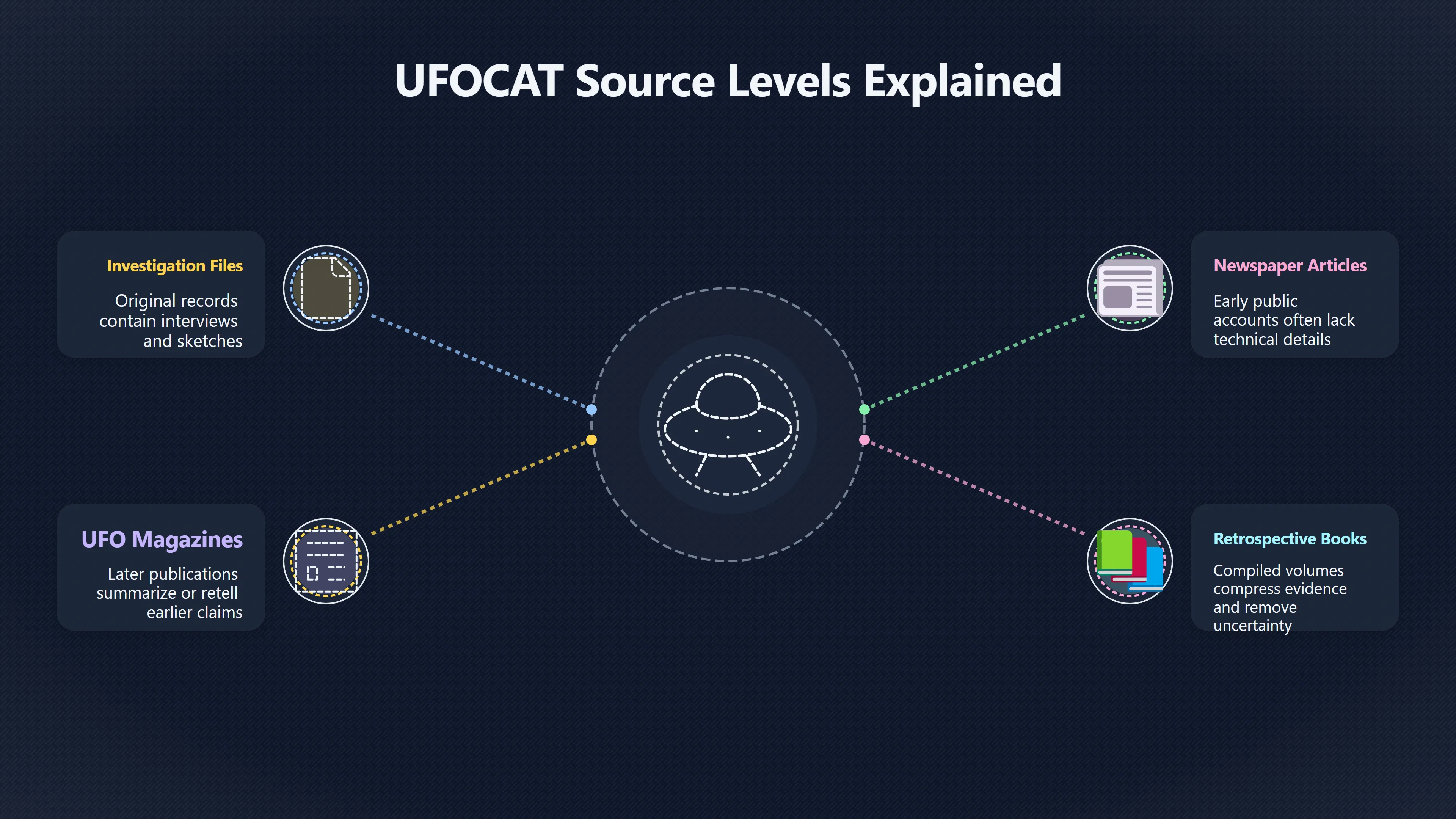
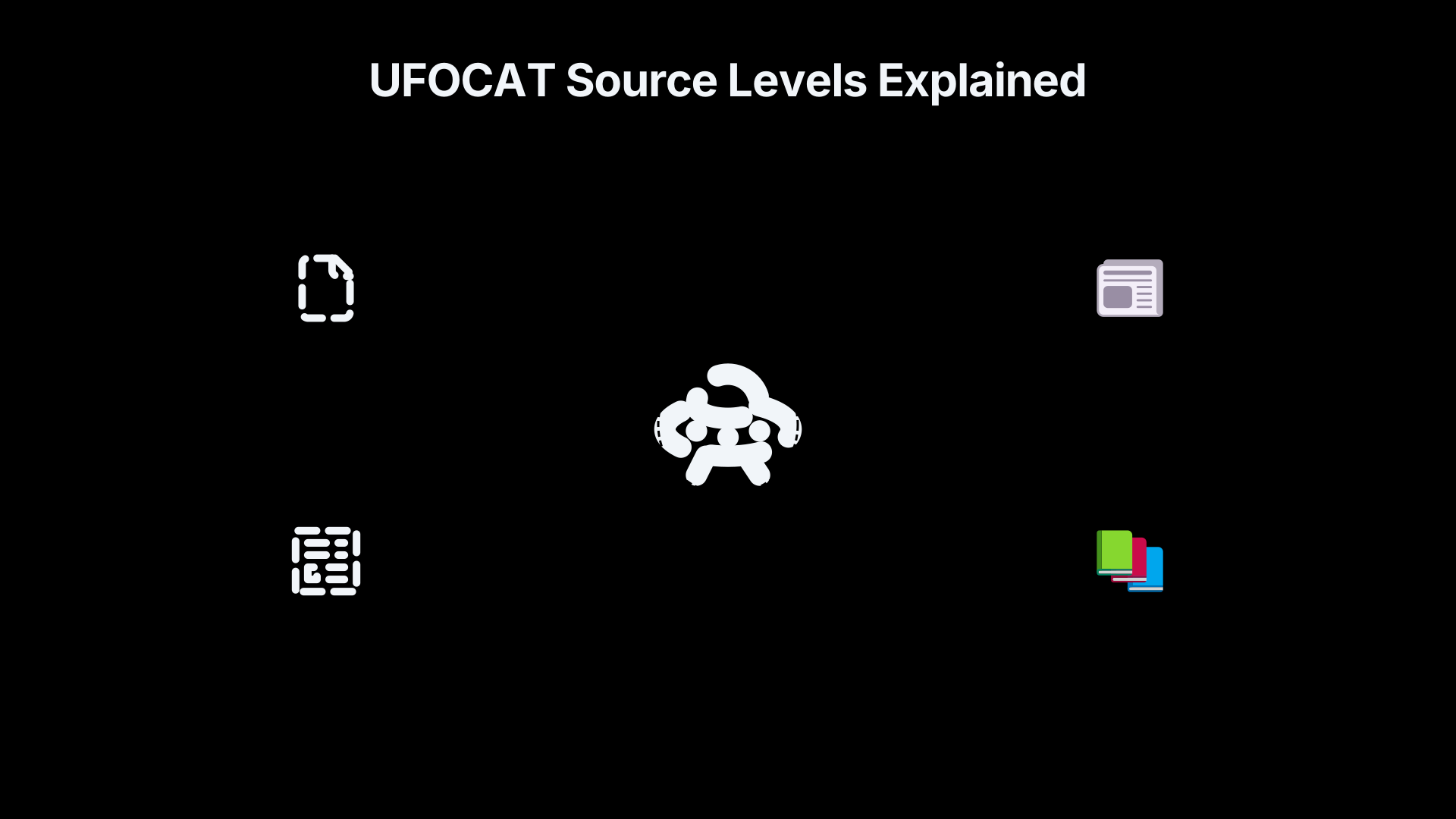
Among UFO researchers, contemporary investigation records are generally considered stronger sources because they are closer to the witness testimony and often contain information omitted from later summaries. Investigation files may include interviews, sketches, timelines, weather checks, aircraft identification efforts, and follow-up correspondence.
When UFOCAT identifies a source as an investigation record or organisational case file, researchers can usually trace the information to a specific inquiry rather than a general narrative account. Such records still require critical evaluation, but they provide more opportunity to assess methodology and witness credibility. This reflects a broader tradition in UFO research, from Project Blue Book through later civilian investigations, where case quality depended heavily on the amount of directly collected evidence.[Wikipedia]WikipediaProject Blue BookProject Blue Book
A high-quality investigation source is not automatically correct. Investigators may make errors, introduce assumptions, or overlook conventional explanations. Nevertheless, the existence of original documentation allows later researchers to review those decisions.
The strengths and limits of newspaper sources
Newspapers occupy a more ambiguous position. They are often among the earliest surviving records of a sighting and may preserve details that never appeared elsewhere. For historical cases, a local newspaper can sometimes be the closest available source to the original event.
At the same time, newspapers introduce several reliability concerns:
- Reporters may summarise witness statements inaccurately.
- Sensational headlines can exaggerate claims.
- Technical details are frequently omitted.
- Follow-up corrections may never be published.
A UFOCAT record sourced primarily from a newspaper therefore provides evidence that a report circulated publicly at a particular time, but not necessarily that the event occurred exactly as described.
For historical researchers, newspapers are often most valuable when compared against investigation files, police records, military documents, or multiple independent press accounts.
Books and the problem of narrative accumulation
Books present a different challenge. Many influential UFO books compile earlier reports from newspapers, investigators, government files, and other publications. By the time a case appears in a popular UFO volume, the account may have passed through several layers of interpretation.
UFOCAT’s distinction between first-edition books, revised books, and other published sources helps researchers identify where an account sits within that chain.[Center for UFO Studies]sourcewatch.orgJuly 24, 2013 — Our purpose is to promote serious scientific interest in UFOs and to serve as an archive for reports, document…
A book can contain valuable analysis unavailable elsewhere, especially when written by an investigator directly involved in the case. However, books also tend to compress evidence, remove uncertainty, and emphasise the most dramatic aspects of an incident. Researchers therefore often treat book accounts as secondary sources unless the author had direct access to witnesses or original records.
How Source Levels Expose Information Drift
One of the most important uses of the LEVEL field is detecting how a UFO story changes over time.
A typical reporting chain might look like this:
- Witness reports an observation.
- Local newspaper publishes a brief article.
- A UFO organisation investigates.
- A magazine republishes the case.
- A book summarises the magazine article.
- A later database copies the book entry.
Each stage can introduce new errors, assumptions, or embellishments. Details may become more precise than the original evidence justifies. Witness estimates may harden into apparent facts. Missing information can be replaced with speculation.
Because UFOCAT attempts to identify source relationships through fields such as LEVEL, PRN, IRN, and X2, researchers can often reconstruct this progression and determine whether several records actually derive from one original report.[Center for UFO Studies]sourcewatch.orgJuly 24, 2013 — Our purpose is to promote serious scientific interest in UFOs and to serve as an archive for reports, document…
This is especially important when evaluating famous cases. A sighting that appears in ten UFO books may seem strongly supported until source tracing reveals that all ten authors relied on the same newspaper article or investigative summary.
Using Source Levels for Historical Analysis
Separating report volume from evidential weight
One common mistake in UFO research is treating the number of references to a case as evidence of reliability. UFOCAT’s source-level system helps prevent this error.
A case with:
- one investigation file,
- three newspaper stories,
- two magazine articles,
- and four book references projectaquarius.[mufon](/mufon/). com
may generate numerous catalogue entries while still resting on a single original observation.
The apparent quantity of documentation can therefore be misleading. UFOCAT’s structure encourages researchers to distinguish between the number of records and the number of independent sources.[Center for UFO Studies]sourcewatch.orgJuly 24, 2013 — Our purpose is to promote serious scientific interest in UFOs and to serve as an archive for reports, document…
Identifying stronger historical cases
Researchers often use source levels alongside other UFOCAT fields to locate records with greater historical value.
Characteristics that generally strengthen a case include:
- proximity to original witnesses,
- documented investigations,
- independent corroboration,
- contemporary records,
- traceable source chains.
Conversely, caution increases when a report exists only in late secondary compilations, anonymous summaries, or database transcriptions lacking access to original documentation.
The LEVEL field does not make these judgements automatically, but it provides the information needed to make them.

Comparing eras of UFO reporting
Source levels also reveal how UFO reporting practices changed over time.
Early twentieth-century reports often survive only through newspapers. Mid-century cases may include military files, civilian investigations, and organisational archives. Later decades increasingly involve database exchanges, catalogue imports, and retrospective compilations.
Without source-level distinctions, these different forms of evidence could appear equivalent inside a large database. UFOCAT preserves those differences, allowing researchers to compare periods while accounting for changes in documentation practices.[Center for UFO Studies]sourcewatch.orgJuly 24, 2013 — Our purpose is to promote serious scientific interest in UFOs and to serve as an archive for reports, document…
Why LEVEL Is a Reliability Tool Rather Than a Credibility Verdict
The most important point is that UFOCAT’s LEVEL field does not determine whether a UFO sighting happened. It identifies the character of the source carrying the claim.
A newspaper source may contain an accurate report. An investigation file may contain mistakes. A book may preserve details unavailable anywhere else. Reliability emerges from examining the entire source chain rather than assuming that one category is always superior.
What the LEVEL system provides is transparency. Instead of presenting every record as an equivalent data point, UFOCAT exposes the path by which information entered the catalogue. For historians, archivists, and UFO researchers, that transparency is often more valuable than a simple count of sightings because it allows the evidence behind a report to be weighed rather than merely accumulated.[Center for UFO Studies]sourcewatch.orgJuly 24, 2013 — Our purpose is to promote serious scientific interest in UFOs and to serve as an archive for reports, document…
Amazon book picks
Further Reading
Books and field guides related to How UFOCAT Source Levels Reveal Report Reliability. Use these as the next step if you want deeper reading beyond the article.
The UFO Evidence
Provides detailed documentation and reliability grading of UFO reports, similar to UFOCAT LEVEL fields.

UFOs : Generals, Pilots, and Government Officials Go on the R...
First published 2011.
The UFO Experience
Focuses on assessment of witness credibility and report reliability, matching source-level concerns.
eBay marketplace picks
Marketplace Samples
Example marketplace items related to this page. Use the search link to explore similar finds on eBay.



Endnotes
1.
Source: Wikipedia
Title: Project Blue Book
Link:https://en.wikipedia.org/wiki/Project_Blue_Book
2.
Source: Wikipedia
Title: Identification studies of UFOs
Link:https://en.wikipedia.org/wiki/Identification_studies_of_UFOs
3.
Source: archives.gov
Title: UF O and UAP-related Records
Link:https://www.archives.gov/research/topics/uaps
Source snippet
UFO and UAP-related Records - National ArchivesApril 24, 2025 — NARA has records related to unidentified flying objects (UFO) and unident...
Published: April 24, 2025
4.
Source: Wikipedia
Title: Center for UFO Studies
Link:https://en.wikipedia.org/wiki/Center_for_UFO_Studies
Source snippet
Center for UFO Studies - WikipediaThe Center for UFO Studies (CUFOS) is a privately funded UFO research group. The group was founded i...
5.
Source: cufos.org
Title: It is the result of a 30-year effort that
Link:https://cufos.org/PDFs/UFOCAT%20Codebook%202023.pdf
Source snippet
Center for UFO Studies[PDF] UFOCAT 2023 - Center for UFO Studies -June 6, 2024 — UFOCAT 2002 refers to a computer database of over 120,00...
Published: June 6, 2024
6.
Source: cufos.org
Title: Center for UFO Studies UFOCAT
Link:https://cufos.org/cufos-publications-databases/ufocat/
Source snippet
Center for UFO StudiesUFOCAT - Center for UFO StudiesUFOCAT is a catalog of published and unpublished UFO sighting reports. It often cont...
7.
Source: sourcewatch.org
Title: Center for UFO Studies
Link:https://www.sourcewatch.org/index.php/Center_for_UFO_Studies
Source snippet
July 24, 2013 — Our purpose is to promote serious scientific interest in UFOs and to serve as an archive for reports, document...
Published: July 24, 2013
8.
Source: cufos.org
Link:https://cufos.org/cufos-publications-databases/books/
Source snippet
Center for UFO Studies -Selected books and monographs published by CUFOS over the years are available online: Ted Phillips, comp., Physic...
Additional References
9.
Source: nicap.org
Link:https://www.nicap.org/books/Behavioral_Scientist/UFO_Phenomena_and_Behavioral_Scientist.pdf
Source snippet
UFO Phenomena and the Behavioral ScientistI just hope that this book will help the time come sooner when they will not only understand th...
10.
Source: amazon.com
Link:https://www.amazon.com/Grassroots-UFOs-Reports-Studies-Paperback/dp/B0157HNLIS
Source snippet
A collection of nearly 1,200 firsthand UFO sighting testimonies gathered by John Timmerman through CUFOS mall exhibits, documenting encou...
11.
Source: governmentattic.org
Title: [PDF] UFOs and Related Subjects: An Annotated Bibliography, Lynn E
Link:https://www.governmentattic.org/13docs/UFOsRelatedSubjBiblio_Catoe_1969.pdf
Source snippet
Introduction is a brief history of UFO reports and studies and provides some information on scientific observations and analyses; the sec...
12.
Source: cufos.org
Title: Proceedings of the 1976 CUFOS Conference
Link:https://www.cufos.org/PDFs/books/Proceedings_of_the_1976_CUFOS_Conference.pdf
Source snippet
PROCEEDINGS 1976 CUFOS CONFERENCE13 Feb 1976 — The papers presented in this volume were delivered or distributed at a conference on UFO r...
13.
Source: scribd.com
Title: Proceedings of the 1976 CUFOS Conference
Link:https://www.scribd.com/document/398117188/Proceedings-of-the-1976-CUFOS-Conference
Source snippet
PDFAttention has focused on the UFO percipient as a source of information. But at the field investigator level little attention has been...
14.
Source: archive.org
Title: Full text of “The Hynek UFO Report”
Link:https://archive.org/stream/TheHynekUFOReport/The_Hynek_UFO_Report_djvu.txt
Source snippet
Internet ArchiveDr. J. Allen Hynek is Professor of Astronomy at Northwestern University in the United States. He is also head of the Cent...
15.
Source: newspaceeconomy.ca
Title: It combines early historical
Link:https://newspaceeconomy.ca/2025/07/30/ufocat-the-ufo-sightings-catalog-by-cufos/
Source snippet
UFOCAT: The UFO Sightings Catalog by CUFOSJuly 30, 2025 — UFOCAT remains the largest structured archive of UFO sighting reports ever asse...
Published: July 30, 2025
16.
Source: youtube.com
Title: How to Analyze & Evaluate Historical Documents
Link:https://www.youtube.com/watch?v=xH8B6MGhzLU
Source snippet
UAP data reliability source evaluation investigative journalism scientific assessment House committee holds UFO hearing Associated Press...
17.
Source: usabusinessradio.com
Link:https://usabusinessradio.com/top-ufo-research-websites-to-follow-in-2026/
Source snippet
Top UFO Research Websites To Follow in 202625 Mar 2026 — Aside from UFO sightings, you can also read about alien encounters and abduction...
18.
Source: projectaquarius.[mufon]({{ ‘mufon/’ | relative_url }}). com
Title: December November 1985
Link:https://projectaquarius.mufon.com/wp-content/uploads/2023/09/December_November_1985.pdf
Source snippet
UFO JOURNAL6 Dec 1985 —... code book. E) A special section will provide the references for each entry in detail. CRITERIA. The criteria...
Published: November 1985
Topic Tree