Within Reliability
When Does Unexplained Really Mean Unknown?
Labels such as unexplained, unknown, insufficient data, and anomalous can mean very different things across UFO databases.
On this page
- Common UFO classification words
- Why insufficient data is not an anomaly
- How visible rules improve comparison
Page outline Jump by section
Introduction
A UFO case can appear much stronger than it really is because of a single word in a database entry. Labels such as “unexplained”, “unknown”, “unidentified” and “anomalous” often sound as if investigators ruled out every ordinary explanation and were left with a genuine mystery. In practice, different databases use those words in very different ways. Some labels reflect a completed investigation. Others simply mean that the report could not be matched to a known explanation using the information available at the time.
 This creates one of the biggest comparison problems in UFO research. Two databases may both contain a category called “unknown”, yet one may reserve it for heavily investigated cases while another applies it to reports with minimal follow-up. Understanding how labels are assigned is often more important than the label itself. A database with strict classification rules can make a small number of “unknowns” meaningful. A database with vague rules can make the same word almost impossible to interpret. Pieces of History[Eds Whs]esd.whs.milEds WhsProject Blue BookThe Air Force groups its evaluations of UFO reports under three general headings: (1) identified. (2) insufficie…
Common UFO Classification Words
The language used in UFO catalogues has accumulated over decades, but many terms carry assumptions that readers do not notice.
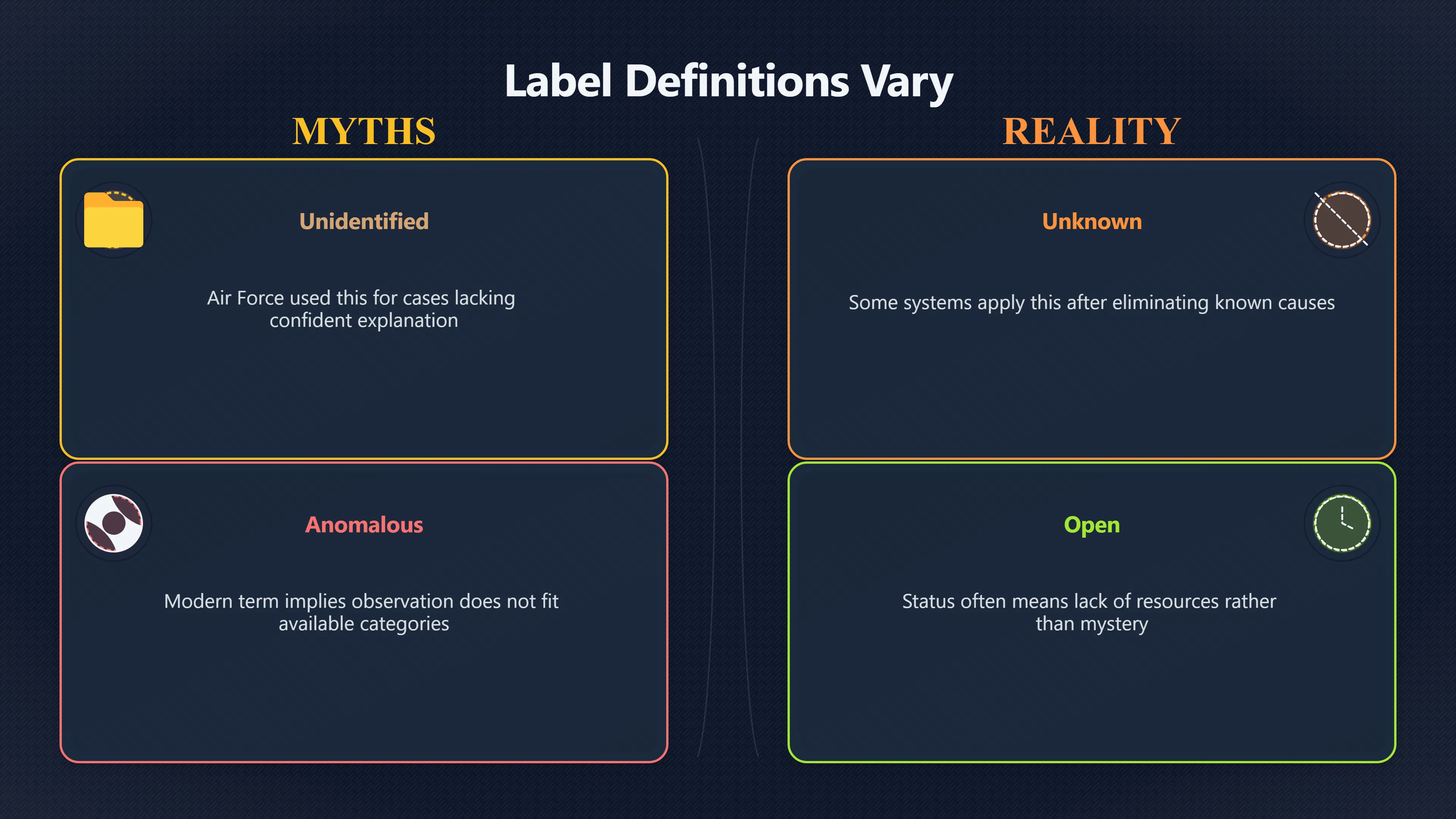
“Unidentified” is not the same as “extraordinary”
The classic example comes from Project Blue Book. The Air Force sorted reports into categories including identified, insufficient data and unidentified. By the end of the programme, 701 cases remained classified as unidentified. However, the Air Force also stated that there was no evidence that these unidentified reports represented extraterrestrial vehicles. In other words, “unidentified” meant the available investigation did not reach a confident explanation, not that an exotic explanation had been established.[Eds Whs]esd.whs.milEds WhsProject Blue BookThe Air Force groups its evaluations of UFO reports under three general headings: (1) identified. (2) insufficie…[Air Force]af.milAir ForceUnidentified Flying Objects and Air Force Project Blue BookWith the termination of Project Blue Book, the Air Force regulation e…
This distinction is frequently lost when databases or commentators cite the number of unexplained cases without explaining how the category was defined.
“Unknown” can mean different things in different systems
Some investigators have historically used “unknown” for reports that survived a process of elimination. In that framework, a case only reaches the category after investigators compare it against aircraft, astronomical objects, weather phenomena and other possibilities.
Other databases use “unknown” more loosely, sometimes because the original source already used that label or because there was not enough information to reach any conclusion. Readers may see the same word and assume the same evidential value when the underlying process was completely different.
“Anomalous” sounds stronger than it often is
The modern term UAP, or unidentified anomalous phenomena, has introduced another classification problem. In ordinary language, “anomalous” implies something genuinely unusual. Yet in many reporting contexts it simply means that the observation does not immediately fit available categories.
A radar track, a distant light and a complex multi-sensor event can all be described as anomalous during initial review. The label says little about the final evidential quality.
“Open”, “pending” and “under investigation”
Some databases display cases as open or under investigation. These labels can create the impression that a report is unusually compelling when the reality may be more mundane. A case may remain open simply because nobody completed a follow-up investigation or because investigators lacked resources.
The National UFO Reporting Center, for example, primarily functions as a reporting and archival system. A report’s presence in the database or its unresolved status should not automatically be interpreted as evidence that investigators found something extraordinary. [nuforc. org+2nuforc.org]
Why Insufficient Data Is Not an Anomaly
One of the most common mistakes in UFO database analysis is treating “insufficient data” as if it belongs in the same category as unexplained anomalies.
Project Blue Book explicitly separated insufficient-data cases from unidentified cases. This distinction recognised a basic investigative reality: a report cannot be analysed properly if key information is missing.[Pieces of History]prologue.blogs.archives.govblue book 2Pieces of HistoryUFOs: Natural Explanations - Pieces of History16 Apr 2018 — After investigating a case, the Air Force placed it into one…
Missing information can include:
- No precise time or date.
- No witness contact details.
- No information about viewing direction or duration.
- No weather information.
- No corroborating witnesses.
- Poor-quality photographs or videos.
- Reports submitted years after the event.
A weak report can remain unresolved because there is too little information to evaluate it. That does not make it mysterious. It simply means the evidence is inadequate.
This is especially important in large public databases. Online reporting systems can collect thousands of sightings, but the amount of detail varies dramatically. NASA’s recent discussions of UAP data quality have repeatedly stressed that scientific analysis depends on metadata, calibration information and contextual details. Without those elements, a report may remain unexplained for procedural reasons rather than because it represents a genuine anomaly.[Live Science]livescience.comLive Science US government declassifies dozens of additional UFO filesDue to the poor data quality, the reports do not contain any compelling evidence of alien intelligence. While NASA has not…Read more…
A useful mental test is to ask whether the case remained unexplained after investigation or before investigation. Those are very different situations that are often collapsed into a single category when databases present summary statistics.

How Labels Can Accidentally Inflate Mystery
Classification systems can make databases appear more dramatic even when nobody intends to mislead.
Large unresolved totals attract attention
Readers often focus on counts of unexplained cases. Project Blue Book’s 701 unidentified reports are regularly cited because the number is memorable. Yet the figure only becomes meaningful when viewed alongside the programme’s more than 12,000 total reports and the specific classification procedures used to sort them. Office of the Secretary of the Air Force[osi.af.mil]osi.af.milproject blue book part 1 ufo reportsBlue Book Part 1 (UFO Reports)6 Aug 2020 — Project Blue Book continued until 1969. A total of 12,618 sightings were reported to Project B…
Without that context, the label becomes a rhetorical shortcut rather than an analytical category.
Databases inherit older classifications
Many UFO catalogues aggregate material from books, magazines, archives and previous databases. A classification assigned decades ago may be carried forward without showing how it was reached.
A modern user may see a case marked “unknown” but have no access to the original investigator’s reasoning. The label survives while the underlying evidence trail becomes harder to verify.
Ambiguous categories merge weak and strong cases
Some databases place very different reports into the same bucket. A multi-witness event with radar data may share a classification category with a single brief sighting of a distant light.
When categories are broad, readers can mistakenly assume that all entries carry similar evidential weight.
Public reporting systems reward memorable labels
Terms such as “unexplained”, “anomalous” and “unknown” attract more attention than “insufficient information” or “likely misidentification”. This can subtly shape how databases are discussed online. Reports that receive dramatic labels are more likely to be shared, quoted and counted, even when the underlying evidence remains weak.
How Visible Rules Improve Comparison
The most reliable UFO databases do not merely assign labels. They explain them.
A useful classification system should answer several questions:
- What evidence threshold is required for each category?
- Is witness testimony alone sufficient?
- Are photographs, radar returns or other data considered separately?
- Can a case move between categories after review?
- Is insufficient data separated from unexplained cases?
- Are investigators required to document alternative explanations?
When these rules are visible, readers can compare databases more fairly.
For example, a database reporting 5 per cent unidentified cases after extensive investigation may be more informative than a database reporting 40 per cent unexplained cases without documented review procedures. The percentage alone tells very little. The classification method tells much more.
The strongest systems also preserve uncertainty. Rather than forcing every report into either “explained” or “mysterious”, they show intermediate states such as probable explanation, insufficient evidence, pending review and unresolved after investigation. Those distinctions reduce the risk that ordinary data limitations are mistaken for evidence of extraordinary phenomena.
The Key Question Behind Every Label
When comparing UFO databases, the most important question is not whether a case is labelled unexplained. It is why.
An “unidentified” classification may represent a carefully investigated report that resisted available explanations. It may also represent a brief witness account with missing information and no meaningful follow-up. The same word can cover both situations.
That is why classification labels alone are poor indicators of evidential strength. The value of a label depends on the rules behind it, the quality of the underlying data and the transparency of the investigative process. Without those elements, categories that sound impressive can tell readers far less than they appear to.
Amazon book picks
Further Reading
Books and field guides related to When Does Unexplained Really Mean Unknown?. Use these as the next step if you want deeper reading beyond the article.
The UFO Experience
Hynek’s work is central to UFO report categories, case quality, and the difference between unexplained and extraordinary.
UFOs
Uses official and professional testimony where labels such as unidentified, unexplained, and unknown matter.
The Hynek UFO Report
Directly relates to how official UFO cases were evaluated, labelled, and interpreted.
UFOs and Government
Explains government UFO programmes and the institutional meaning of classification terms.
eBay marketplace picks
Marketplace Samples
Example marketplace items related to this page. Use the search link to explore similar finds on eBay.




Endnotes
1.
Source: prologue.blogs.archives.gov
Title: blue book 2
Link:https://prologue.blogs.archives.gov/2018/04/16/ufos-natural-explanations/
Source snippet
Pieces of HistoryUFOs: Natural Explanations - Pieces of History16 Apr 2018 — After investigating a case, the Air Force placed it into one...
2.
Source: esd.whs.mil
Link:https://www.esd.whs.mil/Portals/54/Documents/FOID/Reading%20Room/UFOsandUAPs/proj_b1.pdf?ver=2017-05-22-113513-837
Source snippet
Eds WhsProject Blue BookThe Air Force groups its evaluations of UFO reports under three general headings: (1) identified. (2) insufficie...
3.
Source: nuforc.org
Title: Browse reports, images, videos, maps and more
Link:https://nuforc.org/
Source snippet
National UFO Reporting Center | Report a UFO | Report a UAPThe most trustworthy, transparent and respectful organization for UFO/UAP witn...
4.
Source: nuforc.org
Title: Data Bank | NUFORC
Link:https://nuforc.org/databank/
Source snippet
Latest UFO SightingsThe NUFORC Databank is the largest independently collected set of UFO / UAP sighting reports available on the interne...
5.
Source: Wikipedia
Title: Project Blue Book
Link:https://en.wikipedia.org/wiki/Project_Blue_Book
6.
Source: history.com
Title: Project Blue Book
Link:https://www.history.com/articles/project-blue-book
Source snippet
Project Blue Book - Alien, Definition & Files22 Feb 2010 — Similarly to the Robertson Panel, Blue Book would eventually classify m...
7.
Source: nuforc.org
Link:https://nuforc.org/reportform/
Source snippet
UFO Sighting Report Form | NUFORCSIGHTING DATE AND TIME · SIGHTING LOCATION · DESCRIBE WHAT YOU SAW · TELL US ABOUT YOU · ADD IMAGES OR V...
8.
Source: nuforc.org
Link:https://nuforc.org/ndx/?id=shape
Source snippet
NUFORC Reports by Shape... File a UFO Report · Donate · About Us · Toggle website search. NUFORC Reports by Shape. SHAPE, REPORT COUNT. U...
9.
Source: nuforc.org
Link:https://nuforc.org/spatial/
Source snippet
Military tests? Experimental Boeing/...Read more...
10.
Source: nuforc.org
Link:https://nuforc.org/report-a-ufo/
Source snippet
agency for reporting UFO/UAP related events...
11.
Source: nuforc.org
Link:https://nuforc.org/univutahstudy/
Source snippet
University of Utah and Recent [AARO]({{ 'aaro/' | relative_url }}) Director Publish...15 Dec 2023 — Data [Reliability]({{ 'reliability/' | relative_url }}): The study acknowledges the challenge of...
12.
Source: archives.gov
Title: Project BLUE BOOK
Link:https://www.archives.gov/research/military/air-force/ufos
Source snippet
The project closed in 1969 and we have no...Read more...
13.
Source: Wikipedia
Title: UFO Report (U.S. Intelligence)
Link:https://en.wikipedia.org/wiki/UFO_Report_%28U.S._Intelligence%29
Source snippet
UFO Report (U.S. Intelligence)A lack of data does not mean aliens are the likely answer." Research... Five questions left unanswered...
14.
Source: af.mil
Link:https://www.af.mil/About-Us/Fact-Sheets/Display/Article/104590/unidentified-flying-objects-and-air-force-project-blue-book/
Source snippet
Air ForceUnidentified Flying Objects and Air Force Project Blue BookWith the termination of Project Blue Book, the Air Force regulation e...
15.
Source: osi.af.mil
Title: project blue book part 1 ufo reports
Link:https://www.osi.af.mil/News/Features/Display/Article/2302429/project-blue-book-part-1-ufo-reports/
Source snippet
Blue Book Part 1 (UFO Reports)6 Aug 2020 — Project Blue Book continued until 1969. A total of 12,618 sightings were reported to Project B...
16.
Source: livescience.com
Title: Live Science US government declassifies dozens of additional UFO files
Link:https://www.livescience.com/space/extraterrestrial-life/us-government-declassifies-nearly-200-uap-files-including-strange-sightings-from-apollo-astronauts
Source snippet
Due to the poor data quality, the reports do not contain any compelling evidence of alien intelligence. While NASA has not...Read more...
17.
Source: britannica.com
Title: Project Blue Book
Link:https://www.britannica.com/topic/Project-Blue-Book
Source snippet
Definition, History, Aliens, UFOs, & Facts16 May 2026 — Project Blue Book, code name for the United States' longest-running Air Force pro...
Published: May 2026
18.
Source: cuny.manifoldapp.org
Title: national ufo reporting center
Link:https://cuny.manifoldapp.org/read/national-ufo-reporting-center
Source snippet
UFO Reporting CenterApr 2, 2025 — The National UFO Reporting Center (NUFORC) is a text-heavy web-based archive with a searchable database...
19.
Source: geekchocolate.co.uk
Title: project blue book
Link:https://geekchocolate.co.uk/project-blue-book/
Source snippet
9 Jan 2019 — Allen Hynek's investigations for the U.S. Air Force into the existence of UFOs. The cases depicted are based on real events...
Additional References
20.
Source: enigmalabs.io
Link:https://enigmalabs.io/library/d3b9f01b-ddb8-4ecf-bcf4-832e413200bf
Source snippet
[Enigma]({{ 'enigma/' | relative_url }}) Labs | Report a UFO sightingThe National UFO Reporting Center (NUFORC)Gribble, receives, records, documents, and corroborates repo...
21.
Source: facebook.com
Link:https://www.facebook.com/OriginsOSU/posts/recently-the-pentagon-released-more-files-on-ufos-it-seems-like-every-few-months/1809383503713749/
Source snippet
The Air Force Investigation into UFOsProject Blue Book investigated 12,618 UFO sightings and 701 of those sightings remained unidentified...
22.
Source: ufodatalive.com
Link:https://www.ufodatalive.com/about/
Source snippet
sightings — is drawn from peer-reviewed academic research geocoding historical NUFORC (National UFO Reporting Center)...Read more...
23.
Source: sofrep.com
Title: the truth behind ufos from project blue book to the pentagons uap task force
Link:https://sofrep.com/news/the-truth-behind-ufos-from-project-blue-book-to-the-pentagons-uap-task-force/
Source snippet
The Truth Behind UFOs: From Project Blue Book to the...8 Feb 2026 — Project Blue Book had two main goals: to determine whether UFOs posed...
24.
Source: enigmaticideas.com
Title: Shadowy beings: 68% of witnesses report fear. Greys: 38% involve abduction
Link:https://enigmaticideas.com/what-152-000-ufo-reports-reveal-about-entity-encounters/
Source snippet
What 152,000 UFO Reports Reveal About Entity Encounters8 Jan 2026 — I analyzed entity encounters in the NUFORC sightings database...
25.
Source: weirddatascience.net
Title: the shape of the other the evolution of ufo sightings by shape
Link:https://www.weirddatascience.net/2018/06/20/the-shape-of-the-other-the-evolution-of-ufo-sightings-by-shape/
Source snippet
The Shape of the Other: The Evolution of UFO Sightings...20 Jun 2018 — The NUFORC dataset classifies each sighting as one of 46 possible...
26.
Source: popularmechanics.com
Title: j allen hynek project blue book ufo investigation truth
Link:https://www.popularmechanics.com/military/a70995826/j-allen-hynek-project-blue-book-ufo-investigation-truth/
Source snippet
Allen Hynek & Project Blue Book: UFO Secrets Revealed12 Apr 2026 — Explore the UFO mysteries J. Allen Hynek uncovered with Project Blue B...
27.
Source: metabunk.org
Title: nuforc sightings categorized by decade and shape.14610
Link:https://www.metabunk.org/threads/nuforc-sightings-categorized-by-decade-and-shape.14610/
Source snippet
NUFORC sightings categorized by decade and shape1 Dec 2025 — Interesting. I've been working on a report rating scheme to grade UFO report...
28.
Source: medium.com
Link:https://medium.com/illumination/project-blue-book-unidentified-unexplained-or-misunderstood-0a9524ba3664
Source snippet
es Air Force (USAF), started in 1952 and continuing until the end of 1969.Read more...
29.
Source: steeped.ai
Title: ufo sightings data analysis exploring tier 1 reports
Link:https://steeped.ai/ufo-sightings-data-analysis-exploring-tier-1-reports/
Source snippet
UFO Sightings Data Analysis: Exploring 1500+ Tier 1 Reports21 Jan 2026 — As the “National” in NUFORC suggests, these sightings were heavi...
Topic Tree