Within UFO Archives
Why Ordinary Objects Fill UFO Databases
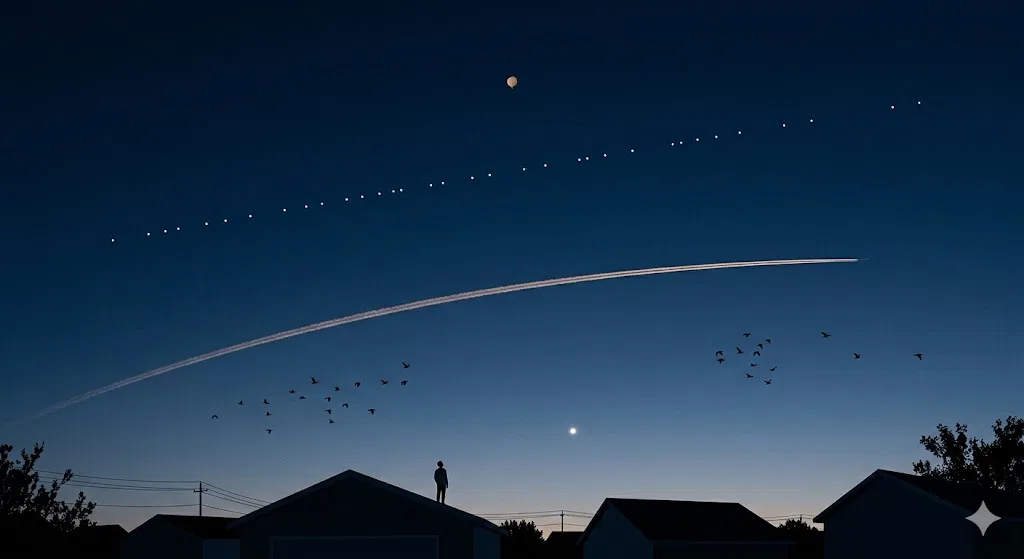
Balloons, birds, aircraft, satellites, and weather effects can all enter UFO databases before they are identified.
On this page
- Common mistaken objects
- How deconfliction works
- Why unresolved does not mean exotic
Page outline Jump by section
Introduction
Misidentification is not a side issue in UFO report databases; it is one of the main reasons those databases exist. A witness may honestly report a strange light, shape, motion or photograph, but the later database entry can turn out to be a balloon, bird, aircraft, satellite train, planet, rocket plume, camera artefact or weather effect. The important lesson is not that witnesses are foolish. It is that sky observations are often made quickly, at distance, in poor lighting, without range information, and through human eyes or sensors that can make ordinary objects look extraordinary.
For UFO report databases and catalogues, this creates a constant sorting problem. A good catalogue does not simply count “unidentified” reports. It records enough time, location, direction, duration, media and investigative notes to let later reviewers compare the report with known objects and conditions. Official bodies such as AARO, NASA and GEIPAN all describe this as a data-quality problem: the more complete the record, the easier it is to separate prosaic cases from genuinely unresolved ones.[Director of National Intelligence]dni.govDOD AARO Consolidated Annual Report on UAP Nov2024Director of National IntelligenceAll-domain Anomaly Resolution Office FY 2024 Consolidated Annual Report on UAP…[NASA Science]science.nasa.govNASA Science…
The everyday objects that become UFO entries
The most common mistaken objects are not obscure. They are things that move through the sky every day: aircraft, balloons, birds, drones, satellites, planets, meteors and atmospheric effects. What makes them enter UFO databases is not their rarity, but the mismatch between what the observer expects and what the object looks like under particular viewing conditions.
A balloon can seem to hover, drift against the wind at ground level, change brightness, or appear metallic when lit by the sun. A bird or insect crossing a camera frame can look like a fast object if it is close to the lens. An aircraft seen head-on can appear stationary; a distant aircraft turning can seem to accelerate or reverse; a contrail lit by low sun can look fiery or artificial. The old Project Blue Book fact sheet listed astronomical objects, satellites, aircraft and balloons among the recurring sources of UFO reports, noting that planets seen through haze or moving cloud could be reported as unidentified flying objects, while aircraft reflections, afterburners and condensation trails could also produce misleading appearances.[esd.whs.mil]esd.whs.milproj b1proj b1
The same pattern persists in modern databases. NUFORC, one of the best-known public UFO reporting centres, asks submitters to review common false positives before filing a report. Its report form highlights Starlink satellite trains, rocket launches, Venus and Jupiter, camera artefacts, birds, insects, lens flare and phone-focus effects as things that should be ruled out before submission.[nuforc.org]nuforc.orgFile a UFO Report | NUFORCFile a UFO Report | NUFORC
AARO’s recent official reporting shows the same mechanism in a government setting. In its FY 2024 consolidated annual report, AARO said it received 757 UAP reports for the reporting period and resolved 118 cases to prosaic objects such as balloons, birds and unmanned aerial systems. It also said a further 174 cases were later finalised as prosaic objects including balloons, birds, UAS, satellites and aircraft.[Director of National Intelligence]dni.govDOD AARO Consolidated Annual Report on UAP Nov2024Director of National IntelligenceAll-domain Anomaly Resolution Office FY 2024 Consolidated Annual Report on UAP…
Why the same object can look anomalous
Misidentification usually begins with missing context. The observer sees an angle, a light pattern, a short fragment of motion or a recorded image, but not the object’s true distance, size, altitude or speed. Without those quantities, the brain fills in the gaps. A nearby insect can look fast because it crosses the frame quickly. A distant planet can look like it is moving if thin cloud passes in front of it. A satellite can seem to vanish when it moves into Earth’s shadow. A balloon can seem to perform intelligent manoeuvres when the viewer has no reliable depth cue.
The problem is sharper in databases because entries often preserve the witness’s first impression. “Hovered”, “shot away”, “changed shape” or “moved impossibly fast” may describe the appearance of the event, not a measured physical motion. That distinction matters because a database field can later be searched as if it were an objective property of the object. A report tagged as a “sphere” or “orb” may include anything from a balloon to an out-of-focus light, while “light” can mean a satellite, star, aircraft beacon or something genuinely unresolved.
| Enigma Labs, a modern public reporting platform, makes this caution explicit in its own discussion of sighting trends. It reports that “light” is one of the most common shape labels in its dataset, but says that such submissions should be treated carefully because a point light in the distance may be a misidentified star, satellite or plane. It also notes that future analysis depends on adding validation layers such as smartphone metadata, known-object databases and sensor overlays rather than relying only on self-reported impressions.[Enigma Labs]enigmalabs.ioEnigma Labs | Report a UFO sighting25K Sightings & Counting | Enigma LabsEnigma Labs | Report a UFO sighting25K Sightings & Counting | Enigma Labs | Report a UFO sighting |
Satellites and Starlink changed the false-positive landscape
Satellites have been mistaken for UFOs since the early space age, but low-Earth-orbit megaconstellations have made the problem more visible. Starlink trains can appear as a line of lights moving together, sometimes fading out in sequence or appearing as a blurred luminous streak. For someone who has never seen one, the sight can look coordinated, artificial and unfamiliar — which is exactly why it enters UFO reporting systems.
NUFORC now warns potential submitters that a line of lights moving slowly across the sky on the same course is probably Starlink, not a UFO, and points users towards satellite-tracking tools before they file a report.[nuforc.org]nuforc.org722 new ufo reports722 new ufo reports A 2024 case study on commercial aviation described how a newly launched Starlink satellite train was misidentified as UAP by pilots on two flights over the Pacific on 10 August 2022. The researchers reconstructed the event using orbital data and aircraft tracking data, showing how satellite visibility modelling can turn a puzzling pilot report into a conventional explanation.[arXiv]arxiv.orgSource details in endnotes.
This matters for databases because a Starlink false positive can look unusually persuasive. It may have multiple witnesses, cockpit photographs, video, and a report from trained observers. Those features improve evidential value, but they do not by themselves eliminate ordinary explanations. They only make deconfliction more powerful, because the sighting can be tested against satellite orbits, illumination geometry and aircraft position.
How deconfliction works in practice
Deconfliction is the process of checking a UFO report against known objects, environmental conditions and sensor limitations. In a good database workflow, investigators do not ask only “does this sound strange?” They ask whether the reported time, location, direction, elevation, duration and appearance match something already known.
That process can include:
- Astronomical checks: comparing the sighting with Venus, Jupiter, bright stars, meteors, fireballs and satellite passes.
- Aviation checks: comparing the report with civil and military flight tracks, airport approaches, training routes and aircraft lighting.
- Balloon and drone checks: looking at weather balloon launches, hobby balloons, scientific balloons, drones and local wind conditions.
- Weather checks: reviewing cloud, haze, temperature inversions, storms, lightning, aurora, sun angle and visibility.
- Media checks: testing whether a photo or video shows lens flare, reflections, compression artefacts, focus breathing, rolling shutter, insects or birds near the camera.
- Duplicate checks: identifying whether multiple reports describe the same event from different places or whether the same witness submitted to more than one database.
GEIPAN’s public classification scheme shows why this matters. It classifies cases by both “consistency” — the quantity and reliability of the available data — and “strangeness” after comparison with known hypotheses. Its categories distinguish perfectly identified cases, probably identified cases, cases not identified because of insufficient data, and cases not identified after investigation.[cnes-geipan.fr]cnes-geipan.frHow does GEIPAN classify observation cases? | GEIPANHow does GEIPAN classify observation cases? | GEIPAN
That distinction is crucial. A poor report may remain unidentified not because the object was extraordinary, but because the report lacks enough information to test ordinary explanations. A stronger report may become identified precisely because it contains enough detail to match a satellite, aircraft, balloon or weather event.

Why “unresolved” does not mean exotic
One of the most common mistakes in reading UFO catalogues is treating unresolved entries as a special class of evidence. In reality, “unresolved” can mean several different things: there was too little information; the data arrived too late; the relevant flight, balloon or satellite record was unavailable; the witness’s direction or time estimate was wrong; the image was too poor; or the case was investigated and still did not match a known source.
AARO’s FY 2024 report makes this point in practical terms. After resolving or recommending closure for many cases as prosaic objects, it placed 444 cases in an active archive because they lacked sufficient information for analysis. Those cases may be held for pattern analysis or reopened if more data becomes available, but their unresolved status does not automatically imply unusual technology.[Director of National Intelligence]dni.govDOD AARO Consolidated Annual Report on UAP Nov2024Director of National IntelligenceAll-domain Anomaly Resolution Office FY 2024 Consolidated Annual Report on UAP…
NASA’s independent UAP study framed the same problem scientifically. It argued that the search for anomalies depends on characterising the “background” of known airborne events — balloons, drones, aircraft and other normal objects — with calibrated instruments. Without that baseline, databases risk confusing rare but ordinary appearances with genuinely anomalous signals.[NASA Science]science.nasa.govNASA Science…
This is why good UFO database use is probabilistic rather than dramatic. An unresolved case is a prompt for better data, not a conclusion. It may deserve attention, especially if it involves trained observers, multiple sensors or aviation safety concerns, but it still sits inside a catalogue where ordinary misidentifications are common.
The database design choices that reduce mistakes
Misidentifications are not eliminated by scepticism alone. They are reduced by better data fields, better filtering and better links to external reference systems. A database that collects only a date, location and dramatic description is much less useful than one that records exact time zone, direction of travel, elevation angle, duration, witness position, camera metadata, weather, astronomical context and whether the object was visible to the naked eye.
The strongest systems also make room for later correction. A report first entered as “unknown” may later be updated when a rocket launch, satellite pass, balloon track or aircraft route is found. GEIPAN explicitly allows revisits or new analysis of cases when new information is communicated after the initial investigation.[cnes-geipan.fr]cnes-geipan.frOpen source on cnes-geipan.fr.
Public systems face an additional problem: they receive reports before expert review. That makes front-end education important. NUFORC’s pre-report warnings about Starlink, planets, rocket launches and camera artefacts are not merely disclaimers; they are a database-quality filter. Every false positive stopped before submission improves the usefulness of the remaining catalogue.[nuforc.org]nuforc.orgOpen source on nuforc.org.
Canada’s Sky Canada project identified a related structural issue: fragmented reporting channels and non-standardised data collection make it difficult to assess the number and nature of UAP cases. It noted that Canada has multiple public, civil and government reporting routes, and that duplicate reporting across organisations can complicate estimates of annual case numbers.[science.gc.ca]science.gc.caManagement of Public Reporting of Unidentified Aerial Phenomena in CanadaManagement of Public Reporting of Unidentified Aerial Phenomena in Canada
What misidentifications teach readers of UFO catalogues
Misidentifications do not make UFO databases worthless. They make them more useful when read correctly. A catalogue full of balloons, planets, aircraft and satellites can still reveal how people perceive the sky, where false positives cluster, which technologies create new reporting waves, and which cases survive ordinary checks.
The practical reading rule is simple: treat every entry as a report, not a verdict. Ask what was recorded, what was checked, what ordinary explanations were ruled out, and whether the case is unresolved because it is strong or because it is thin. The difference between “not yet identified” and “not identifiable from the available data” is one of the most important distinctions in the whole field.
For UFO report databases and catalogues, misidentification is therefore not an embarrassment to be hidden. It is the sorting mechanism that makes the remaining data meaningful. The better a database handles ordinary objects, the more seriously its unresolved cases can be read.
Amazon book picks
Further Reading
Books and field guides related to Why Ordinary Objects Fill UFO Databases. Use these as the next step if you want deeper reading beyond the article.
Bad Astronomy
Explains common astronomical misunderstandings behind many apparent UFOs.

UFOs : Generals, Pilots, and Government Officials Go on the R...
Balances misidentification issues with serious cases and official testimony.
The Demon-Haunted World
Rating: 4.5/5 from 43 Google Books ratings
Directly supports careful evaluation of extraordinary UFO claims and misidentifications.
The UFO Experience
Explores classification, witness reports and the challenge of separating identified from unidentified cases.
eBay marketplace picks
Marketplace Samples
Example marketplace items related to this page. Use the search link to explore similar finds on eBay.



Endnotes
1.
Source: science.nasa.gov
Link:https://science.nasa.gov/wp-content/uploads/2023/09/uap-independent-study-team-final-report.pdf
Source snippet
NASA Science...
2.
Source: cnes-geipan.fr
Title: How does GEIPAN classify observation cases? | GEIPAN
Link:https://www.cnes-geipan.fr/en/node/412
3.
Source: esd.whs.mil
Title: proj b1
Link:https://www.esd.whs.mil/Portals/54/Documents/FOID/Reading%20Room/UFOsandUAPs/proj_b1.pdf?ver=2017-05-22-113513-837
4.
Source: nuforc.org
Title: File a UFO Report | NUFORC
Link:https://nuforc.org/report-a-ufo/
5.
Source: enigmalabs.io
Title: Enigma Labs | Report a UFO sighting25K Sightings & Counting | Enigma Labs
Link:https://enigmalabs.io/blog/25k-sightings
6.
Source: arxiv.org
Link:https://arxiv.org/abs/2403.08155
7.
Source: science.gc.ca
Title: Management of Public Reporting of Unidentified Aerial Phenomena in Canada
Link:https://science.gc.ca/site/science/en/office-chief-science-advisor/sky-canada-project/management-public-reporting-unidentified-aerial-phenomena-canada
8.
Source: science.nasa.gov
Link:https://science.nasa.gov/uap/faqs/
9.
Source: cnes-geipan.fr
Link:https://www.cnes-geipan.fr/en/missions-methodes-et-resultats
10.
Source: cnes-geipan.fr
Link:https://www.cnes-geipan.fr/sites/default/files/Aids_to_identification_of_flying_objects_0.pdf
11.
Source: cnes-geipan.fr
Link:https://www.cnes-geipan.fr/en/node/58787
12.
Source: cnes-geipan.fr
Link:https://www.cnes-geipan.fr/en/node/58788
13.
Source: cnes-geipan.fr
Link:https://www.cnes-geipan.fr/en/node/58792
14.
Source: cnes-geipan.fr
Link:https://www.cnes-geipan.fr/en/node/422
15.
Source: cnes-geipan.fr
Link:https://www.cnes-geipan.fr/en/node/58791
16.
Source: aaro.mil
Link:https://www.aaro.mil/
17.
Source: aaro.mil
Link:https://www.aaro.mil/UAP-Cases/Official-UAP-Imagery/
18.
Source: aaro.mil
Link:https://www.aaro.mil/Portals/136/PDFs/Information%20Papers/AARO_Declassification_Info_Paper_2025.pdf
19.
Source: aaro.mil
Link:https://www.aaro.mil/UAP-Cases/UAP-Reporting-Trends/
20.
Source: nasa.gov
Link:https://www.nasa.gov/
21.
Source: science.nasa.gov
Link:https://science.nasa.gov/uap/
22.
Source: science.nasa.gov
Title: identifying ufos and uaps
Link:https://science.nasa.gov/solar-system/skywatching/night-sky-network/identifying-ufos-and-uaps/
23.
Source: nasa.gov
Link:https://www.nasa.gov/news-release/nasa-to-release-discuss-unidentified-anomalous-phenomena-report/
24.
Source: nuforc.org
Title: 722 new ufo reports
Link:https://nuforc.org/722-new-ufo-reports/
25.
Source: nuforc.org
Link:https://nuforc.org/
26.
Source: cnes.fr
Link:https://cnes.fr/en/projects/geipan
27.
Source: space.com
Title: mystery objects shot down ufos uap
Link:https://www.space.com/mystery-objects-shot-down-ufos-uap
28.
Source: space.com
Title: pentagon 2022 ufo uap report
Link:https://www.space.com/pentagon-2022-ufo-uap-report
29.
Source: dni.gov
Title: DOD AARO Consolidated Annual Report on UAP Nov2024
Link:https://www.dni.gov/files/ODNI/documents/assessments/DOD-AARO-Consolidated-Annual-Report-on-UAP-Nov2024.pdf
Source snippet
Director of National IntelligenceAll-domain Anomaly Resolution Office FY 2024 Consolidated Annual Report on UAP...
30.
Source: enigmalabs.io
Link:https://enigmalabs.io/
31.
Source: enigmalabs.io
Link:https://enigmalabs.io/collection/a7111520-9526-4939-9a66-d225db45ba80
32.
Source: Wikipedia
Link:https://en.wikipedia.org/wiki/NASA
33.
Source: Wikipedia
Title: Project Blue Book
Link:https://en.wikipedia.org/wiki/Project_Blue_Book
34.
Source: Wikipedia
Link:https://en.wikipedia.org/wiki/GEIPAN
35.
Source: [archives]({{ ‘archives/’ | relative_url }}). gov
Title: Project BLUE BOOK
Link:https://www.archives.gov/research/military/air-force/ufos
36.
Source: britannica.com
Title: Project Blue Book
Link:https://www.britannica.com/topic/Project-Blue-Book
Additional References
37.
Source: youtube.com
Title: UAP Revelations with AARO’s Dep. Director Lt. Col. (ret.) Tim Phillips
Link:https://www.youtube.com/watch?v=yAaO4P4Jc1U
Source snippet
Mick West UAP misidentifications balloons drones Syria 2021 Leak - UAP, or Balloon?...
38.
Source: youtube.com
Title: Explained: “Go Fast” UFO Video
Link:https://www.youtube.com/watch?v=PLyEO0jNt6M
Source snippet
Sutter Buttes UFO Solved & Balloon Identified...
39.
Source: cia.gov
Link:https://www.cia.gov/readingroom/docs/CIA-RDP81R00560R000100060001-5.pdf
40.
Source: youtube.com
Title: The Pentagon’s Wind Farm UFO Video
Link:https://www.youtube.com/watch?v=Xn9G1TEEqFE
Source snippet
Explained: "Go Fast" UFO Video - Not Low and Not Fast - Like a Balloon...
41.
Source: youtube.com
Title: Sutter Buttes UFO Solved & Balloon Identified
Link:https://www.youtube.com/watch?v=eckSMfh5l84
Source snippet
UAP Revelations with AARO's Dep. Director Lt. Col. (ret.) Tim Phillips...
42.
Source: wesh.com
Link:https://www.wesh.com/article/bill-nelson-blue-origin-explosion-cape-canaveral/71447655
43.
Source: academia.edu
Link:https://www.academia.edu/7482584/Project_Blue_Book_Archive
44.
Source: researchgate.net
Link:https://www.researchgate.net/publication/376891986_A_global_picture_of_unidentified_anomalous_phenomena_Towards_a_cross-cultural_understanding_of_a_potentially_universal_issue
45.
Source: facebook.com
Link:https://www.facebook.com/TheFrenchHistoryPodcast/posts/a-drawing-from-the-files-at-the-french-ufo-department/1337099231754482/
46.
Source: facebook.com
Link:https://www.facebook.com/NewsNationNow/posts/a-video-sharing-platform-run-by-enigma-labs-is-storing-images-of-unidentified-an/873015845105434/
Topic Tree
Follow this branch
Parent topic
UFO ArchivesRelated pages 14
- AARO Why AARO Cases Remain Unresolved
- Archives Finding Original UFO Records in Archives
- Blue Book What Project Blue Book Records Still Reveal
- Clusters Why UFO Sightings Cluster on the Map
- Duplicates How One UFO Sighting Becomes Many Records
- Enigma Can a UFO App Fix Old Data Problems?
- GEIPAN How France Classifies Public UAP Cases
- MUFON How MUFON Turns Sightings Into Cases
- +6 more in sidebar