Within Clusters
Why Cloud Cover Reduces UFO Sightings in Some Areas
Frequent cloud cover and adverse weather reduce visibility, contributing to lower UFO report numbers in certain regions.
On this page
- Mapping cloud frequency and skies
- Linking meteorological data to sighting reports
- Examples from high and low cloud regions
Page outline Jump by section
Introduction
When people map large databases of UFO or Unidentified Aerial Phenomena (UAP) reports — such as public archives from NUFORC or similar catalogues — striking spatial and temporal patterns often emerge. But seeing where and when reports cluster is only part of the story. A parallel question asks whether weather conditions such as cloud cover and broader meteorological patterns influence how many sightings get recorded. In other words, are we looking at variations in the sky itself, or variations in our ability to notice and report what’s up there? A growing body of research suggests that visibility conditions — including cloud cover — matter for observing and reporting aerial phenomena, and that weather patterns can shape where and when people document unusual sightings.

How Cloud Cover Affects Visibility and Reporting
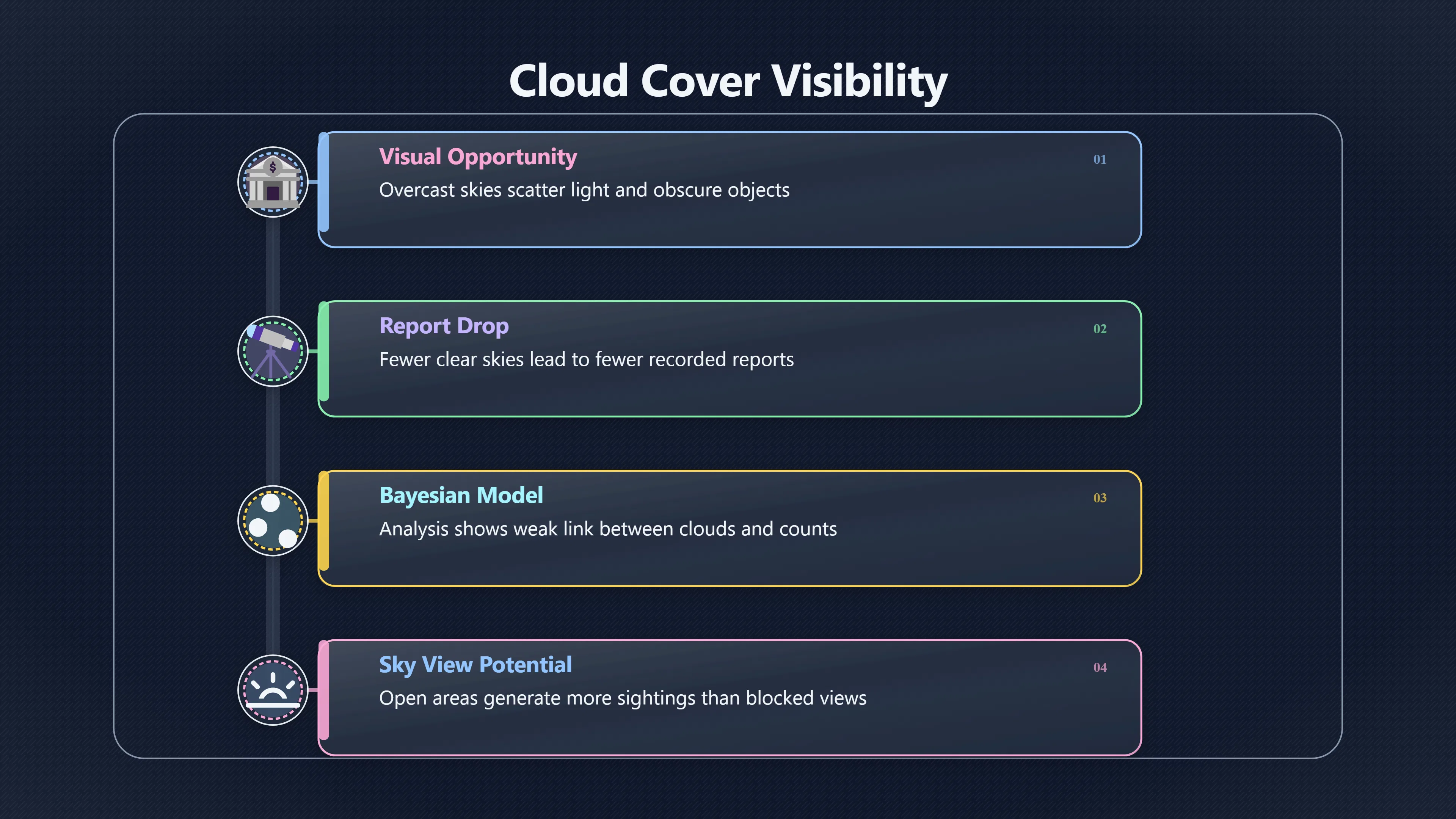
At the most basic level, cloud cover reduces the visual opportunity for observers to see atmospheric or aerial events. Overcast skies scatter and absorb light, diminishing contrast and obscuring objects, lights, and movements that might otherwise be noticeable against a clear sky. This mechanism is well‑established in atmospheric science; for example, work in meteorology shows how fog and low clouds degrade visibility conditions for ground observers and instruments alike, complicating the detection of distant features or motion (visibility loss and its effects on observation are core topics in visibility research)[Springer].
In the context of UFO/UAP reporting, fewer clear observation opportunities logically lead to fewer reports simply because potential witnesses see less of the sky. Informal observations — such as those made on enthusiast forums — note that many curated sighting videos and descriptions occur under clear or lightly clouded skies, while heavily overcast conditions seem under‑represented in public sightings threads, even accounting for night‑time reporting biases[Reddit]reddit.comQuestion About UAP Sightings and Weather PatternsQuestion About UAP Sightings and Weather PatternsDecember 16, 2024….
Evidence From Spatial Analyses of Sightings
One of the few systematic attempts to quantify environmental effects on UFO/UAP reports is a study that modelled thousands of public sighting reports against a set of “sky view potential” variables — including cloud cover, light pollution, and tree canopy cover — across counties in the continental United States. The hypothesis was straightforward: areas with fewer visibility obstructions should have more reported sightings, all else equal[Nature]nature.comAn environmental analysis of public UAP sightings and sky view potential | Scientific ReportsDecember 14, 2023….
The results from Bayesian regression confirmed credible correlations for some variables (such as light pollution and proximity to air traffic), but cloud cover did not show a strong independent relationship with reports in this particular analysis. The authors suggested that this might be because areas with consistently cloudier weather (for example, coastal Pacific Northwest regions) can still generate many sightings, while desert regions with mostly clear skies also produce many reports, weakening a simple statistical link between clouds and counts of reports at the county scale[PMC]pmc.ncbi.nlm.nih.govPMCAn environmental analysis of public UAP sightings and sky view potentialDecember 14, 2023….
However, the broader interpretation remains aligned with the visibility mechanism: locations where observers have a better unobstructed view of the sky — whether due to fewer trees, less light pollution, or generally clearer conditions — tend to generate more sightings reports than places where sightlines are blocked or the sky is obscured. This supports the idea that cloud cover and related weather patterns moderate observational opportunities, shaping the apparent spatial distribution of UFO report density.
Weather Patterns and Human Observation Behaviour
Beyond cloud cover alone, larger weather regimes can affect when and how people look at the sky. Seasonal and climatic patterns — for example, extended periods of overcast conditions, storms, or persistent low clouds — can discourage outdoor observation. Conversely, clear, dry weather often invites more people outdoors at dawn, dusk, or night, increasing the pool of casual witnesses who might notice and report unusual aerial activity. Although detailed quantitative work connecting seasonal meteorology to UFO report rates is limited, common reporting patterns deposited in databases show seasonal cycles, with peaks in reports during warmer months when skies are often clearer and outdoor activity is higher[ufotimelineproject.com]ufotimelineproject.comUF O Sightings | UFO Timeline ProjectUF O Sightings | UFO Timeline Project.
Weather dynamics can also influence the perception of ordinary aerial or atmospheric phenomena. Light scattering by thin clouds or high cirrus layers can create optical effects — halos, glows, or unusual light patterns — that are more noticeable than the objects themselves and may be misreported as unexplained sighting events. While this kind of perceptual effect is seldom directly measured in large datasets, atmospheric optics research shows how cloud layers and moisture gradients can significantly alter visual impressions of celestial objects or aircraft.

Clouds, Technological Detection, and Sighting Data Artefacts
Although much UFO reporting depends on eyewitness testimony, an increasing number of reports include photographs and video captured by cameras or phones. Here, cloud cover also affects sensor performance: cameras struggle to focus or auto‑adjust under low contrast conditions, and cloud layers can mask objects moving above them. Technology‑focused research on atmospheric conditions routinely uses cloud masks from satellites (e.g., MODIS products) to identify clear pixels before analysing phenomena above the atmosphere, precisely because clouds block or scatter signals of interest[ScienceDirect]sciencedirect.comEffect of clouds on apertures of space-based air fluorescence detectors - ScienceDirectJanuary 1, 2004…. This illustrates why both human and instrument‑based sightings are likely to be underrepresented under heavy cloud cover.
Putting Cloud Cover in Context With Other Environmental Factors
The relationship between weather patterns and UFO sightings does not operate in isolation. Cloud cover interacts with other environmental factors that shape visibility — such as light pollution, altitude, and terrain. For example, mountainous or arid regions with generally clearer skies and low light pollution often appear as hotspots in sighting catalogues, while dense urban areas with frequent low clouds and high pollution show fewer reports per capita. Similarly, extended periods of certain weather patterns — like persistent high‑pressure systems with clear skies — may coincide with spikes in sightings, while prolonged cloudiness can depress reporting without necessarily indicating changes in actual aerial phenomena.
What This Means for Interpreting Sighting Clusters
Understanding the effect of cloud cover and weather patterns on UFO report data helps distinguish between “real” clustering — events suggesting unusual aerial activity — and clusters that are artefacts of visibility and human behaviour. Regions with clearer, open skies naturally provide better opportunities for observers to notice objects, lights, or atmospheric anomalies. Conversely, areas with frequent cloud cover, storms, or persistent poor visibility are less likely to generate reports, not necessarily because nothing unusual occurs there, but because conditions reduce chances for people to see and record events.
This perspective — grounded in geographical and atmospheric analysis — emphasises that environmental factors like cloudiness should be considered when interpreting patterns in UFO databases, helping to avoid over‑attributing clusters to unexplained phenomena rather than to differences in observational opportunity and weather‑related visibility conditions.
Summary
- Cloud cover reduces visibility, making it less likely that observers will notice or report aerial phenomena.
- Large‑scale analyses suggest that environmental visibility variables (including cloud cover) are linked to sighting reports, though cloudiness alone may not always show a simple statistical effect at broad spatial scales.
- Seasonal and weather patterns influence human observation behaviour and the technological detectability of events.
- Considering cloud cover helps disentangle apparent geographic clusters in UFO report databases from variations in sky visibility and reporting likelihood.
In short, weather and cloud cover shape our view of the sky, and that, in turn, shapes what we count as sightings in UFO/UAP catalogues — reminding researchers to account for perceptual and environmental context when analysing report patterns.
Amazon book picks
Further Reading
Books and field guides related to Why Cloud Cover Reduces UFO Sightings in Some Areas. Use these as the next step if you want deeper reading beyond the article.
The UFO Experience
Helps readers understand how observation conditions affect sighting classification.
Bad Astronomy
Supports critical thinking about apparent sky phenomena and observation errors.
The Backyard Astronomer's Guide
Explains observing conditions, sky clarity and common night-sky objects often confused in reports.
eBay marketplace picks
Marketplace Samples
Example marketplace items related to this page. Use the search link to explore similar finds on eBay.
Endnotes
1.
Source: link.springer.com
Link:https://link.springer.com/article/10.1007/s10546
Source snippet
Understanding and Reducing False Alarms in Observational Fog Prediction | Boundary-Layer Meteorology | Springer Nature LinkJuly 3...
2.
Source: reddit.com
Title: Question About UAP Sightings and Weather Patterns
Link:https://www.reddit.com/r/UFOs_Archives/comments/1hfoq22
Source snippet
Question About UAP Sightings and Weather PatternsDecember 16, 2024...
Published: December 16, 2024
3.
Source: nature.com
Link:https://www.nature.com/articles/s41598-023-49527-x
Source snippet
An environmental analysis of public UAP sightings and sky view potential | Scientific ReportsDecember 14, 2023...
Published: December 14, 2023
4.
Source: pmc.ncbi.nlm.nih.gov
Title: PMCAn environmental analysis of public UAP sightings and sky view potential
Link:https://pmc.ncbi.nlm.nih.gov/articles/PMC10721628/
Source snippet
December 14, 2023...
Published: December 14, 2023
5.
Source: ufotimelineproject.com
Title: UF O Sightings | UFO Timeline Project
Link:https://www.ufotimelineproject.com/ufo-sightings
6.
Source: sciencedirect.com
Link:https://www.sciencedirect.com/science/article/abs/pii/S0927650503001968
Source snippet
Effect of clouds on apertures of space-based air fluorescence detectors - ScienceDirectJanuary 1, 2004...
Published: January 1, 2004
7.
Source: nuforc.org
Title: For 25 years, it ha
Link:https://nuforc.org/databank/
Source snippet
Data Bank | NUFORC - Latest UFO SightingsSeptember 6, 2021 — THE NATIONAL UFO REPORTING CENTER ONLINE DATABASE Image The NUFORC Databank...
Published: September 6, 2021
8.
Source: link.springer.com
Link:https://link.springer.com/article/10.1186/1880
Source snippet
clouds observed from the ground: sensitivity to mesospheric parameters and long-term time series | Earth, Planets and Space | Springer Na...
9.
Source: sciencedirect.com
Link:https://www.sciencedirect.com/science/article/abs/pii/S0169809514002403
Source snippet
ATMOSPHERIC RESEARCH Volume 149, November 2014, Pages 166-173 CLOUD COVER AND COSMIC RAY VARIATIONS AT LOMNICKÝ ŠTÍT HIGH AL...
Published: November 2014
10.
Source: earth-planets-space.springeropen.com
Link:https://earth-planets-space.springeropen.com/articles/10.1186/1880
Source snippet
clouds observed from the ground: sensitivity to mesospheric parameters and long-term time series | Earth, Planets and Space | Full TextAu...
Additional References
11.
Source: ouci.dntb.gov.ua
Link:https://ouci.dntb.gov.ua/en/works/4EweyOK9/
Source snippet
environmental analysis of public UAP sightings and sky view potentialAN ENVIRONMENTAL ANALYSIS OF PUBLIC UAP SIGHTINGS AND SKY VIEW POTEN...
12.
Source: ufofeed.com
Link:https://www.ufofeed.com/33080/dr-sean-kirkpatrick-publishes-an-environmental-analysis-of-public-uap-sightings-and-sky-view-potential-research-study-in-the-scientific-journal-nature/
Source snippet
Sean Kirkpatrick publishes “An environmental analysis of public UAP sightings and sky view potential” research study in the scientific jo...
13.
Source: earth.com
Title: UF O sightings surprisingly connected to the environment
Link:https://www.earth.com/news/ufo-sightings-are-influenced-by-the-environment/
Source snippet
UFO sightings surprisingly connected to the environment - Earth.comMarch 3, 2024 — Image: Surprising connection between UFO sightings and...
Published: March 3, 2024
14.
Source: impacts.ucar.edu
Title: climatological study of aircraft turbulence versus cloud cover ba
Link:https://impacts.ucar.edu/en/publications/climatological-study-of-aircraft-turbulence-versus-cloud-cover-ba
Source snippet
Wolff *, Robert Sharman * National Center for Atmospheric Research Research output: Abstra...
15.
Source: youtube.com
Title: Exclusive: ‘Incredible’ UAP video captured in Greenland | Reality Check
Link:https://www.youtube.com/watch?v=awml9Z6eF_M
Source snippet
LIVE | The TRUTH About Donald Trump's UFO Shocker | US Congress Hearing on UFOs | UAP or UFO | N18G...
16.
Source: youtube.com
Link:https://www.youtube.com/watch?v=Xjsng_aBBxg
Source snippet
Caught on camera: Mysterious orbs in the sky | Unreported...
17.
Source: youtube.com
Title: Best place to spot UFOs? The West, according to University of Utah
Link:https://www.youtube.com/watch?v=fBjqEtnaK2Y
Source snippet
Exploring the questions surrounding UAPs and the search for extraterrestrial life...
18.
Source: ntrs.nasa.gov
Link:https://ntrs.nasa.gov/citations/19840026757
Source snippet
Volume 1: Analysis and conclusions - NASA Technical Reports Server (NTRS)October 1, 1984 — NTRS NTRS - NASA TECHNICAL REPORTS SERVER Back...
Published: October 1, 1984
19.
Source: doaj.org
Link:https://doaj.org/article/35b2b566d73240e9928509834240b34f
Source snippet
M. Medina, * S. C. Brewer, * S. M. Kirkpatrick Affiliations R. M. Medina Department of...
20.
Source: ideas.repec.org
Link:https://ideas.repec.org/a/eee/phsmap/v603y2022ics0378437122005295.html
Source snippet
* Itami, Andreia S. * Dalmedico, Jônatas F. * Mendes, Renio S. Registered: ABSTRACT There...
Topic Tree