Within Reliability
Can You Trace the UFO Report Back?
A UFO entry is stronger when readers can trace the summary back to reports, files, images, notes, or archive references.
On this page
- What counts as an original source
- How summaries can change a case
- Red flags in source free entries
Page outline Jump by section
Introduction
When comparing the reliability of UFO report databases, one of the most concrete trust signals is whether an entry can be traced right back to its original records — the documents, sightings forms, investigation notes, images, transcripts or archival files that were first created at the time of the reported event. Unlike summary fields or secondary digests, original source material embodies provenance — a core archival concept meaning the documented origin and custody trail of a record — which is essential for evaluating authenticity and credibility in any historical or research context. In archival science, establishing and documenting provenance and original order (the context of creation and storage) is a basic precondition for reliable research use, because gaps or uncertain chains of custody degrade authority and invite misinterpretation.[Wikipedia]
 Beyond academic practice, in practical UFO research this principle plays out in how databases handle and cite underlying evidence. Some catalogues provide direct access to witness reports, military case files or agency microfilm scans, while others rely on extracted summaries or unattributed narratives. The former approach — showing original records or clear citations to them — gives users the ability to verify, contextualise and re-analyse individual entries, whereas the latter leaves the credibility of the summary dependent on unverified editorial choices.
What Counts as an Original Source
At its most literal, an original source is material created contemporaneously with a sighting or investigation and preserved in a way that preserves its context and metadata:
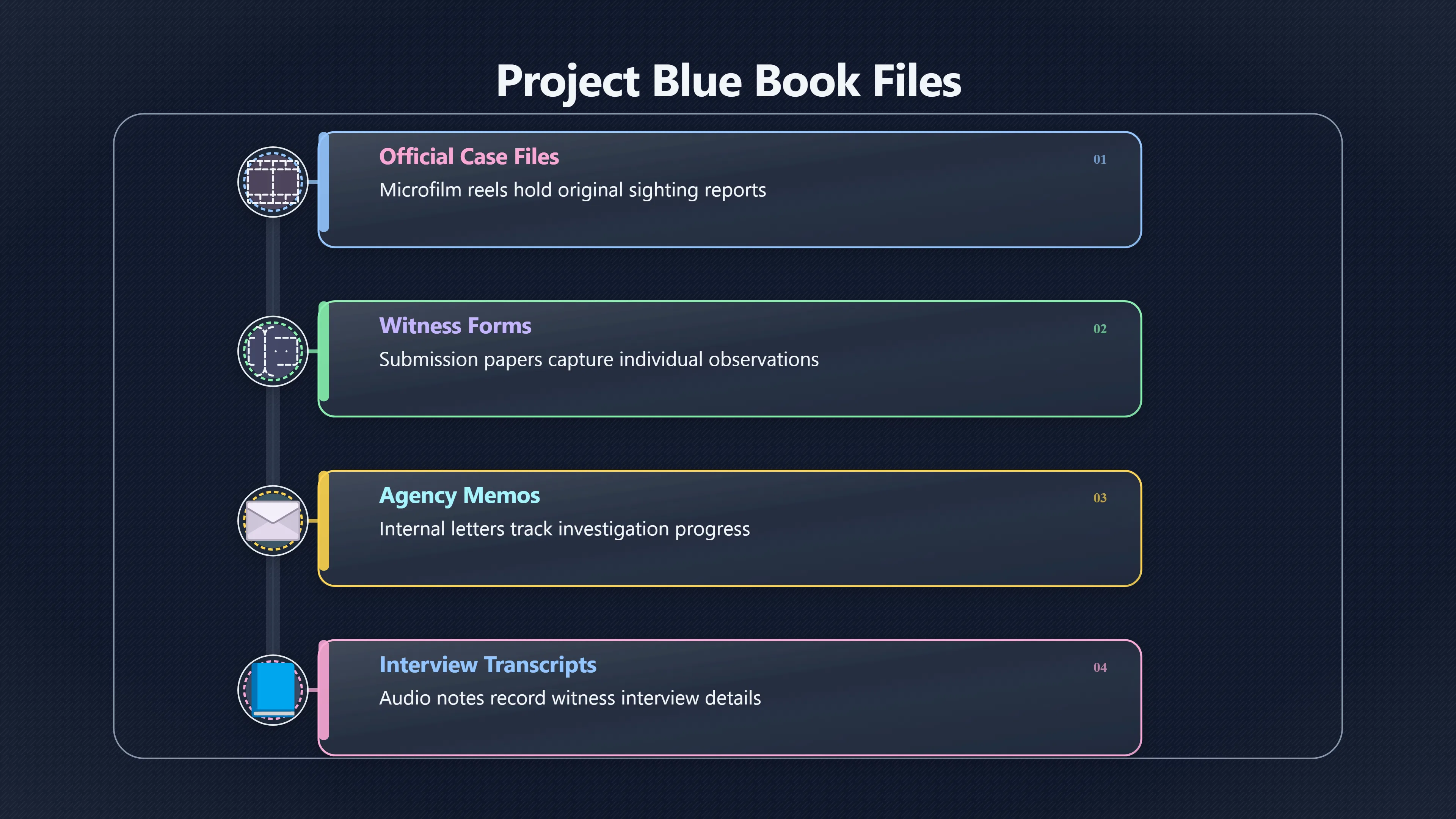
- Official case files and agency documents — for example, the U.S. Air Force’s Project Blue Book records now held at the U.S. National Archives. These comprise microfilm reels of the original sighting reports, investigation notes and administrative files from 1947–1969.[National Archives]nationalarchives.gov.ukUFOS This is a brief guide to researching records of UFOs. The surviving records consist mainly of documents relating to official policy…
- Witness report forms and correspondence — formal sighting submissions made by individuals at the time of observation, whether to civilian centres like the National UFO Reporting Center (NUFORC) or to government or defence departments.[nuforc.org]nuforc.orgData Bank | NUFORCLatest UFO SightingsSeptember 6, 2021…
- Archival catalogues of public records — collections such as Canada’s Library and Archives UFO documents, which preserve letters, memos and sighting forms from multiple federal agencies.[Canada]canada.caCanada's UFOs: The search for the unknown2 Mar 2026 — These documents were accumulated between 1947 and the early 1980s and represe…
- Published archival collections — curated sets of scanned originals, whether field reports, images, interview transcripts or other primary materials made available by researchers or archive projects like Archives of the Impossible.[Wikipedia]
In every case, traceability is enhanced when the database entry includes explicit references to where the original source lives (agency archive ID, collection name, microfilm roll, catalogue number, page image) rather than simply summarising the narrative.
How Summaries Can Change a Case
Summaries, by definition, compress and interpret. In UFO databases, this process typically involves extracting witness narratives, classifying object types, assigning dates and locations, and possibly labelling explanations. Any such processing step introduces interpretive layers that can diverge from the raw record:
- Extraction artefacts: A database may standardise a witness description into coded fields (shape, duration, altitude), but these fields might omit nuances present in the original narrative.
- Editorial bias: Human curators or automated scripts might infer meaning (such as shape categories or event classification) that was not in the source.
- Lossy transformation: If a summary entry does not link back to the original form or file number, researchers cannot check whether omissions or assumptions were appropriate.
From an evidence standpoint, entries with direct links to original reports or scans allow users to judge for themselves how much the summary aligns with the source; entries lacking those links force an a priori trust in how the summariser interpreted the material.
Red Flags in Source‑Free Entries
Certain database practices can indicate a weak trust signal around original records:
- No source citation: Entries that do not show where the data came from — catalogue identifier, archive reference, collection name — offer no foothold for independent verification.
- Aggregated narratives without provenance: Collated reports drawn from secondary sources (books, periodicals, web forums) without tracing them back to the first‑generation document chain can propagate errors or myths.
- Missing metadata: Location, date, witness identity and creation context are all metadata that help establish whether a report reflects an identifiable event; summaries that strip these for brevity reduce traceability.
- Unlinked image or media claims: Visual evidence or sensor data referenced without clear links to original files (with date, format and source metadata) cannot be evaluated for authenticity.
The archival principle of provenance — ensuring that records are kept and described according to their origins and original context — emphasises that uncertain or fragmented record trails weaken trust and must be treated with caution.[Wikipedia]
Practical Value of Traceability for Users
For users comparing UFO databases, the presence of original records or clear source trails serves multiple evaluative functions:
- Verification: Users can check entries against the original material to confirm that summaries are accurate and complete.
- Contextual understanding: Original notes or forms often contain contextual clues — formatting, additional comments, interview transcripts — that enrich interpretation beyond a narrow summary.
- Re‑analysis potential: Researchers can re‑examine original reports with updated methods or criteria; without access to source material, re‑analysis is impossible.
- Transparency: Transparent linkages build trust by showing how information was obtained and processed, aligning UFO research practice with standards in archival and historical inquiry.
In short, a UFO database that embeds or cites original records — with archive identifiers, images, scan links or clearly documented custodial history — provides a stronger foundation for credible use than one that presents disassociated summaries without a traceable evidence trail.
Amazon book picks
Further Reading
Books and field guides related to Can You Trace the UFO Report Back?. Use these as the next step if you want deeper reading beyond the article.
UFOs and Government
Strong fit for tracing UFO claims back through government files, sources, and archival context.

UFOs : Generals, Pilots, and Government Officials Go on the R...
Highlights official testimony and documentary trails, matching the trust-through-original-sources theme.
The UFO Experience
Encourages case-based evaluation rather than relying on unsupported database summaries.
The Report on Unidentified Flying Objects
Shows how early official UFO reports were gathered, handled, and narrated.
eBay marketplace picks
Marketplace Samples
Example marketplace items related to this page. Use the search link to explore similar finds on eBay.


Endnotes
1.
Source: Wikipedia
Link:https://en.wikipedia.org/wiki/Provenance
2.
Source: Wikipedia
Title: Original order
Link:https://en.wikipedia.org/wiki/Original_order
3.
Source: archives.gov
Title: National Archives Project BLUE BOOK
Link:https://www.archives.gov/research/military/air-force/ufos
Source snippet
National ArchivesProject BLUE BOOK - Unidentified Flying Objects | National ArchivesJune 25, 2024...
Published: June 25, 2024
4.
Source: [nuforc]({{ ‘nuforc/’ | relative_url }}). org
Title: Data Bank | NUFORC
Link:https://nuforc.org/databank/
Source snippet
Latest UFO SightingsSeptember 6, 2021...
Published: September 6, 2021
5.
Source: canada.ca
Link:https://www.canada.ca/en/library-archives/collection/research-help/science-technology/ufos.html
Source snippet
Canada's UFOs: The search for the unknown2 Mar 2026 — These documents were accumulated between 1947 and the early 1980s and represe...
6.
Source: Wikipedia
Title: Archives of the Impossible
Link:https://en.wikipedia.org/wiki/Archives_of_the_Impossible
7.
Source: archives.gov
Link:https://www.archives.gov/research/topics/uaps/rg-collections
Source snippet
ecord Group or Collection | National ArchivesDecember 12, 2025 — RECORDS RELATED TO UNIDENTIFIED FLYING OBJECTS (UFOS) AND UNIDENTIFIED A...
Published: December 12, 2025
8.
Source: archives.gov
Link:https://www.archives.gov/research/topics/uaps/textual-and-microfilm
Source snippet
icrofilm | National ArchivesApril 24, 2025 — RECORDS RELATED TO UNIDENTIFIED FLYING OBJECTS (UFOS) AND UNIDENTIFIED ANOMALOUS PHENOMENA (...
Published: April 24, 2025
9.
Source: archives.gov
Link:https://www.archives.gov/news/topics/ufos
Source snippet
hivesApril 24, 2025 — RECORDS RELATED TO UNIDENTIFIED FLYING OBJECTS (UFOS) AND UNIDENTIFIED ANOMALOUS PHENOMENA (UAPS) AT THE NATIONAL A...
Published: April 24, 2025
10.
Source: archives.gov
Title: Do Records Show Proof of UFOs?
Link:https://www.archives.gov/news/articles/do-records-show-proof-of-ufos
Source snippet
National ArchivesJuly 24, 2023 — DO RECORDS SHOW PROOF OF UFOS? En Español Image: UFO graphic banner By Kerri Lawrence | National Archi...
Published: July 24, 2023
11.
Source: Wikipedia
Title: Identification studies of UFOs
Link:https://en.wikipedia.org/wiki/Identification_studies_of_UFOs
Source snippet
Identification studies of UFOsIdentifying unidentified flying objects (UFOs) is a difficult task due to the normally poor quality of t...
12.
Source: Wikipedia
Title: Investigation of UFO reports by the United States government
Link:https://en.wikipedia.org/wiki/Investigation_of_UFO_reports_by_the_United_States_government
Source snippet
kuow... "CIA's Role in the Study of UFOs, 1947–90". Central Intelligence Agency...
13.
Source: youtube.com
Title: UFO Project Blue Book at National Archives Museum
Link:https://www.youtube.com/watch?v=JHeZjJgO9Ns
Source snippet
National archives digitizes once-secret UFO records | Elizabeth Vargas Reports...
14.
Source: youtube.com
Title: National archives digitizes once-secret UFO records | Elizabeth Vargas Reports
Link:https://www.youtube.com/watch?v=MEeG81arab0
Source snippet
Here are the released videos from Pentagon's first batch of UFO files...
15.
Source: uapradar.com
Title: National Archives publishes guide to UFO and UAP
Link:https://www.uapradar.com/articles/generated/national-archives-publishes-guide-to-ufo-and-uap-record-groups
Source snippet
UAP RadarJanuary 10, 2026 — Official New Government Release NATIONAL ARCHIVES PUBLISHES GUIDE TO UFO AND UAP RECORD GROUPS NARA maintai...
Published: January 10, 2026
16.
Source: cufos.org
Title: Project Blue Book
Link:https://cufos.org/resources/project-blue-book/
Source snippet
14, as edited by Leon Davidson, July 1966The United States Air Force managed three UFO projects, from 1948 to 1969. The first w...
17.
Source: nationalarchives.gov.uk
Link:https://www.nationalarchives.gov.uk/help-with-your-research/research-guides/ufos/
Source snippet
UFOS This is a brief guide to researching records of UFOs. The surviving records consist mainly of documents relating to official policy...
Additional References
18.
Source: researchgate.net
Link:https://www.researchgate.net/publication/320593846A_Literature_Review_of_Authenticity_of_Records_in_Digital_Systems_From%27Machine-Readable%27_to_Records_in_the_Cloud
Source snippet
(PDF) A Literature Review of Authenticity of Records in...24 Oct 2017 — This paper presents a review of the literature about authenticit...
19.
Source: hi-storylessons.eu
Link:https://hi-storylessons.eu/wp-content/uploads/2021/02/8a_L.Kaminski_How-Historians-Verify-Information_EN.pdf
Source snippet
How Historians Verify InformationThe aim of these processes is to verify the authenticity of the source as well as to determine its credi...
20.
Source: uapradar.com
Link:https://uapradar.com/methodology
Source snippet
Source Policy & Methodology | UAP RadarSource Policy & Methodology HOW UAP RADAR LABELS, SEPARATES, AND FRAMES INFORMATION UAP Radar is d...
21.
Source: aliencatalog.com
Link:https://www.aliencatalog.com/
Source snippet
Alien Catalog | AlienCatalog.com Official UFO and UAP RecordsLegally public records from official sources ALIEN CATALOG AlienCatalog.com...
22.
Source: taylorresearchgroup.com
Link:https://taylorresearchgroup.com/news/provenance-and-certification-how-to-show-that-your-historical-documentation-is-authentic/
Source snippet
How to show that your historical documentation is authentic24 Jul 2025 — With every project, we diligently record the original location o...
23.
Source: reddit.com
Link:https://www.reddit.com/r/AskHistorians/comments/1809hc/wednesday_ama_i_research_the_history_of_ufo/
Source snippet
I was asked to do an AMA, so here I am. Thanks to the moderation team in advance for allowing me to do this. To prime the discussion...
24.
Source: pmc.ncbi.nlm.nih.gov
Title: We believe the root cause is trust rather than truth
Link:https://pmc.ncbi.nlm.nih.gov/articles/PMC12173498/
Source snippet
trustworthy information: countering disinformation...by M Boumans · 2025 · Cited by 7 — We argue that countering misinformation requires...
25.
Source: tvi.show
Link:https://www.tvi.show/skywatch-files/how-ufo-sightings-are-archived-in-national-libraries
Source snippet
This includes authenticating documents and obtaining clear transfer or copyright rights to ensur...
26.
Source: uaparchive.it
Title: Documenti governativi, testimonianze militari, studi sci
Link:https://www.uaparchive.it/
Source snippet
UAP//ARCHIVE — Archivio Documenti UAP/UFOYesterday — UAP//ARCHIVE AGGR La piattaforma open-source per aggregare, catalogare e discutere d...
27.
Source: apus.libguides.com
Title: UAP History Research Strategies and Primary Sources
Link:https://apus.libguides.com/apusuahome/blog/UFO/UAP-History-Research-Strategies-and-Primary-Sources
Source snippet
libguides.comUFO/UAP History, Research Strategies, and Primary Sources6 Mar 2025 — From the past to the present, a wide variety of online...
Topic Tree