Within UFOCAT
Historical UFOCAT Case Studies Addressing Duplicate Entries
Examines specific UFOCAT analyses, like David Saunders’ work, to handle duplicate sightings in research.
On this page
- David Saunders' county level analysis
- Techniques for deduplicating reports
- Lessons for modern researchers
Page outline Jump by section
Introduction
Historical UFO catalogues quickly ran into a problem that still affects modern databases: the same sighting often appeared multiple times under different sources, investigators, publications or witness accounts. UFOCAT, the long-running catalogue developed by Dr. David R. Saunders and later maintained by the Center for UFO Studies (CUFOS), became one of the earliest large-scale attempts to manage that problem systematically. Rather than deleting overlapping reports, UFOCAT preserved them while creating mechanisms to identify which record was closest to the original source and which entries were derivative versions of the same event.[Center for UFO Studies]cufos.orgUFOCAT Codebook 2023Center for UFO StudiesUFOCAT 2023June 6, 2024 — David R. Saunders, who at the time was a co-Principal Investigator on the. Colorado UFO s…
 The result was a series of practical historical case studies in duplicate control. Researchers working with UFOCAT learned that raw case totals could be misleading unless duplicate reports were identified, linked and analysed. Those lessons emerged from specific investigations, statistical studies and catalogue redesign efforts rather than from abstract database theory alone.
David Saunders’ County-Level Analysis and the Duplicate Problem
One of the most frequently cited examples of early UFOCAT-based statistical work came from David Saunders’ examination of geographical reporting patterns. J. Allen Hynek later described Saunders’ study as an analysis of UFOCAT records seeking correlations between UFO report frequency, county population and county area. Saunders found that counties with larger populations and larger geographical areas generally produced more reports.[Internet Archive]archive.orgInternet ArchiveFull text of "The Hynek UFO Report"David Saunders of the Center for UFO Studies. Dr. Saunders examined the cases in the C…
That conclusion sounds straightforward, but it depended heavily on controlling for duplicated material. A county that generated extensive newspaper coverage could appear to have a disproportionate number of sightings simply because one incident was reported repeatedly through several channels. Saunders’ work highlighted a recurring challenge in UFO cataloguing: researchers needed to distinguish between an increase in observations and an increase in documentation.
The issue became particularly visible when comparing heavily investigated regions with areas that had fewer active UFO organisations. Places with strong local investigative networks often produced multiple records for the same incident because witness statements, newspaper reports, investigator files and later book summaries all entered the documentary chain. Without source tracing, statistical maps risked measuring reporting activity rather than underlying events.
Hynek’s discussion of Saunders’ findings also showed an important methodological shift. Researchers increasingly recognised that a UFO catalogue should not be treated as a simple count of incidents. Instead, it functioned as a record of information transmission, requiring analysis of how reports moved through the literature before numerical conclusions could be trusted.[Internet Archive]archive.orgInternet ArchiveFull text of "The Hynek UFO Report"David Saunders of the Center for UFO Studies. Dr. Saunders examined the cases in the C…
How UFOCAT Linked Duplicate Reports
The most significant historical response to duplication was built directly into UFOCAT’s structure. Rather than attempting to merge all overlapping records into a single master entry, the catalogue preserved multiple versions while creating explicit relationships among them. CUFOS documentation describes several fields designed specifically for this purpose.[Center for UFO Studies]cufos.orgUFOCAT Codebook 2023Center for UFO StudiesUFOCAT 2023June 6, 2024 — David R. Saunders, who at the time was a co-Principal Investigator on the. Colorado UFO s…
Key mechanisms included:
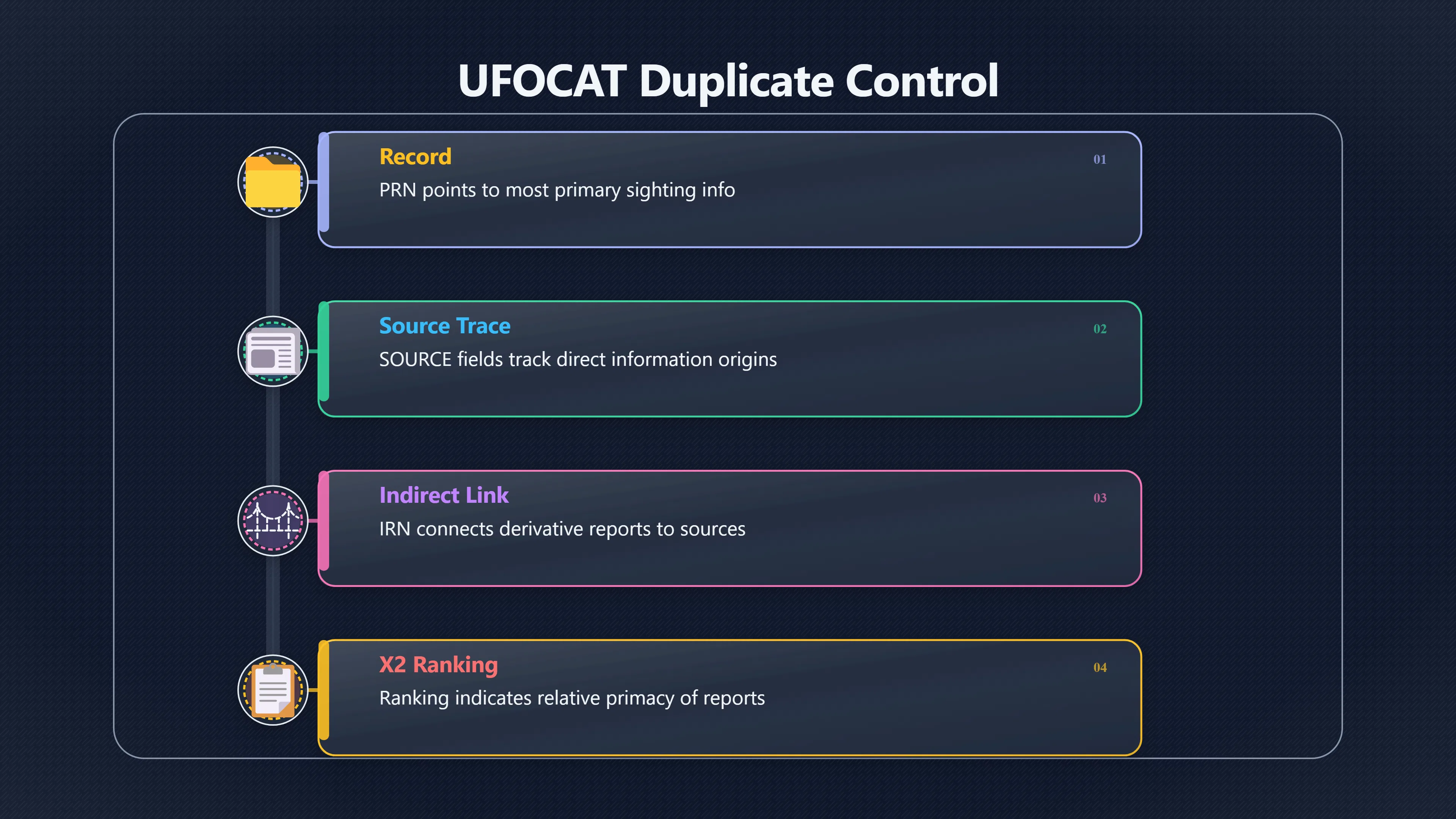
- PRN (Primary Record Number): pointed to the record judged to contain the most primary information about a particular sighting.
- X2 ranking: indicated the relative primacy of reports associated with the same event.
- IRN (Indirect Record Number): connected derivative reports to related source material.
- SOURCE and ISOURCE fields: recorded direct and indirect origins of information.
- Source-level classifications: distinguished investigator files, newspapers, books, catalogues and later database compilations.[Center for UFO Studies]cufos.orgUFOCAT Codebook 2023Center for UFO StudiesUFOCAT 2023June 6, 2024 — David R. Saunders, who at the time was a co-Principal Investigator on the. Colorado UFO s…
Historically, this represented a compromise between two competing goals. Eliminating duplicates entirely would have reduced inflation in case counts but would also have destroyed valuable evidence about how a story evolved. Retaining every version without linkage would have made statistical work unreliable. UFOCAT’s designers chose a middle path: preserve the documentary trail while marking relationships among records.
This approach reflected the reality of UFO research literature. A witness account might first appear in a local newspaper, later in a civilian investigation file, then in a national UFO magazine and eventually in a catalogue or book. Each version could contain unique details, omissions or errors. Keeping all versions allowed historians to reconstruct transmission chains while still identifying the underlying event as a single occurrence.
Project Blue Book Records as a Deduplication Challenge
The integration of Project Blue Book material into UFOCAT created one of the largest historical tests of duplicate control. Researchers working with Blue Book records discovered that the apparent number of reports depended heavily on how duplicate and grouped entries were handled.
Historical reviews of Blue Book catalogues noted that many files contained multiple reports bundled together under a single case designation. In other situations, the same incident appeared repeatedly across different collections and publications. Brad Sparks, discussing Blue Book-derived catalogues and UFOCAT holdings, observed that duplicate entries within the broader Blue Book record system were difficult and time-consuming to identify and remove.[Internet Archive]archive.orgInternet ArchiveFull text of "The Hynek UFO Report"David Saunders of the Center for UFO Studies. Dr. Saunders examined the cases in the C…
The problem worked in both directions:
- Some catalogues inflated totals by counting multiple records describing one incident.
- Other collections undercounted events by combining numerous separate sightings into a single file.
- Different investigators often applied inconsistent criteria when deciding whether reports represented one event or several.[Internet Archive]archive.orgInternet ArchiveFull text of "The Hynek UFO Report"David Saunders of the Center for UFO Studies. Dr. Saunders examined the cases in the C…
This historical experience helped establish an important lesson for later researchers: deduplication is not merely a technical exercise. It requires interpretive decisions about witness location, timing, source independence and event boundaries.
For example, several witnesses observing the same object from different locations may produce multiple legitimate reports. A catalogue must decide whether those records represent one sighting event, several observational perspectives on the same event, or separate incidents. UFOCAT’s linking system allowed researchers to preserve those distinctions without forcing a single answer.

Case Chains and Source Lineages
Some of the most revealing duplicate-control exercises emerged when researchers traced famous sightings through successive publications.
A well-known UFO case could move through several stages:
- Initial witness report.
- Local media coverage.
- Investigation by a civilian organisation.
- Inclusion in a regional catalogue.
- Citation in books or encyclopaedic reference works.
- Entry into later databases.
Each stage increased the possibility of duplication. Dates could shift slightly, locations might be standardised differently, and witness counts could change as new versions circulated. A researcher looking only at database totals might mistakenly interpret five records as five independent sightings.
UFOCAT’s historical value lay partly in exposing these chains. By preserving source references and linking related records, investigators could determine whether multiple entries reflected independent testimony or merely repeated publication of the same narrative. CUFOS documentation explicitly describes the catalogue as a guide to original sources rather than a final authority on case interpretation.[Center for UFO Studies]cufos.orgUFOCAT Codebook 2023Center for UFO StudiesUFOCAT 2023June 6, 2024 — David R. Saunders, who at the time was a co-Principal Investigator on the. Colorado UFO s…
That philosophy distinguished UFOCAT from many later public reporting databases, where duplicate detection often focused primarily on keeping counts clean. UFOCAT treated duplication as evidence about the history of a report.
Lessons for Modern Researchers
The historical UFOCAT experience remains relevant because contemporary UFO and UAP databases face many of the same problems on a larger scale.
Several enduring lessons emerged from the catalogue’s duplicate-control efforts:
Source provenance matters as much as the sighting itself. A report without a clear source trail can easily be counted multiple times when databases are merged.
Preserving duplicates can be valuable. Historical researchers often need to know how a story changed across different publications. Deleting every duplicate record can erase that history.
Statistical studies require event-level filtering. Saunders’ geographical analyses demonstrated that meaningful correlations depend on identifying underlying incidents rather than counting every record indiscriminately.[Internet Archive]archive.orgInternet ArchiveFull text of "The Hynek UFO Report"David Saunders of the Center for UFO Studies. Dr. Saunders examined the cases in the C…
Deduplication is partly interpretive. Witnesses observing the same object from different locations create legitimate reporting ambiguities. No purely automatic rule can resolve every case.
Database transparency improves credibility. UFOCAT’s use of primary-record indicators and source-ranking fields allowed later researchers to inspect the catalogue’s assumptions instead of accepting invisible editorial decisions.[Center for UFO Studies]cufos.orgUFOCAT Codebook 2023Center for UFO StudiesUFOCAT 2023June 6, 2024 — David R. Saunders, who at the time was a co-Principal Investigator on the. Colorado UFO s…
The broader historical significance of these case studies is that they transformed duplication from a hidden bookkeeping problem into an explicit research topic. UFOCAT’s designers recognised that the history of a UFO report often matters as much as the reported event itself. By documenting relationships among records rather than simply counting them, the catalogue provided a framework that later database projects could adapt when confronting the same challenge on a larger digital scale.
Amazon book picks
Further Reading
Books and field guides related to Historical UFOCAT Case Studies Addressing Duplicate Entries. Use these as the next step if you want deeper reading beyond the article.
UFOs
Provides historical UFO cases and discussions of duplicate reports and investigations.

UFOs : Generals, Pilots, and Government Officials Go on the R...
First published 2011.
The UFO Experience
Covers methodology and analysis of UFO reports, including historical cataloging and duplicates.
The UFO Experience: A Scientific Inquiry
Covers methodology and analysis of UFO reports, including historical cataloging and duplicates.
eBay marketplace picks
Marketplace Samples
Example marketplace items related to this page. Use the search link to explore similar finds on eBay.


Endnotes
1.
Source: cufos.org
Title: UFOCAT Codebook 2023
Link:https://cufos.org/PDFs/UFOCAT%20Codebook%202023.pdf
Source snippet
Center for UFO StudiesUFOCAT 2023June 6, 2024 — David R. Saunders, who at the time was a co-Principal Investigator on the. Colorado UFO s...
Published: June 6, 2024
2.
Source: archive.org
Link:https://archive.org/stream/TheHynekUFOReport/The_Hynek_UFO_Report_djvu.txt
Source snippet
Internet ArchiveFull text of "The Hynek UFO Report"David Saunders of the Center for UFO Studies. Dr. Saunders examined the cases in the C...
3.
Source: archive.org
Title: Brad Sparks Comprehensive Catalog of 1,600 Project Blue Book UFO Unknowns
Link:https://archive.org/download/BernardSieglerTechnicsAndTime1TheFaultOfEpimetheus/Brad%20Sparks%20-%20Comprehensive%20Catalog%20of%201%2C600%20Project%20Blue%20Book%20UFO%20Unknowns.pdf
Source snippet
Page 2. entries cataloged by former Condon Committee scientist David Saunders, has...Read more...
Additional References
4.
Source: dokumen.pub
Link:https://dokumen.pub/download/ufos-and-close-encounters-1502968088-9781502968081.html
Source snippet
The first step is to compile a computer catalog of sightings—the Ufocat now has...Read more...
5.
Source: academia.edu
Link:https://www.academia.edu/69518005/Proceedings_of_the_Sign_Historical_Group_UFO_History_Workshop
Source snippet
ence, less well known, stretching back to the sixteenth century.Read more...
6.
Source: scribd.com
Link:https://www.scribd.com/document/51179838/UFOlogy-The-Book-NICAP-Database
Source snippet
tself later became the term for this research, UFOlogy.Read more...
7.
Source: newspaceeconomy.ca
Title: ufocat the ufo sightings catalog by cufos
Link:https://newspaceeconomy.ca/2025/07/30/ufocat-the-ufo-sightings-catalog-by-cufos/
Source snippet
UFOCAT: The UFO Sightings Catalog by CUFOS30 Jul 2025 — UFOCAT is an electronic database of UFO sightings maintained by the Center for UF...
8.
Source: youtube.com
Link:https://www.youtube.com/watch?v=avCDzCxjPEM
Source snippet
The Scientific Traceability Matrix: Replicating and Validating Historical Aerial Reports...
9.
Source: youtube.com
Link:https://www.youtube.com/watch?v=pxKOdtmHTSo
Source snippet
Algorithmic Data Processing and Local Tools for Eliminating Redundant System Inputs...
10.
Source: youtube.com
Link:https://www.youtube.com/watch?v=8R34a9_sRKQ
Source snippet
Project Blue Book and the History of Archival Record De-duplication...
11.
Source: youtube.com
Title: Project Blue Book and the History of Archival Record De-duplication
Link:https://www.youtube.com/watch?v=WWqwB52wnuI
Source snippet
Analyzing Ethnographic Data and Regional Trends in Anomalous Phenomenon Catalogues...
12.
Source: facebook.com
Link:https://www.facebook.com/groups/150258691719744/posts/8468799559865574/
Source snippet
UFO sighting File Unit # **Mineral Wells**, Texas...The Levelland Sightings.....on November 2nd of 1957, a series of UFO occurrences in...
13.
Source: arxiv.org
Link:https://arxiv.org/pdf/2305.18566
Source snippet
This necessitated mapping the [NUFORC]({{ 'nuforc/' | relative_url }}) counts from city- to county-level.Read more...
Topic Tree