Within UFOCAT
How X2 and PRN Codes Identify Primary UFOCAT Entries
Readers learn how X2 and PRN codes help distinguish primary UFO records from duplicates in UFOCAT.
On this page
- Explanation of X2 field values
- PRN pointing to primary sources
- Filtering techniques for accurate counts
Page outline Jump by section
Introduction
In the context of UFOCAT — the extensive Center for UFO Studies (CUFOS) catalogue of unidentified flying object (UFO) reports — researchers must carefully distinguish primary records (the closest-to-original accounts of a sighting) from multiple peripheral references to the same event. UFOCAT deliberately preserves multiple entries per actual sighting because one UFO report often appears in many sources: original case files, newspaper articles, books, periodicals and derivative compilations. Without filtering, researchers can easily over-count events, misinterpret statistical patterns, or conflate independent sightings with reposted narratives. Two critical database fields — X2 and PRN — exist precisely to help researchers isolate the most authoritative, primary UFOCAT records for accurate counts and analysis.[Center for UFO Studies]cufos.orgCenter for UFO Studies UFOCATCenter for UFO StudiesUFOCAT - Center for UFO Studies…
What the X2 Field Tells You About Record Primacy
The X2 field in UFOCAT is a compact, numerical indicator of how primary a given record is within its cluster of entries referring to the same UFO event. According to the official UFOCAT codebook:
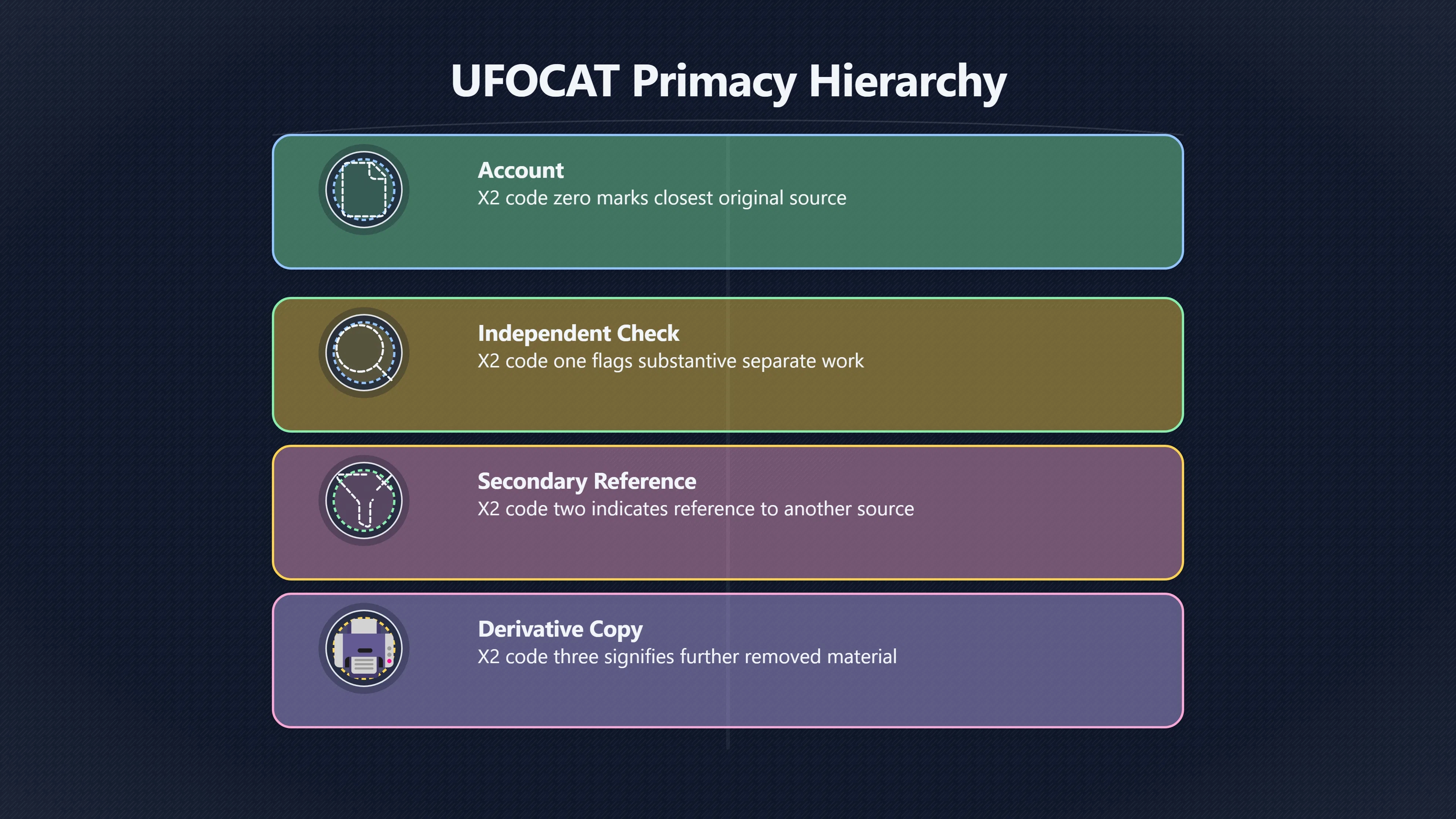
- Records coded 0 in X2 are judged the true primary account — closest to an original source and least mediated by other reports. These are the entries most suitable for basic tallies of unique incidents.
- X2 = 1 marks independent investigations that are substantive but were not chosen as the main primary entry.
- Values of 2 indicate records that mainly reference another source and thus are secondary sources.
- Codes of 3 signify records that clearly derive from secondary material and are even further removed from the original reporting.
This coding scheme turns X2 into a shortcut to primary-source quality in the database. By filtering for X2 = 0 alone, a researcher can extract the set of entries representing the primary, non-duplicate records for a given query. Without this filter, raw queries would include many entries that are merely derivative references to the same event across different media.[Center for UFO Studies]cufos.orgCenter for UFO Studies UFOCATCenter for UFO StudiesUFOCAT - Center for UFO Studies…
How PRN Points to the Core Event
While X2 flags the primacy quality of an individual entry, the PRN (Primary Record Number) field links every record to the URN (Unique Record Number) of the entry judged to contain the most authoritative account of the same event. In practice:
- Every UFOCAT record carries a URN — its unique identifier in the catalogue.
- The PRN attaches that record to a primary URN for the event it documents; records referring to the same incident carry identical PRN values.
- Filtering by a given PRN will return all records (primary and linked secondary references) for the same UFO sighting, enabling researchers to understand the source trail behind an event.
In configured searches, this means a PRN grouping is the canonical way to collect all entries about one incident, and the corresponding X2 = 0 record within that group is the locus of the primary account. Analysts can use PRN to link and navigate cross‑references even when X2 values vary across sources.[Center for UFO Studies]cufos.orgCenter for UFO Studies UFOCATCenter for UFO StudiesUFOCAT - Center for UFO Studies…
Practical Filtering Techniques for Accurate Counts
Researchers using UFOCAT for counting or statistical work typically combine X2 and PRN to avoid duplicating events that appear in many derivative sources:
- Primary count extraction: Query for X2 = 0 across the whole dataset or within focus parameters (e.g. year, location, object shape) to get a dataset of events counted once at their primary source.
- Cluster retrieval: Group query results by PRN to see all the records tied to a specific primary event. This reveals how many derivative references exist and where they came from.
- Source trail analysis: After grouping by PRN, researchers can use the full set of associated records to map the flow of a case through newspapers, books, periodicals, and investigatory files to understand which sources carried the report and how it changed over time.
Such filtering transforms UFOCAT from a flat list of entries into a structured, source-tracing tool. By isolating X2 = 0 records for unique incident tallies and using PRN linkages to explore related entries, researchers can avoid over‑counting and appreciate the propagation of UFO reports across the literature.[Center for UFO Studies]cufos.orgCenter for UFO Studies UFOCATCenter for UFO StudiesUFOCAT - Center for UFO Studies…
Implications for UFOCAT Research
The existence and proper use of X2 and PRN demonstrate that UFOCAT was designed not simply as a historical archive but as a reference map of source chains for UFO events. Counting events without respect for these fields leads to inflated totals and obscures the relative research value of different sources. By emphasising primary entries (via X2 = 0) and event clusters (via PRN linkages), analysts can generate statistics that approximate actual unique sightings rather than bibliographic echoes.[Center for UFO Studies]cufos.orgCenter for UFO Studies UFOCATCenter for UFO StudiesUFOCAT - Center for UFO Studies…
In short, X2 and PRN are essential tools within UFOCAT for filtering, de‑duplicating, and navigating the tangled web of sighting reports — enabling researchers to extract meaningful, evidence‑anchored insights from a catalogue designed to preserve, not obfuscate, the origins of UFO narratives.[Center for UFO Studies]cufos.orgCenter for UFO Studies UFOCATCenter for UFO StudiesUFOCAT - Center for UFO Studies…
Amazon book picks
Further Reading
Books and field guides related to How X2 and PRN Codes Identify Primary UFOCAT Entries. Use these as the next step if you want deeper reading beyond the article.
The Hynek UFO Report
Useful background for catalogue-based UFO research and case classification.
UFOs
Shows distinctions between primary and secondary sources in UFO records, akin to X2/PRN filtering.

UFOs : Generals, Pilots, and Government Officials Go on the R...
First published 2011.
The UFO Experience
Covers evaluation of firsthand vs derivative reports, aligning with X2/PRN concepts.
eBay marketplace picks
Marketplace Samples
Example marketplace items related to this page. Use the search link to explore similar finds on eBay.




Endnotes
1.
Source: cufos.org
Title: Center for UFO Studies UFOCAT
Link:https://cufos.org/cufos-publications-databases/ufocat/
Source snippet
Center for UFO StudiesUFOCAT - Center for UFO Studies...
2.
Source: cufos.org
Link:https://cufos.org/PDFs/UFOCAT%20Codebook%202023.pdf
Source snippet
USER'S GUIDE UFOCAT 2023 Concord, New HamNovember 7, 2025...
Published: November 7, 2025
3.
Source: ufocat.com
Link:https://ufocat.com/
Source snippet
[Input] DRAG & DROP EVIDENCE Supported formats: JPG, PNG, WEBP OR BROWSE FILES [LOG_ID: 8823-A] NEW SIGH...
4.
Source: cufos.org
Title: Frequently Asked Questions
Link:https://cufos.org/faqs
Source snippet
We have tried to keep the answers simple, so that students and...
5.
Source: encyclopedia.com
Title: Ufo | Encyclopedia.com
Link:https://www.encyclopedia.com/science-and-technology/technology/aviation-general/ufo
Source snippet
the study of UFOs.DERIVATIVES: u·fo·log·i·cal / ˌyoōfəˈläjikəl/ adj.u·fol·o·gist / -jist/ n. The Oxford Pocket Dictionary of Current...
Additional References
6.
Source: aliencatalog.com
Link:https://www.aliencatalog.com/
Source snippet
Alien Catalog | AlienCatalog.com Official UFO and UAP RecordsLegally public records from official sources ALIEN CATALOG AlienCatalog.com...
7.
Source: ai-2.io
Title: Every record is traced to its primary origin, processed through the sa
Link:https://ai-2.io/sources.html
Source snippet
Data Sources — UAP Knowledge Graph29 Independent Sources EVERY SOURCE, Explained Each source was selected for its provenance, accessibili...
8.
Source: scribd.com
Link:https://www.scribd.com/document/471252323/36773908-[MUFON
Source snippet
David R. Saunders in 199 and donated to the Center for UFO Studies in 1975. In its present form UFOCAT has...
9.
Source: u-sphere.com
Link:https://www.u-sphere.com/?title=UAP_Database
Source snippet
This project is part of an assessment of the possible correlations between the UFO phenomenon (or UAP) and potential environmental risks...
10.
Source: decur.org
Title: Qualitative data catalogued for anal
Link:https://decur.org/
Source snippet
UAP & NHI Research ArchiveA REFERENCE ARCHIVE FOR UAP AND NHI RESEARCH Structured documentation of insider testimony, primary sour...
11.
Source: disclosdex.com
Title: CUFO S | Disclosdex
Link:https://disclosdex.com/organizations/cufos
Source snippet
Allen Hynek in 1973 to apply scientific rigor to global UFO incident data Astronomer J. Allen Hynek established the Center for UFO Studie...
12.
Source: [nuforc]({{ ‘nuforc/’ | relative_url }}). org
Title: For 25 years, it ha
Link:https://nuforc.org/databank/
Source snippet
Data Bank | NUFORC - Latest UFO SightingsSeptember 6, 2021 — THE NATIONAL UFO REPORTING CENTER ONLINE DATABASE Image The NUFORC Databank...
Published: September 6, 2021
13.
Source: ufosearch.org
Title: UF O Search — PURSUE UAP Archive
Link:https://ufosearch.org/
Source snippet
UFO Search — PURSUE UAP ArchiveMay 8, 2026 — Image: Apollo 17 — December 1972 Image: Witness composite sketch — April 2024 Image: Unresol...
Published: May 8, 2026
14.
Source: youtube.com
Title: Governments Using AI To Decode Massive UFO Databases | WION Podcast
Link:https://www.youtube.com/watch?v=adCsqd_-M94
Source snippet
UFO Sightings Data & Trends [Python Data Visualization Project]...
15.
Source: youtube.com
Title: UAP Data Analysis On 80,000 Sightings! | Don Tadaya
Link:https://www.youtube.com/watch?v=VmVf2Axe6as
Source snippet
Governments Using AI To Decode Massive UFO Databases | WION Podcast - YouTube...
Topic Tree