Within Reliability
Why GEIPAN Separates Quality From Strangeness
GEIPAN shows how separating observation quality from residual strangeness can make UFO case labels easier to judge.
On this page
- How GEIPAN categories work
- Why consistency and strangeness are separate tests
- What other databases can borrow from the model
Page outline Jump by section
Introduction
When comparing the reliability of UFO/UAP databases, one of the key challenges is distinguishing between how good the data is and how strange or unexplained a case remains after investigation. France’s official investigative body, the GEIPAN (Groupe d’Études et d’Informations sur les Phénomènes Aérospatiaux Non‑identifiés), offers a well‑documented classification model that illustrates this distinction in practice. Because its methodology is public and reproducible, GEIPAN’s approach is frequently cited as an example of how to separate observation quality (data reliability) from residual unexplained content (strangeness) in UFO reporting systems — a valuable lens for judging and comparing database reliability.[geipan.fr]geipan.frClassification | GEIPANClassification | GEIPAN

How GEIPAN Categories Work
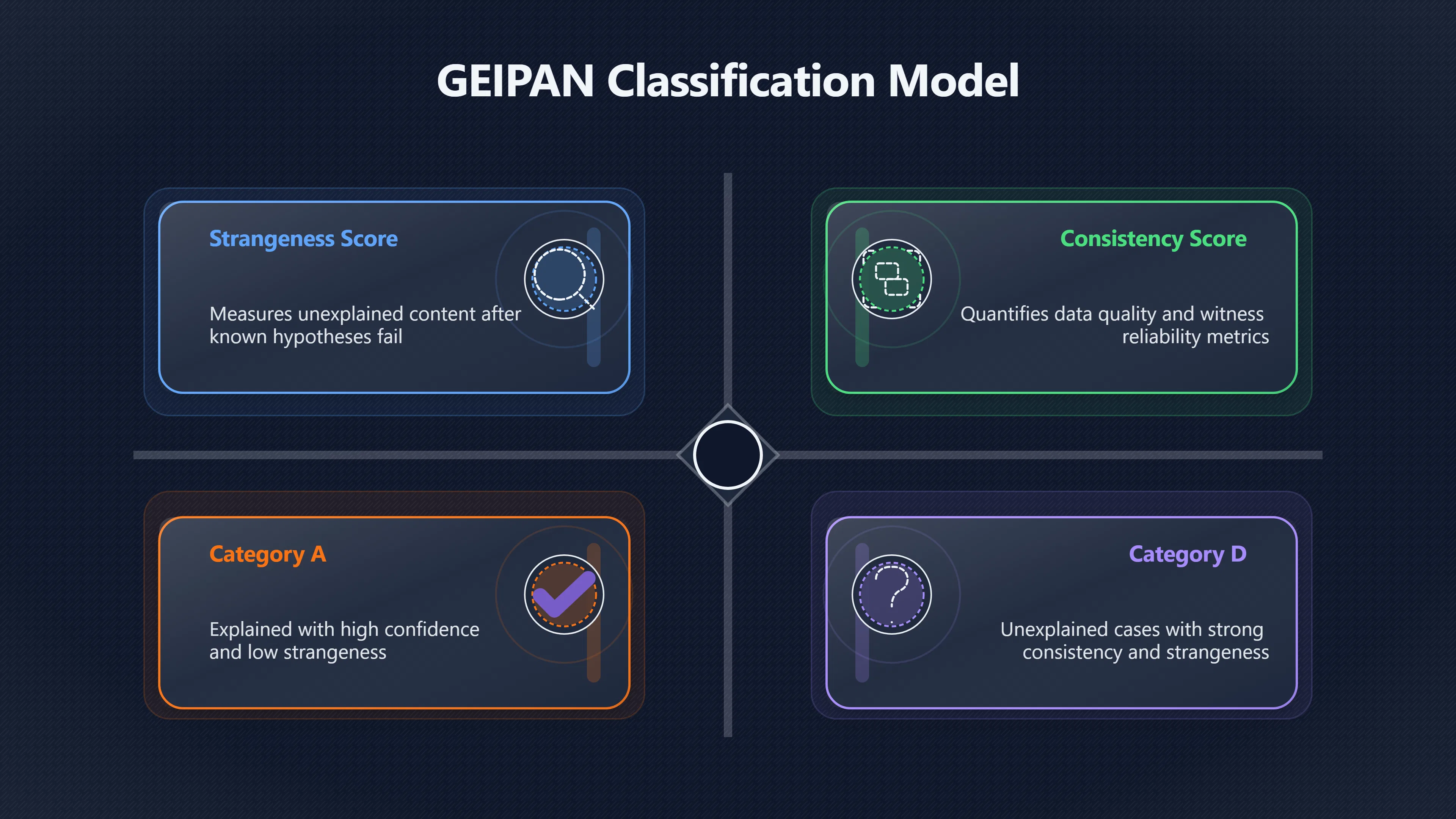
At the heart of GEIPAN’s reliability model are two independent criteria used to classify every case: residual strangeness (E) and data consistency (C). After a report is collected and analysed, these metrics determine its final category.[geipan.fr]geipan.frMission & Geipan | GEIPANMission & Geipan | GEIPAN
Residual Strangeness (E)
This is a quantitative measure of how much of the reported phenomenon cannot be explained by known physical or perceptual hypotheses. Investigators generate and assess possible explanations grounded in current scientific knowledge — such as astronomical objects, atmospheric phenomena or known human‑made artefacts — and then evaluate how much of the witness’s description remains strange after this comparison. A higher E score indicates more unexplained content.[geipan.fr]geipan.frMission & Geipan | GEIPANMission & Geipan | GEIPAN
Data Consistency (C)
This metric reflects the quality and reliability of the information collected — the number of independent witnesses, the precision of their responses, the presence of supporting evidence such as photographs or radar, and the overall coherence of the account. GEIPAN uses a specific weighting scheme to quantify this.[geipan.fr]geipan.frL E GEIPAN: « LE BUREAU DES OVNIS » OU DES PAN?GEIPANJune 28, 2021 — Date de publication 28 juin 2021 LE GEIPAN: « LE BUREAU DES OVNIS » OU DES PAN? Date de publication 28 juin 202…
These two dimensions are deliberately evaluated separately: a sighting can be highly strange but poorly supported by reliable data, or strongly consistent yet easily explained. The categories that GEIPAN assigns emerge from the interplay between these axes.[geipan.fr]geipan.frMethodology | GEIPANFAQ GEIPAN 1What is GEIPAN? * GEIPAN (Group for the Study and Information of Unidentified Aerial/Aerospace Phenomena) is a technical department of th…
Why Consistency and Strangeness Are Separate Tests
One of the strengths of GEIPAN’s model from a reliability standpoint is its conceptual separation of “can we reasonably explain this sighting?” from “how good and reliable is the evidence?”. This separation has practical implications:
- Quality isn’t confused with mystery. A bizarre report with minimal corroborating evidence doesn’t automatically become an unexplained case; it often falls into category C (insufficient data).[geipan.fr]geipan.frUNE MÉTHODOLOGIE DE CLASSIFICATION CONSOLIDÉE SUR DES DÉCENNIES La classification du GEIPAN (A/B/C/D*) a été…
- Strangeness alone doesn’t inflate confidence. GEIPAN requires not just high residual strangeness but also high consistency before a case is categorised as genuinely unexplained.[geipan.fr]geipan.fr1977 within the CNES: * Provides a public and official feedback to all people’s “liv…
- Routine re‑evaluation is built in. Because both metrics are based on evidence and hypotheses, cases — especially those initially unresolved — can be revisited as new data or analysis methods become available.[geipan.fr]geipan.frdentifiés) consiste à fournir un service opérationnel basé sur des enquêtes liées aux…
In practice, GEIPAN’s categories work like this:
- Category A: Explained with high confidence — both low strangeness and adequate consistency.[geipan.fr]geipan.frClassification | GEIPANClassification | GEIPAN
- Category B: Probably explained — plausible hypotheses but some uncertainties remain.[geipan.fr]geipan.frMission & Geipan | GEIPANMission & Geipan | GEIPAN
- Category C: Unresolved due to insufficient or unreliable data, regardless of strangeness.[geipan.fr]geipan.frMission & Geipan | GEIPANMission & Geipan | GEIPAN
- Category D: Unexplained after full investigation — where strangeness is significant and data consistency is strong. Subdivisions (D1 and D2) can reflect middling versus strong consistency among unexplained cases.[geipan.fr]geipan.frL E GEIPAN: « LE BUREAU DES OVNIS » OU DES PAN?GEIPANJune 28, 2021 — Date de publication 28 juin 2021 LE GEIPAN: « LE BUREAU DES OVNIS » OU DES PAN? Date de publication 28 juin 202…
This dual‑axis logic turns classification into a reliability model, where the evidential weight is explicit rather than implicit.


What Other Databases Can Borrow from the Model
GEIPAN’s approach offers several lessons for other UFO/UAP databases that aim to be reliable reference sources rather than simple crowd‑sourced collections:
- Explicit criteria reduce ambiguity. Separating observational quality from unexplained content helps users understand why a case is considered identified, unresolved, or unexplained.
- Quantifiable measures aid comparability. By modelling metrics like strangeness and consistency on numeric scales, GEIPAN makes classification less subjective, or at least more traceable.
- Documentation supports external evaluation. Because GEIPAN publishes its methodology and many of its investigation outcomes, third‑party analysts can assess how categories are reached — a key aspect of database reliability.
- Re‑evaluation mechanisms bolster quality over time. Systems that allow for revisiting uncertain cases as new evidence comes in help ensure that databases remain accurate and up‑to‑date.
In the broader landscape of UFO report catalogues, GEIPAN’s method stands out because it makes the reliability model itself visible rather than leaving users to infer it from opaque labels or aggregated totals. This transparency helps researchers, journalists and the public differentiate between high‑confidence explanations, data limitations, and genuinely unresolved phenomena, which in turn supports more grounded comparisons across international databases.[geipan.fr]geipan.frMethodology | GEIPANFAQ GEIPAN 1What is GEIPAN? * GEIPAN (Group for the Study and Information of Unidentified Aerial/Aerospace Phenomena) is a technical department of th…
Amazon book picks
Further Reading
Books and field guides related to Why GEIPAN Separates Quality From Strangeness. Use these as the next step if you want deeper reading beyond the article.
UFOs
Useful background for readers interested in official UFO investigation models such as GEIPAN.
The UFO Experience
Relevant to separating report quality, strangeness, explanation, and classification standards.
UFOs and Government
Covers international government UFO study context, aligning well with GEIPAN methodology and reliability comparisons.
The Demon-Haunted World
Rating: 4.5/5 from 43 Google Books ratings
Supports the page’s emphasis on evidence quality, careful explanation, and disciplined scepticism.
eBay marketplace picks
Marketplace Samples
Example marketplace items related to this page. Use the search link to explore similar finds on eBay.




Endnotes
1.
Source: geipan.fr
Title: Classification | GEIPAN
Link:https://www.geipan.fr/en/node/58787
2.
Source: geipan.fr
Title: Mission & Geipan | GEIPAN
Link:https://geipan.fr/missions-methodes-et-resultats
3.
Source: geipan.fr
Title: Mission & Geipan | GEIPAN
Link:https://www.geipan.fr/en/node/58792
4.
Source: geipan.fr
Title: L E GEIPAN: « LE BUREAU DES OVNIS » OU DES PAN?
Link:https://geipan.fr/fr/node/58703
Source snippet
GEIPANJune 28, 2021 — Date de publication 28 juin 2021 LE GEIPAN: « LE BUREAU DES OVNIS » OU DES PAN? Date de publication 28 juin 202...
Published: June 28, 2021
5.
Source: geipan.fr
Title: Methodology | GEIPANFAQ GEIPAN 1
Link:https://www.geipan.fr/en/node/58788
Source snippet
What is GEIPAN? * GEIPAN (Group for the Study and Information of Unidentified Aerial/Aerospace Phenomena) is a technical department of th...
7.
Source: geipan.fr
Link:https://geipan.fr/fr/node/58787
Source snippet
UNE MÉTHODOLOGIE DE CLASSIFICATION CONSOLIDÉE SUR DES DÉCENNIES La classification du GEIPAN (A/B/C/D*) a été...
9.
Source: geipan.fr
Link:https://www.geipan.fr/en/node/440
Source snippet
1977 within the CNES: * Provides a public and official feedback to all people’s “liv...
10.
Source: geipan.fr
Link:https://www.geipan.fr/index.php/fr/node/58792
Source snippet
dentifiés) consiste à fournir un service opérationnel basé sur des enquêtes liées aux...
11.
Source: cnes-geipan.fr
Title: Geipan How does GEIPAN classify observation cases? | GEIPAN
Link:https://www.cnes-geipan.fr/en/node/412
Source snippet
GEIPANThe classification process is done according a quantitative and qualitative assessment of two parameters: the consistency (C) of...
12.
Source: cnes-geipan.fr
Link:https://www.cnes-geipan.fr/en/node/58787
Source snippet
[Select] [Input] [Input] [Input] Sommaire 1. A classification methodology consolidated over decades 2. St...
13.
Source: cnes-geipan.fr
Link:https://cnes-geipan.fr/en/node/58788
Source snippet
The most difficult phenomenon to explain...
Additional References
14.
Source: cnes-geipan.fr
Title: Mission & Geipan | GEIPANSommaire 1
Link:https://www.cnes-geipan.fr/fr/missions-methodes-et-resultats
Source snippet
40 ans de GEIPAN, c'est d'abord 40 ans d'émotions dans le ciel 2. L’étrangeté moderne dans le ciel s’appelle Soucoupe ou OVNI depuis 1947...
15.
Source: cnes-geipan.fr
Title: It is based on 2 main crite
Link:https://www.cnes-geipan.fr/en/missions-methodes-et-resultats
Source snippet
Mission & Geipan | GEIPANA CLASSIFICATION METHODOLOGY CONSOLIDATED OVER DECADES Image: Consistance Cas Geipan Since 2008, a more detailed...
16.
Source: youtube.com
Title: 70 Years of UFO-UAP Data: A Scientific Review with Robert Powell (SCU Founder)
Link:http://www.youtube.com/watch?v=0hS4OYk_rOU
Source snippet
I Analyzed 173,747 UFO Reports… Here’s What I Found...
17.
Source: youtube.com
Title: CNES’s UFO Archive!
Link:http://www.youtube.com/watch?v=jdN-BBirSA8
Source snippet
GEIPAN UAP UFO investigation classification GEIPAN: Everything You Need to Know About UFOs and Aerial Phenomena Science And Life...
18.
Source: youtube.com
Title: France’s Official UFO Investigation Agency (GEIPAN)
Link:http://www.youtube.com/watch?v=lXi5B0NTwVc
Source snippet
70 Years of UFO-UAP Data: A Scientific Review with Robert Powell (SCU Founder)...
19.
Source: youtube.com
Title: GEIPAN: Everything You Need to Know About UFOs and Aerial Phenomena
Link:http://www.youtube.com/watch?v=K-dgmfIOYBE
Source snippet
France's Official UFO Investigation Agency (GEIPAN)...
20.
Source: cnes-geipan.fr
Link:https://www.cnes-geipan.fr/fr/node/25
Source snippet
La méthodologie de classification au GEIPAN | GEIPANFebruary 26, 2021 — Date de publication 26 Février 2021 LA MÉTHODOLOGIE DE CLASSIFICA...
Published: February 26, 2021
21.
Source: youtube.com
Title: I Analyzed 173,747 UFO Reports… Here’s What I Found
Link:http://www.youtube.com/watch?v=dnQU6Rj1fD8
Source snippet
CNES's UFO Archive...
Topic Tree