Within UFO Archives
Which UFO Databases Are Worth Trusting?
A reliable UFO database should show sources, metadata, duplicate controls, classification rules, and access to original records.
On this page
- Metadata that matters
- Transparency and original records
- Warning signs in sighting databases
Page outline Jump by section
Introduction
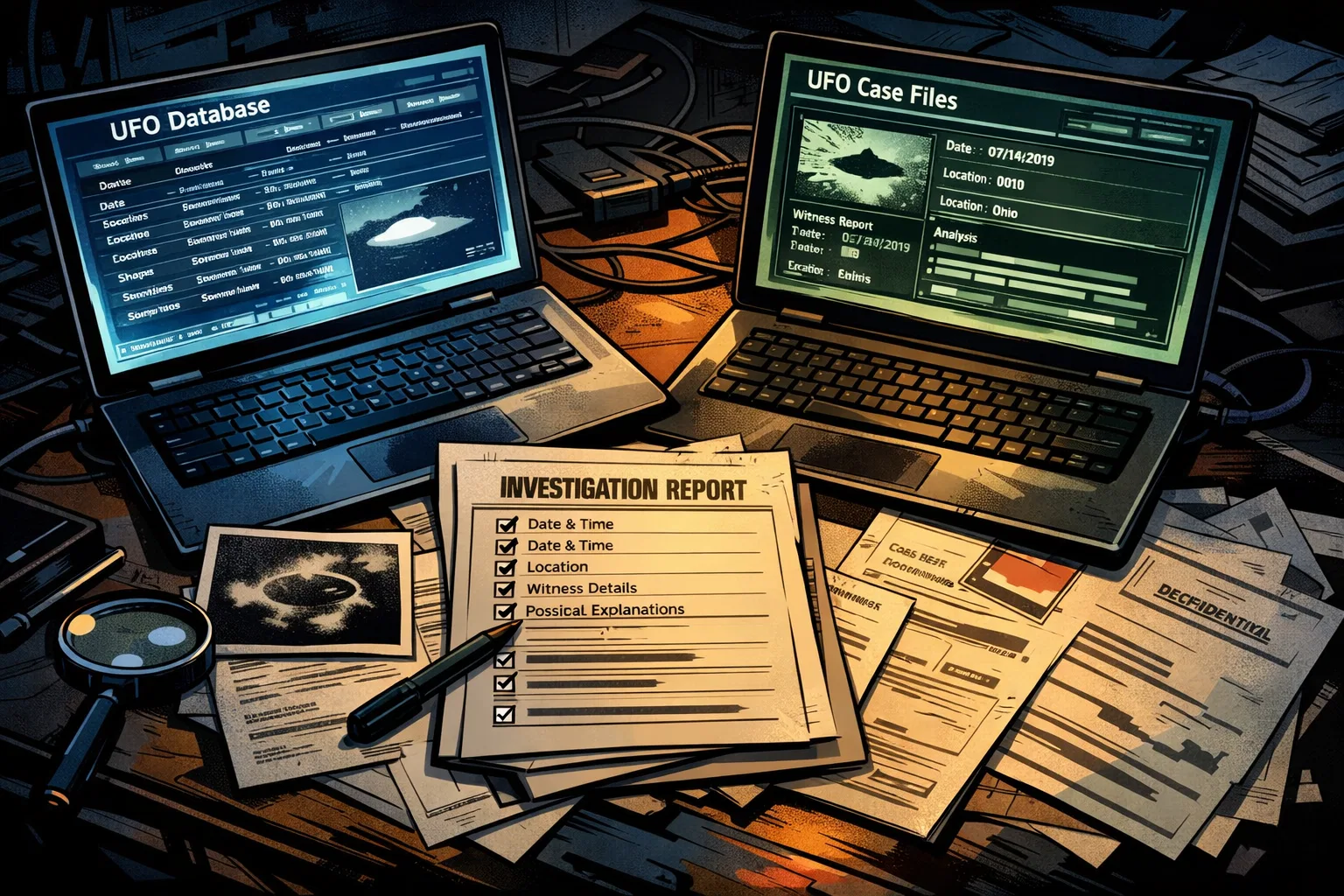
A UFO database is worth trusting only to the extent that it lets you trace a report back to its sources, understand how the entry was created, and see what has been done to rule out ordinary explanations. The best databases are not the ones with the biggest totals or the most dramatic language. They are the ones with clear metadata, visible classification rules, duplicate controls, and access to original records or investigation notes.
That matters because UFO report databases are usually collections of observations, not collections of confirmed anomalies. A short public sighting form, a declassified military case file, a moderated mobile-app submission and a national space-agency investigation can all sit under the same broad “UFO” or “UAP” label, but they do not carry the same evidential weight. NASA’s 2023 independent UAP study stressed that scientific progress depends on higher-quality data, including time, location, sensor details, calibration and other metadata, and noted that civilian reporting remains sparse and non-standardised.[NASA Science]science.nasa.govNASA ScienceIndependent Study Team ReportIn short, calibration ensures that future data gathered are reliable and accurate, while gatheri…
Start with the question the database can actually answer
The first reliability test is simple: what is the database designed to do? Some catalogues are reporting channels, some are archival indexes, some are investigative case systems, and some are research datasets. Treating them as interchangeable is one of the fastest ways to misuse them.
NUFORC, the National UFO Reporting Center, is valuable because it provides a large, public, browsable databank of witness reports, including fields such as date, location, shape and narrative description. It describes its databank as the largest independently collected set of UFO/UAP sighting reports available online, but its main strength is breadth and public accessibility rather than uniform investigation of every entry.[nuforc.org]nuforc.orgData Bank | NUFORCLatest UFO SightingsThe NUFORC Databank is the largest independently collected set of UFO / UAP sighting reports available on the interne…
UFOCAT, by contrast, is explicitly a reference catalogue. CUFOS notes that it includes published and unpublished reports and may contain multiple entries for the same sighting, because one event might appear in an original case file, a periodical article and a book account. That makes it useful for finding source trails, but risky for counting events unless duplicates are handled carefully.[Center for UFO Studies]cufos.orgCenter for UFO StudiesUFOCATUFOCAT is a catalog of published and unpublished UFO sighting reports. It often contains multiple entries for…
Official archives work differently again. The US National Archives says Project Blue Book records have been declassified and are available for examination, while its UAP bulk downloads include digitised or born-digital records plus JSON metadata for catalogue records. These are stronger for provenance and document tracing than for instant statistical claims, because the user still has to understand what each record series includes and excludes.[National Archives]nationalarchives.gov.ukSource details in endnotes.
A practical rule follows: judge each database against its stated function. A reporting database should be assessed on intake quality and moderation. An archive should be assessed on provenance and completeness. An investigative database should be assessed on classification rules, evidence handling and whether explanations are documented.
Metadata that matters
Reliable UFO databases make the basic facts machine-readable and human-checkable. At minimum, a useful entry should record when the event occurred, when it was reported, where it happened, how long it lasted, what direction or elevation was observed, what the witness saw, whether media or sensor data exists, and what possible explanations were considered.
The distinction between event time and report time is especially important. Research using more than 80,000 UFO reports from 1906 to 2014 found that reporting behaviour itself can be shaped by factors such as media broadcasting and daytime hours. That means spikes in a database may reflect changes in reporting behaviour, not necessarily changes in aerial phenomena.[ScienceDirect]sciencedirect.comSource details in endnotes.
Location data needs similar caution. A 2023 Scientific Reports study using NUFORC data examined public UAP sightings alongside sky-view potential and environmental variables. Its value for database users is not that it “solves” the reports, but that it shows how sighting patterns can be affected by where people live, how much sky they can see, light pollution, weather and other ordinary conditions.[Nature]nature.comOpen source on nature.com.
When comparing databases, give higher trust to entries that include:
- Precise time and date, including time zone where possible.
- Specific location, not just a town, state or country.
- Duration, because a two-second flash and a ten-minute object require different explanations.
- Viewing geometry, such as direction, elevation, angular size or motion across the sky.
- Witness context, including whether the observer was alone, trained, moving, using equipment or watching from a fixed location.
- Environmental context, such as weather, visibility, nearby airports, satellites, astronomical objects, drones, balloons or aircraft.
- Media and sensor information, including original files, timestamps, metadata and whether the material has been edited.
- Investigation status, showing whether the entry is raw, moderated, investigated, explained, unresolved or awaiting more data.
MUFON’s description of its investigative method illustrates why these fields matter. It says a field investigator may interview witnesses and collect information such as angular size, elevation, azimuth, brightness, possible distance and other measurable details, while checking for misidentified objects such as aircraft, drones, astronomical objects, Chinese lanterns and reflections. A database that preserves that kind of structured follow-up is more useful than one that only stores a dramatic paragraph.[MUFON]mufon.comOpen source on mufon.com.
Transparency and original records
The strongest reliability signal is traceability. A database entry should let the reader move from a summary to the underlying material: original report, official file, witness statement, photograph, video, radar note, investigator comment, correspondence or archival reference.
This is where archives often outperform modern public dashboards. The National Archives’ UFO and UAP pages organise records by record group and link to catalogue descriptions and digital copies where available. Its bulk-download page also explains that downloadable files include digital objects and metadata, but that not every relevant record is necessarily included in the bulk set. That kind of boundary statement is part of reliability: it tells users what the dataset is, and what it is not.[National Archives]nationalarchives.gov.ukSource details in endnotes.
GEIPAN, the French government unit within CNES that studies unidentified aerospace phenomena, offers another useful model because it publishes its classification method. It classifies cases using the consistency of the observation and the residual strangeness after investigation, with categories such as A, B, C and D, and explains that anonymisation and witness publication are part of its process.[Geipan]geipan.frOpen source on geipan.fr.
That does not mean official databases are automatically “true” and civilian databases are unreliable. Official systems may redact, omit or classify sensitive information. Civilian systems may be faster, broader and more open to public browsing. The key comparison is not government versus private; it is whether the user can see enough of the chain of custody to evaluate the entry.
A database is more trustworthy when it shows:
- Who created the entry, or at least what organisation or process did.
- Where the information came from, such as witness submission, police file, military record, investigator interview or media report.
- Whether the text is original or summarised, because a later paraphrase can change emphasis.
- What has been removed, such as names, addresses, classified sensor data or personal information.
- What version is being viewed, especially if entries are updated after investigation.
- How to retrieve the source, through archive references, case numbers, scans, downloads or stable links.
If a database offers only a polished summary with no route back to source material, use it as a lead, not as evidence.
Classification rules should be visible, not implied
A reliable UFO database should explain how cases are labelled. “Unidentified”, “unknown”, “unexplained”, “insufficient information”, “possible balloon” and “anomalous” are not interchangeable terms. A database that blurs those labels can make weak cases look stronger than they are.
GEIPAN’s method is useful because it separates the quality of the observation from the strangeness of the remaining phenomenon. A well-documented but ordinary aircraft sighting should not be treated the same as a poorly documented report with an exotic description.[Geipan]geipan.frOpen source on geipan.fr.
AARO, the US All-domain Anomaly Resolution Office, shows the same problem from a government-analysis angle. Its public materials describe a data-driven approach, but its reports and information papers repeatedly note that many UAP reports are hard to compare because they lack timely sensor data, standardised metadata, common formatting or shared nomenclature.[AARO]aaro.milOpen source on aaro.mil.[AARO]aaro.mil2025 UAP Workshop Paper2025 UAP Workshop Paper
For readers, the practical test is whether the database distinguishes between at least four states:
- Raw report — submitted but not meaningfully checked.
- Moderated report — screened for spam, obvious hoaxing or formatting problems.
- Investigated report — followed up using witness interviews, context checks or technical review.
- Resolved or unresolved case — assigned a reasoned explanation, or left unresolved because available evidence is insufficient.
The most misleading label is often “unexplained”. In a good database, it should mean “investigated but still not resolved on the available evidence”. In a weak database, it may only mean “no one has checked it yet” or “the witness did not know what it was”.
Duplicate controls can change the story
Duplicate handling is not a minor database detail. It can change counts, clusters and apparent patterns. A famous event may generate many reports, many summaries and many later retellings. A mass sighting may produce dozens of witness entries for one incident. A historical case may appear in an official file, a newspaper clipping, a UFO periodical, a book and a modern online index.
UFOCAT’s own description is a useful warning: it may contain multiple entries for the same sighting because its purpose is to catalogue references to available information, not necessarily to produce a one-case-one-row statistical dataset.[Center for UFO Studies]cufos.orgCenter for UFO StudiesUFOCATUFOCAT is a catalog of published and unpublished UFO sighting reports. It often contains multiple entries for…
When comparing reliability, ask whether the database has a visible policy for:
- Same-event clustering, where multiple witness reports are linked to one incident.
- Source duplication, where one case appears in several books, files or articles.
- Location and time fuzziness, where reports close in time and place might be related but not identical.
- Mass-reporting events, such as satellite re-entries, meteor showers, rocket launches, drone waves or media-driven reporting spikes.
- Version control, where updated investigations do not create misleading new “cases”.
A database without duplicate controls can still be useful for reading reports, but it is weak for statistics. A database with strong duplicate controls becomes far more useful for mapping, trend analysis and comparison across time.
Warning signs in sighting databases
Poor reliability often shows up in ordinary details before it shows up in dramatic claims. A database should make users more cautious, not less.
| The first warning sign is big numbers without definitions. “Hundreds of thousands of reports” sounds impressive, but it means little unless the database explains whether those are individual events, witness statements, imported historical records, app submissions, duplicates, media items or catalogue references. Enigma Labs, for example, presents itself as a platform for sharing and exploring sightings with location data, media and community analysis, while reporting large and growing sighting totals; those features may be useful, but users still need to understand moderation, scoring and access to underlying records before treating the count as evidence.[Enigma Labs]enigmalabs.ioSource details in endnotes. | Report a UFO sighting[2Enigma Labs | Report a UFO sighting]enigmalabs.ioSource details in endnotes. |
The second warning sign is no clear separation between report and conclusion. A witness may sincerely describe a silent triangle, a fast light or a hovering sphere. The database should preserve that description without turning it into a stronger claim than the evidence supports.
The third warning sign is weak access to original media. A compressed video, reposted screenshot or cropped image is much less useful than an original file with metadata, capture time, device information and chain of custody. NASA’s UAP report emphasised the importance of calibration and metadata for reliable scientific work, which is exactly what most casual sightings lack.[NASA Science]science.nasa.govNASA ScienceIndependent Study Team ReportIn short, calibration ensures that future data gathered are reliable and accurate, while gatheri…
The fourth warning sign is missing ordinary explanations. A database that does not systematically check aircraft, planets, satellites, drones, balloons, meteors, sky lanterns, reflections and camera artefacts will overstate mystery. AARO’s public mission materials note that many reports show ordinary characteristics of explainable sources and that lack of data hinders comprehensive analysis.[AARO]aaro.milOpen source on aaro.mil.
The fifth warning sign is one-way certainty. Reliable systems should allow cases to move from unexplained to explained when new information emerges, and from weak to stronger if better evidence appears. A database that treats unresolved cases as permanent proof is not doing careful classification.

A practical comparison method
A useful way to compare UFO databases is to score them by decision value rather than by excitement. The question is not “Which database has the most interesting cases?” but “Which database lets me make the least misleading use of its records?”
Use this five-part check:
1. Provenance: Can the entry be traced to an original report, document, witness statement, archive item or investigator file? National archive collections and Project Blue Book records score well when they provide catalogue references and document scans, while summary-only entries require more caution.[National Archives]nationalarchives.gov.ukSource details in endnotes.
2. Metadata: Does the entry include enough structured information to test ordinary explanations? Time, location, duration, direction, elevation, weather, observer position and media metadata matter more than adjectives such as “amazing” or “impossible”.
3. Classification: Are case labels defined? GEIPAN’s explicit use of consistency and residual strangeness is stronger than a vague “unknown” tag with no method behind it.[Geipan]cnes.frOpen source on cnes.fr.
4. Duplicate control: Does the system distinguish one event from multiple reports about that event? UFOCAT is candid that it may include multiple entries for the same sighting, which is acceptable for a source catalogue but dangerous for simple counting.[Center for UFO Studies]cufos.orgCenter for UFO StudiesUFOCATUFOCAT is a catalog of published and unpublished UFO sighting reports. It often contains multiple entries for…
5. Update and correction process: Are entries moderated, corrected, reclassified or linked to later explanations? A database that never changes may preserve history, but an investigative database should show when new evidence changes a case.
For casual reading, a database with modest metadata may still be useful. For research, mapping or evidential argument, weak metadata and uncertain duplicates should be treated as serious limitations.
Match the database to the job
Different uses require different reliability thresholds. A journalist looking for a witness narrative, a historian tracing a 1950s case, a researcher analysing reporting patterns and a sceptic checking a viral video should not all use the same database in the same way.
For case history, archives and source catalogues matter most. Project Blue Book files, national archive records and UFOCAT-style reference trails are useful because they help reconstruct what was reported, by whom, through which channels and how it was handled at the time.[National Archives]nationalarchives.gov.ukSource details in endnotes.[National Archives]nationalarchives.gov.ukSource details in endnotes.
For current public reporting patterns, NUFORC and app-based systems are useful because they gather large numbers of civilian reports quickly. Their weakness is that reporting volume can be shaped by media attention, population density, sky visibility and social factors, so counts should not be treated as direct measurements of anomalous objects.[ScienceDirect For]sciencedirect.comSource details in endnotes.investigated classification, GEIPAN and similar systems are stronger because they publish methods and case categories. Their limitation is scope: they cover particular jurisdictions, periods and intake rules, not the whole world.[Geipan]WikipediaOpen source on wikipedia.org.
For national-security or sensor-linked cases, AARO and official defence reporting may have access to sources unavailable to the public, but public users must account for redaction, classification and incomplete release. AARO’s own public papers indicate that lack of standardised metadata and timely actionable sensor data remains a major obstacle.[AARO]aaro.milUNCLASSIFIED FY23 Consolidated Annual Report on UAP OctUNCLASSIFIED FY23 Consolidated Annual Report on UAP Oct[AARO]aaro.milOpen source on aaro.mil.
The safest approach is to triangulate. Use public report databases to find patterns or leads, archives to check provenance, official systems to understand investigated classifications, and scientific work to identify reporting biases and data limitations.
What “trustworthy” should mean here
A trustworthy UFO database does not guarantee that a sighting is extraordinary. It guarantees that the reader can see the difference between a claim, a report, an investigation, a classification and a source record.
That is a lower but more useful standard. It prevents large databases from being used as proof by accumulation, where thousands of weak entries are treated as one strong argument. It also prevents over-sceptical dismissal, because a well-documented unresolved case should not be flattened into the same category as an anonymous one-line sighting.
The best UFO databases make uncertainty visible. They show where the report came from, what information is missing, what ordinary explanations were checked, how duplicates were handled, and why a case was classified as explained, insufficient, unresolved or anomalous. In a field where the word “unidentified” is often asked to carry too much weight, that kind of disciplined transparency is the real measure of reliability.
Amazon book picks
Further Reading
Books and field guides related to Which UFO Databases Are Worth Trusting?. Use these as the next step if you want deeper reading beyond the article.

UFOs : Generals, Pilots, and Government Officials Go on the R...
Useful for readers comparing serious testimony, source quality and official records rather than sensational sighting lists.
The Hynek UFO Report
Helps readers understand why case files and databases must be judged by data quality, not just unexplained status.
How to Lie with Statistics
Supports the page’s warning that UFO database totals and patterns can mislead without careful source and metadata checks.
The UFO Experience
Directly supports database reliability questions by stressing classification, evidence quality and investigative standards.
eBay marketplace picks
Marketplace Samples
Example marketplace items related to this page. Use the search link to explore similar finds on eBay.




Endnotes
1.
Source: science.nasa.gov
Link:https://science.nasa.gov/wp-content/uploads/2023/09/uap-independent-study-team-final-report.pdf
Source snippet
NASA ScienceIndependent Study Team ReportIn short, calibration ensures that future data gathered are reliable and accurate, while gatheri...
2.
Source: nuforc.org
Title: Data Bank | NUFORC
Link:https://nuforc.org/databank/
Source snippet
Latest UFO SightingsThe NUFORC Databank is the largest independently collected set of UFO / UAP sighting reports available on the interne...
3.
Source: nuforc.org
Link:https://nuforc.org/ndx/?id=shape
Source snippet
NUFORC Reports by ShapeNUFORC Reports by Shape; Unspecified, 6331; Changing, 4595; Chevron, 1911; Cigar, 4164.Read more...
4.
Source: cufos.org
Link:https://cufos.org/cufos-publications-databases/ufocat/
Source snippet
Center for UFO StudiesUFOCATUFOCAT is a catalog of published and unpublished UFO sighting reports. It often contains multiple entries for...
5.
Source: archives.gov
Title: National Archives Project BLUE BOOK
Link:https://www.archives.gov/research/military/air-force/ufos
6.
Source: archives.gov
Link:https://www.archives.gov/research/catalog/catalog-bulk-downloads/uap-bulk-download
7.
Source: sciencedirect.com
Link:https://www.sciencedirect.com/science/article/abs/pii/S0378437122005295
8.
Source: nature.com
Link:https://www.nature.com/articles/s41598-023-49527-x
9.
Source: mufon.com
Link:https://mufon.com/the-scientific-method/
10.
Source: archives.gov
Title: textual and microfilm
Link:https://www.archives.gov/research/topics/uaps/textual-and-microfilm
11.
Source: aaro.mil
Link:https://www.aaro.mil/
12.
Source: aaro.mil
Title: 2025 UAP Workshop Paper
Link:https://www.aaro.mil/Portals/136/PDFs/Information%20Papers/2025_UAP_Workshop_Paper.pdf
13.
Source: aaro.mil
Link:https://www.aaro.mil/Portals/136/PDFs/AARO_Mission_Brief_2025.pdf
14.
Source: enigmalabs.io
Link:https://enigmalabs.io/
15.
Source: enigmalabs.io
Link:https://enigmalabs.io/collection/d5adf125-7bd3-436a-9014-c99290398363
16.
Source: aaro.mil
Title: UNCLASSIFIED FY23 Consolidated Annual Report on UAP Oct 25 2023 1236
Link:https://www.aaro.mil/Portals/136/PDFs/UNCLASSIFIED-FY23_Consolidated_Annual_Report_on_UAP-Oct_25_2023_1236.pdf
17.
Source: aaro.mil
Link:https://www.aaro.mil/Portals/136/PDFs/Information%20Papers/AARO_Declassification_Info_Paper_2025.pdf
18.
Source: nuforc.org
Link:https://nuforc.org/
19.
Source: nuforc.org
Link:https://nuforc.org/ndx/?id=loc
20.
Source: nuforc.org
Link:https://nuforc.org/univutahstudy/
21.
Source: mufon.com
Link:https://mufon.com/2025/11/28/what-about-all-those-uso-sightings-since-august-in-the-media-the-real-story-by-bob-spearing/
22.
Source: mufon.com
Link:https://mufon.com/history-2/
23.
Source: geipan.fr
Link:https://www.geipan.fr/en/faq-page
24.
Source: nature.com
Link:https://www.nature.com/articles/s41599-024-04182-z
25.
Source: archives.gov
Link:https://www.archives.gov/research/topics/uaps
26.
Source: archives.gov
Link:https://www.archives.gov/research/topics/uaps/photographs
27.
Source: science.nasa.gov
Link:https://science.nasa.gov/uap/
28.
Source: nasa.gov
Title: to release discuss unidentified anomalous phenomena report
Link:https://www.nasa.gov/news-release/nasa-to-release-discuss-unidentified-anomalous-phenomena-report/
29.
Source: nasa.gov
Title: update nasa shares uap independent study report names director
Link:https://www.nasa.gov/news-release/update-nasa-shares-uap-independent-study-report-names-director/
30.
Source: science.nasa.gov
Link:https://science.nasa.gov/uap/faqs/
31.
Source: cnes.fr
Link:https://cnes.fr/en/projects/geipan
32.
Source: cnes-geipan.fr
Link:https://www.cnes-geipan.fr/en/missions-methodes-et-resultats
33.
Source: cnes-geipan.fr
Link:https://www.cnes-geipan.fr/en/node/58787
34.
Source: cnes-geipan.fr
Link:https://www.cnes-geipan.fr/en/stats
35.
Source: Wikipedia
Title: National UFO Reporting Center
Link:https://en.wikipedia.org/wiki/National_UFO_Reporting_Center
36.
Source: Wikipedia
Link:https://en.wikipedia.org/wiki/GEIPAN
37.
Source: Wikipedia
Title: Project Blue Book
Link:https://en.wikipedia.org/wiki/Project_Blue_Book
38.
Source: vault.fbi.gov
Link:https://vault.fbi.gov/Project%20Blue%20Book%20%28UFO%29%20/Project%20Blue%20Book%20%28UFO%29%20Part%2001%20%28Final%29/at_download/file
39.
Source: facebook.com
Link:https://www.facebook.com/groups/THEUFOFILESGROUP/posts/2353690051735301/
40.
Source: facebook.com
Link:https://www.facebook.com/NewsNationNow/posts/enigma-labs-collects-videos-submitted-by-people-who-have-seen-ufos/873020898438262/
41.
Source: play.google.com
Link:https://play.google.com/store/apps/details?hl=en_GB&id=com.enigma.mobile
42.
Source: nationalarchives.gov.uk
Link:https://www.nationalarchives.gov.uk/help-with-your-research/research-guides/ufos/
43.
Source: cdn.nationalarchives.gov.uk
Link:https://cdn.nationalarchives.gov.uk/documents/the-ufo-files-extract.pdf
44.
Source: newspaceeconomy.ca
Title: GEIPA N: Frances UAP Investigation Unit
Link:https://newspaceeconomy.ca/2025/07/29/geipan-frances-uap-investigation-unit/
45.
Source: journals.ala.org
Link:https://journals.ala.org/index.php/dttp/article/view/6568/8762
46.
Source: zenodo.org
Link:https://zenodo.org/records/10900264
Additional References
47.
Source: arxiv.org
Link:https://arxiv.org/html/2502.06794v1
48.
Source: youtube.com
Title: Replay! NASA’s Release of the Unidentified Anomalous Phenomena Report
Link:https://www.youtube.com/watch?v=nuBMnluJfs0
Source snippet
3 Unidentified Anomalous Phenomena Independent Study Report...
49.
Source: youtube.com
Title: Unidentified Anomalous Phenomena Independent Study Report
Link:https://www.youtube.com/watch?v=TQcqOW39ksk
Source snippet
4 NASA discusses findings from UFO study | full video...
50.
Source: war.gov
Title: department of defense releases the annual report on unidentified anomalous phen
Link:https://www.war.gov/News/Releases/Release/Article/3964824/department-of-defense-releases-the-annual-report-on-unidentified-anomalous-phen/
51.
Source: researchgate.net
Link:https://www.researchgate.net/publication/368458403_Social_factors_and_UFO_reports_was_the_SARS-CoV-2_pandemic_associated_with_an_increase_in_UFO_reporting
52.
Source: facebook.com
Link:https://www.facebook.com/6abcActionNews/posts/also-included-in-the-files-is-a-written-account-from-a-senior-us-intelligence-of/1530682285090808/
53.
Source: facebook.com
Link:https://www.facebook.com/NypostLifestyle/posts/a-popular-ufo-reporting-app-has-recorded-roughly-30000-ufo-sightings-since-its-l/1447334867434067/
54.
Source: facebook.com
Link:https://www.facebook.com/NewsNationNow/posts/a-video-sharing-platform-run-by-enigma-labs-is-storing-images-of-unidentified-an/873015845105434/
55.
Source: skepticalinquirer.org
Link:https://skepticalinquirer.org/wp-content/uploads/sites/29/2009/01/p47.pdf?ref=thegalacticmind.com
56.
Source: medium.com
Link:https://medium.com/data-science/data-analysis-everything-youve-ever-wanted-to-know-about-ufo-sightings-e16f2ed34151
Topic Tree
Follow this branch
Parent topic
UFO ArchivesRelated pages 14
- AARO Why AARO Cases Remain Unresolved
- Archives Finding Original UFO Records in Archives
- Blue Book What Project Blue Book Records Still Reveal
- Clusters Why UFO Sightings Cluster on the Map
- Duplicates How One UFO Sighting Becomes Many Records
- Enigma Can a UFO App Fix Old Data Problems?
- GEIPAN How France Classifies Public UAP Cases
- Misidentifications Why Ordinary Objects Fill UFO Databases
- +6 more in sidebar