Within UFO Archives
Why UFOCAT Is Not Just a Sighting Count
UFOCAT is strongest as a source-finding catalogue, not as a clean count of unique UFO incidents.
On this page
- Catalogue purpose and source trails
- Why duplicate entries happen
- Best uses for historical research
Page outline Jump by section
Introduction
UFOCAT is best understood as a source-tracing catalogue, not a clean counter of unique UFO incidents. Its value is that it tries to tell researchers where a report came from: an original investigation file, a newspaper item, a UFO periodical, a book, a database listing, or another secondary reference. That same strength creates its central trap. Because one sighting can appear in several sources, UFOCAT may hold several records for the same underlying event, so a raw record count can overstate the number of actual sightings. CUFOS, which maintains UFOCAT, explicitly warns that the catalogue often contains multiple entries for the same sighting and that simple case counts can over-count cases unless users filter for primary entries.[Center for UFO Studies]cufos.orgCenter for UFO Studies
For historical UFO research, this is not a defect to be ignored. It is the main reason UFOCAT matters. The catalogue preserves trails through a messy literature in which one witness report might travel from a local newspaper to an investigator’s file, then to a periodical, then to a book, with small changes at each stage.
Why UFOCAT Works Better as a Source Map Than a Sighting Total
UFOCAT began as a computerised catalogue associated with Dr David R. Saunders during the Air Force-sponsored University of Colorado UFO project, often known as the Condon Committee. CUFOS says the 2023 version represents a 55-year effort, with more than 300,000 entries and more than 192,000 primary UFO reports. The database has existed in some form since 1967, was given by Saunders to CUFOS in 1976, and later moved from mainframe storage into more accessible relational database formats.[Center for UFO Studies]cufos.orgCenter for UFO Studies
That history matters because UFOCAT was built in the world of archival UFO research, not modern app-based reporting. It was designed to organise scattered material: private files, local press reports, case summaries, group investigations, older catalogues and bibliographic references. CUFOS describes a later redesign as placing special emphasis on specifying the source for each report, including author names and longer mnemonic source codes, to make the catalogue easier to use as a reference tool.[Center for UFO Studies]WikipediaCenter for UFO Studies
The codebook is unusually direct about the proper use of the data. It says users should not expect to “begin and end” research with UFOCAT because the data contain gaps and the sources are not equally reliable. It describes the catalogue’s results as a guide to original sources for crucial details, rather than as a final evidential judgement on each sighting.[Center for UFO Studies]cufos.orgCenter for UFO Studies
This makes UFOCAT different from a simple public sightings table. A sightings table invites the reader to ask, “How many reports are there?” UFOCAT invites a more useful historical question: “What is the chain of sources behind this report, and which version is closest to the original observation?”
How the Source Trail Is Built Into the Records
UFOCAT’s internal structure reflects its source-tracing purpose. The codebook describes the basic unit as a record, with fields for record identifiers, source codes, location, time, classification, witness information and notes. It also states that most entries describe UFO events, but some non-UFO events of potential ufological interest have been included, such as nuclear test explosions, aircraft crashes, major power failures, deaths of UFO figures and crop-circle-related entries.[Center for UFO Studies]cufos.orgCenter for UFO Studies
Several fields are especially important for source tracing:
- URN is the permanent unique record number for an individual UFOCAT record.
- PRN points to the record judged to have the most primary source of information about the same UFO event.
- X2 indicates the order of primacy within a block of records concerning the same incident.
- IRN points to the record most closely associated with an indirect source.
- SOURCE, ISOURCE, PAGEVOL and IPAGEVOL identify the direct and indirect source and the relevant page or case position.
- LEVEL records the level or type of source, distinguishing, for example, investigating organisations, newspapers, first-edition books, revised books and database listings.[Center for UFO Studies]WikipediaCenter for UFO Studies
The practical effect is that UFOCAT can preserve several versions of the same case without pretending they are all equal. A researcher can begin with a secondary book reference, follow it to the source the author used, identify whether there is an investigation file or earlier periodical account, and then compare details across the record block.
This is valuable because UFO literature is often cumulative. A dramatic case may be repeated for decades, but later retellings may compress witness numbers, alter dates, simplify locations, or omit failed explanations. UFOCAT’s source fields help researchers avoid treating the most famous version as automatically the best version.
Why Duplicate Entries Happen
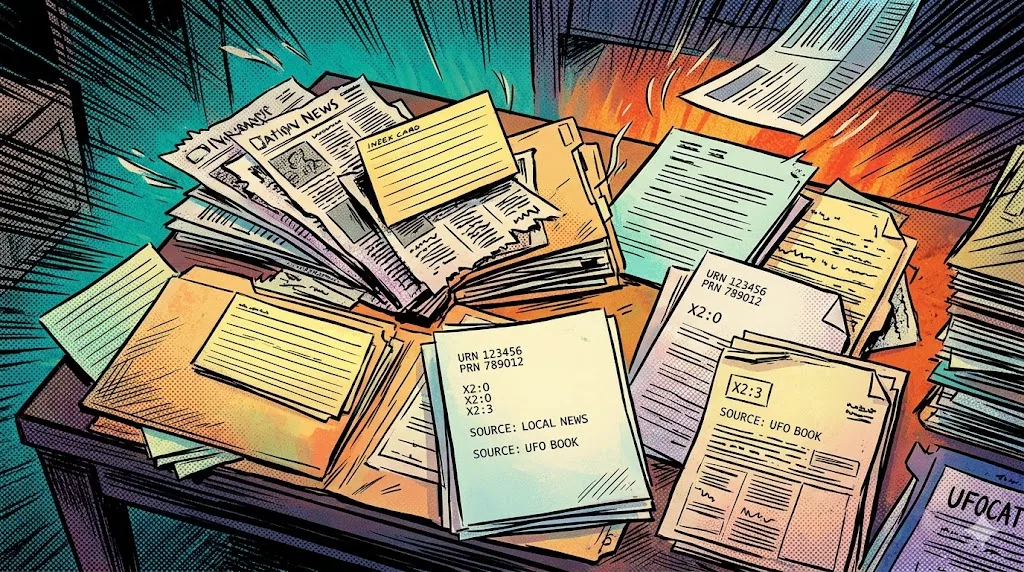
Duplicate records in UFOCAT are not merely accidental data-entry noise. Many are a predictable result of the catalogue’s design. CUFOS gives a simple example: one UFO sighting might have an original case file, an article in a UFO periodical and a description in a UFO book, and UFOCAT may include all three so that a researcher can access the full source trail.[Center for UFO Studies]WikipediaCenter for UFO Studies
The codebook explains this in database terms. Typically, each record reflects one witness or witness group, about one event, as reported through one source. In practice, it adds, witnesses, events and sources are not always cleanly separable. The catalogue therefore tries to preserve what the source actually said, even where the source may contain inaccuracies, while using flags for suspected or known errors.[Center for UFO Studies]WikipediaCenter for UFO Studies
Duplicates can arise in several ways:
One event, multiple publications. A single incident may appear first in a local newspaper, then in an investigator’s file, then in a UFO organisation’s newsletter, then in a later book. Each may contain distinct information or errors.
One object, multiple witnesses. If several witnesses in different places report the same object, some catalogues merge them into one sighting; UFOCAT may preserve them as separate records. Jacques Vallée noted in a workshop paper that both GEiPAN and UFOCAT treat every report of a given case as a separate entry, while other catalogues, such as the Hatch catalogue, use a single entry per sighting.[cnes-geipan.fr]cnes-geipan.fr15 VALLEE full15 VALLEE full
One historical case, uncertain source chain. Older cases may be known through second- or third-hand references. UFOCAT’s indirect-source fields matter because the apparent source may not be the original source.
One location and date, multiple possible events. In waves or heavily publicised periods, several reports can cluster by date and county. Some may be separate observations; others may be repeated accounts of the same stimulus. The catalogue cannot always resolve this perfectly.
The key point is that duplication is partly intentional. UFOCAT tries to preserve source richness before imposing a single cleaned narrative.
The X2 Field: The Reader’s First Guard Against Over-Counting
For anyone trying to count cases rather than trace sources, the X2 field is crucial. CUFOS says preliminary case counts can be produced by selecting records with X2 coded as “0”, because that value identifies primary entries. The codebook gives the same warning in stronger technical terms: X2 identifies the “handedness” or primacy of the record, with “0” marking primary records, “1” marking independent investigations not chosen as primary, “2” marking secondary sources, and “3” marking sources further removed from the original report.[Center for UFO Studies]WikipediaCenter for UFO Studies
The PRN field works with this logic. It points to the record judged to have the most primary source of information for the event, and filtering by that number can retrieve the block of records referring to the same event. The codebook says these blocks contain entries that refer to the same event but are based on different sources, with the earliest report or most complete account treated as the primary record.[Center for UFO Studies]WikipediaCenter for UFO Studies
This is the main difference between a careful UFOCAT count and a misleading one. A raw record count answers: “How many catalogue entries match this query?” A filtered count tries to answer: “How many primary event records match this query?” Those are different numbers, and for historical UFO research the difference can be substantial.
A Concrete Example: Saunders Already Had to Control for Duplicates
The duplicate-record problem is not a modern criticism imposed from outside. David Saunders’ own UFOCAT-based statistical work had to address it. In an analysis of “extrinsic factors in UFO-reporting”, a version of UFOCAT contained 59,237 total entries, but that total included duplicate reports of the same events and reports outside the usable United States county framework. Saunders reduced the usable set to 18,122 entries for the county-level measures he was analysing.[Ufologie]ufologie.patrickgross.orgSource details in endnotes.
Even then, the counting method had to be constrained. The analysis counted no more than one event per county per day for the main UFO-reporting measure, choosing the entry with the highest type code where multiple countable entries existed. Saunders explained that this avoided a larger problem caused by differences in reporting practices among the sources underlying UFOCAT: some sources detailed clusters of reports from one county on one date, while others did not.[Ufologie]ufologie.patrickgross.orgSource details in endnotes.
This example shows why UFOCAT should not be treated as a neutral pile of equal observations. Its entries are shaped by the habits of newspapers, investigators, UFO groups, book authors and database compilers. A county with active newspapers or active investigators may produce more records, not necessarily more anomalous events.
What Source Levels Reveal About Reliability
UFOCAT does not make every source equally strong. Its source-level field helps distinguish kinds of references. The UFOCAT fields summary gives examples: an investigating organisation’s case file may be coded differently from a newspaper source, a first-edition book, a revised book or a database listing without additional information.[Center for UFO Studies]WikipediaCenter for UFO Studies
The 2023 codebook states that lower-numbered source-level codes tend to be closer to primary sources, and that type 3 sources, meaning investigation files, are especially preferred for additions because they are more likely to contain richer case information.[Center for UFO Studies]WikipediaCenter for UFO Studies
This is why source tracing matters more than merely finding a famous case name. Suppose two UFOCAT records describe the same event. One is based on a newspaper paragraph published the next day; another is based on a book published twenty years later; a third is an investigation file with witness interviews. None can be assumed perfect, but they have different evidential weight. The catalogue’s purpose is to keep those distinctions visible.
It also helps researchers identify where a dramatic detail entered the record. If an unusual feature appears only in a later book record but not in earlier newspaper or investigation-file records, that does not automatically disprove it. It does, however, change how cautiously the detail should be used.
The Problem of Preserving Errors on Purpose
One of UFOCAT’s more subtle design choices is that it often preserves the data as given by the source, even when those data are known to be inaccurate. The codebook says this was a principle from earlier versions, with exceptions where an error would cause a major misreading, and with special codes to flag suspected or known inaccuracies.[Center for UFO Studies]WikipediaCenter for UFO Studies
That choice makes sense for a historical source catalogue. If a newspaper got the town name slightly wrong, or a book moved a date by a day, the mistake may be part of the transmission history. Correcting every source into a harmonised modern version would make the data look cleaner but would erase evidence of how the case circulated.
The downside is obvious. A casual spreadsheet user may see several entries with slightly different dates, spellings or locations and treat them as separate sightings. A careful researcher treats those differences as clues. They may indicate duplicate versions, uncertain dating, translation issues, changes from local to national reporting, or real separate events that need to be distinguished.
Best Uses for Historical Research
UFOCAT is strongest when the research question is about provenance, comparison and discovery of sources. It is weaker when the question demands a fully cleaned, de-duplicated population of unique anomalous events.
Its best uses include:
Finding original or earlier sources. UFOCAT can point from a familiar retelling back towards a periodical, file, newspaper item or earlier catalogue reference.
Comparing versions of the same case. Blocks of records can reveal how a case changed as it moved through different sources.
Separating primary and secondary evidence. The X2, PRN, IRN and source-level fields help researchers avoid mixing first-hand investigations with later summaries.
Building cautious statistical samples. Researchers can filter for primary records and then add further controls, as Saunders did when limiting counts by county and date to reduce source-practice distortion.[Ufologie]ufologie.patrickgross.orgSource details in endnotes.
Identifying archival targets. A UFOCAT record may not contain everything needed to evaluate a case, but it can tell a researcher which newspaper, organisation, book or file trail to pursue.
The catalogue is least suitable for simple claims such as “UFOCAT proves there were X sightings” or “this many reports means this many anomalous objects”. CUFOS itself warns that using only UFOCAT risks losing the distinction between poorly investigated reports and exhaustively studied sightings.[Center for UFO Studies]WikipediaCenter for UFO Studies
How to Read a UFOCAT Entry Without Being Misled
A good reading of UFOCAT starts with the source trail, not the dramatic content. The first question is whether the record is primary or secondary. If X2 is “0”, it is treated as the primary record for that event block. If it is “2” or “3”, it is further from the original report and should be used mainly as a pointer unless it adds a clearly identified source.[Center for UFO Studies]WikipediaCenter for UFO Studies
The next question is whether other records share the same PRN. If they do, they are part of a block concerning the same event. This is where UFOCAT becomes useful as a historical tool: the reader can compare what each source says and determine which details are stable across versions.
The third question is what kind of source is being cited. A newspaper item, an organisation file, a book, a revised book and a database listing do not carry the same weight. The source-level and direct-source fields help identify that difference.[Center for UFO Studies]WikipediaCenter for UFO Studies
Finally, the reader should look for missing or flagged information. The codebook says blanks generally indicate missing data or information unknown to the person making the entry, and it asks users to distinguish omissions from errors already flagged as source errors.[Center for UFO Studies]WikipediaCenter for UFO Studies
This is a slower way to read a UFO catalogue, but it is the only way to use UFOCAT responsibly. The catalogue’s great virtue is not that it gives a final answer. It helps the researcher find where the answer would have to come from.
Why UFOCAT’s Messiness Is Part of Its Value
A perfectly clean UFO database would have one row per event, one date, one location, one explanation status and one polished narrative. UFOCAT is not that kind of database. It is closer to a map of documentary survival: what was reported, where it was reported, how it was later reused, and how close each record seems to be to the original observation.
That makes it frustrating for headline counts but valuable for historical work. Duplicate records are not simply clutter. They can show that a case was widely circulated, that multiple witnesses or sources existed, that later accounts depended on earlier ones, or that a famous version is actually far removed from the original documentation.
The proper takeaway is therefore restrained but important: UFOCAT should not be cited as a raw tally of unique UFO incidents. It should be used as a bibliographic and evidential guide, with X2 and PRN used to control duplicate counting and the source fields used to trace each case back towards its earliest recoverable documentation.
Amazon book picks
Further Reading
Books and field guides related to Why UFOCAT Is Not Just a Sighting Count. Use these as the next step if you want deeper reading beyond the article.
The Hynek UFO Report
Useful background for catalogue-based UFO research and case classification.
UFOs and Government
Matches source trails, historical catalogues and official UFO documentation.
The Report on Unidentified Flying Objects
Primary-style account of early official UFO reporting and case handling.
The UFO Experience
Explains case categories and research methods behind historical UFO cataloguing.
eBay marketplace picks
Marketplace Samples
Example marketplace items related to this page. Use the search link to explore similar finds on eBay.


Endnotes
1.
Source: cufos.org
Title: Center for UFO Studies UFOCAT
Link:https://cufos.org/cufos-publications-databases/ufocat/
2.
Source: cufos.org
Title: Center for UFO Studies
Link:https://cufos.org/PDFs/UFOCAT%20Codebook%202023.pdf
3.
Source: cufos.org
Title: Center for UFO Studies
Link:https://cufos.org/PDFs/pdfs/UFOCAT%20fields.pdf
4.
Source: cnes-geipan.fr
Title: 15 VALLEE full
Link:https://www.cnes-geipan.fr/sites/default/files/15_VALLEE_full.pdf
5.
Source: cufos.org
Link:https://cufos.org/resources/ufo-catalogues/
6.
Source: cufos.org
Link:https://cufos.org/PDFs/books/UFO_REPORTS_INVOLVING_VEHICLE_INTERFERENCE.pdf
7.
Source: cufos.org
Link:https://cufos.org/PDFs/CUFOS_Associate_Newsletter/AN1_1.pdf
8.
Source: cufos.org
Link:https://cufos.org/PDFs/JUFOS/1980_OS_vol2_JUFOS.pdf
9.
Source: ufocat.com
Link:https://ufocat.com/
10.
Source: colorado.edu
Link:https://www.colorado.edu/coloradan/2021/11/05/condon-report-cu-boulders-historic-ufo-study
11.
Source: cnes-geipan.fr
Link:https://www.cnes-geipan.fr/sites/default/files/UFO_Waves.An_International_Bibliography__November__1_2015.pdf
12.
Source: ufologie.patrickgross.org
Link:https://ufologie.patrickgross.org/htm/saundersefur.htm
13.
Source: ufologie.patrickgross.org
Link:https://ufologie.patrickgross.org/bio/saunders.htm
14.
Source: Wikipedia
Title: Center for UFO Studies
Link:https://en.wikipedia.org/wiki/Center_for_UFO_Studies
15.
Source: Wikipedia
Title: Condon Committee
Link:https://en.wikipedia.org/wiki/Condon_Committee
16.
Source: jstor.org
Link:https://www.jstor.org/stable/1296963
17.
Source: jstor.org
Link:https://www.jstor.org/stable/1725090
18.
Source: encyclopedia.com
Link:https://www.encyclopedia.com/science-and-technology/technology/aviation-general/ufo
Additional References
19.
Source: youtube.com
Title: UFO & UAP “Need to Know” News Documentary with Coulthart & Zabel
Link:https://www.youtube.com/watch?v=pSZUBulON6I
Source snippet
Dr. David Saunders and the University of Colorado UFO Project History...
20.
Source: youtube.com
Title: Dr. David Saunders and the University of Colorado UFO Project History
Link:https://www.youtube.com/watch?v=8R34a9_sRKQ
Source snippet
Project [Blue Book]({{ 'blue-book/' | relative_url }}) Archive Files and Database Anomalies...
21.
Source: cia.gov
Link:https://www.cia.gov/readingroom/docs/CIA-RDP81R00560R000100010008-3.pdf
22.
Source: cia.gov
Link:https://www.cia.gov/readingroom/docs/DOC_0000042346.pdf
23.
Source: youtube.com
Title: Exploring the Center for UFO Studies Historical Records
Link:https://www.youtube.com/watch?v=E-b0LwW0I6Q
Source snippet
Scientific Principles of UAP Data Collection and Duplicate Traps...
24.
Source: youtube.com
Title: Project Blue Book Archive Files and Database Anomalies
Link:https://www.youtube.com/watch?v=k_F9RscL25o
Source snippet
Exploring the Center for UFO Studies Historical Records...
25.
Source: researchgate.net
Link:https://www.researchgate.net/publication/371163445_The_Scientific_Investigation_of_Unidentified_Aerial_Phenomena_UAP_Using_Multimodal_Ground-Based_Observatories
26.
Source: academia.edu
Link:https://www.academia.edu/71337593/UFOs_and_the_extraterrestrial_contact_movement_a_bibliography
27.
Source: researchgate.net
Link:https://www.researchgate.net/publication/252518312_Time-Series_Analysis_of_a_Catalog_of_UFO_Events_Evidence_of_a_Local-Sidereal-Time_Modulation
28.
Source: ufo-com.net
Link:https://www.ufo-com.net/_pics/vik_gajd/vallee_sysclassif.pdf
Topic Tree
Follow this branch
Parent topic
UFO ArchivesRelated pages 14
- AARO Why AARO Cases Remain Unresolved
- Archives Finding Original UFO Records in Archives
- Blue Book What Project Blue Book Records Still Reveal
- Clusters Why UFO Sightings Cluster on the Map
- Duplicates How One UFO Sighting Becomes Many Records
- Enigma Can a UFO App Fix Old Data Problems?
- GEIPAN How France Classifies Public UAP Cases
- Misidentifications Why Ordinary Objects Fill UFO Databases
- +6 more in sidebar
- Duplicate Case Studies Historical UFOCAT Case Studies Addressing Duplicate Entries
- Duplicate Rationale Why UFOCAT Intentionally Keeps Duplicate UFO Records
- Primary Records How X2 and PRN Codes Identify Primary UFOCAT Entries
- Source Reliability How UFOCAT Source Levels Reveal Report Reliability
- Source Versions Why UFOCAT Keeps Multiple Source Versions of UFO Events