Within UFO Archives
Why NASA Wants Better UAP Data
NASA's UAP work highlights why repeatable measurements, sensor context, and calibration matter more than dramatic counts.
On this page
- Scientific evidence standards
- Sensor and calibration problems
- How better reporting could help
Page outline Jump by section
Introduction
NASA’s UAP study matters to UFO report databases and catalogues because it shifts the question from “how many sightings are listed?” to “what kind of data would let anyone test what was seen?” The 2023 NASA-commissioned independent study did not present a new catalogue of solved UFO cases. It argued that current UAP evidence is usually too thin for strong scientific conclusions because reports often lack calibrated sensors, multiple simultaneous measurements, baseline data and contextual metadata.[NASA Science]science.nasa.govNASA Science…
That makes NASA’s contribution less dramatic but more important: it treats UAP reporting as a data-quality problem. A useful UAP database should not merely store narratives, shapes and dates. It should preserve the conditions under which an observation was made, the instruments involved, their limitations, the local environment, possible known objects in the area, and the uncertainty attached to each interpretation. For readers comparing UFO report databases, NASA’s work is a reminder that scientific value comes from repeatability, calibration and context, not from large sighting counts alone.
Why NASA’s UAP study was really about evidence quality
NASA announced its UAP independent study in 2022 as a way to examine unidentified anomalous phenomena from a scientific perspective, focusing on what data already existed, what new data should be collected, and which analysis methods could move understanding forward. The study’s statement of task asked about NASA and civilian government datasets, non-profit and commercial datasets, future data collection, analysis techniques, physical constraints, civilian airspace data, and reporting protocols.[NASA Science]science.nasa.govNASA Science…
The final report’s central finding was not that existing UAP catalogues contain a hidden answer. It was that existing records are often not the right kind of evidence. The report says that despite many accounts and images, the absence of “consistent, detailed, and curated observations” means there is not yet a sufficient body of data for definitive scientific conclusions. It also states that NASA’s independent study was a roadmap for future usable data, not a re-investigation of past incidents.[NASA Science]science.nasa.govNASA Science…
This is a crucial distinction for UFO databases. A civilian database such as NUFORC can be valuable as a public reporting archive, and NUFORC describes its databank as the largest independently collected online set of UFO/UAP sighting reports. But a large public archive is not the same thing as a calibrated scientific dataset. NUFORC-style records can show patterns in public reporting, but they often cannot establish distance, speed, size, sensor reliability or whether a known object was present at the same time.[nuforc.org]nuforc.orgData Bank | NUFORCData Bank | NUFORC
NASA’s standard is closer to the one used in mature observational sciences: preserve the original measurement, document the instrument, record the context, compare with known baselines, and make uncertainty visible. In UAP work, that means a report should ideally connect witness testimony with time-synchronised optical, infrared, radar or other sensor data, plus aircraft tracks, satellite positions, weather, astronomical conditions and instrument settings. Without that supporting context, “unidentified” may simply mean “insufficiently documented”.
What counts as scientific evidence for UAP?
NASA’s report repeatedly points to one practical principle: a UAP observation becomes more scientifically useful when it is measured in several ways at once. A single blurry image, a short narrative report or an isolated radar return may still be worth preserving, but it is hard to analyse in isolation. The report says the importance of detecting UAP with multiple, well-calibrated sensors is “paramount”, and specifically mentions the potential value of multispectral or hyperspectral data as part of a rigorous acquisition campaign.[NASA Science]science.nasa.govNASA Science…
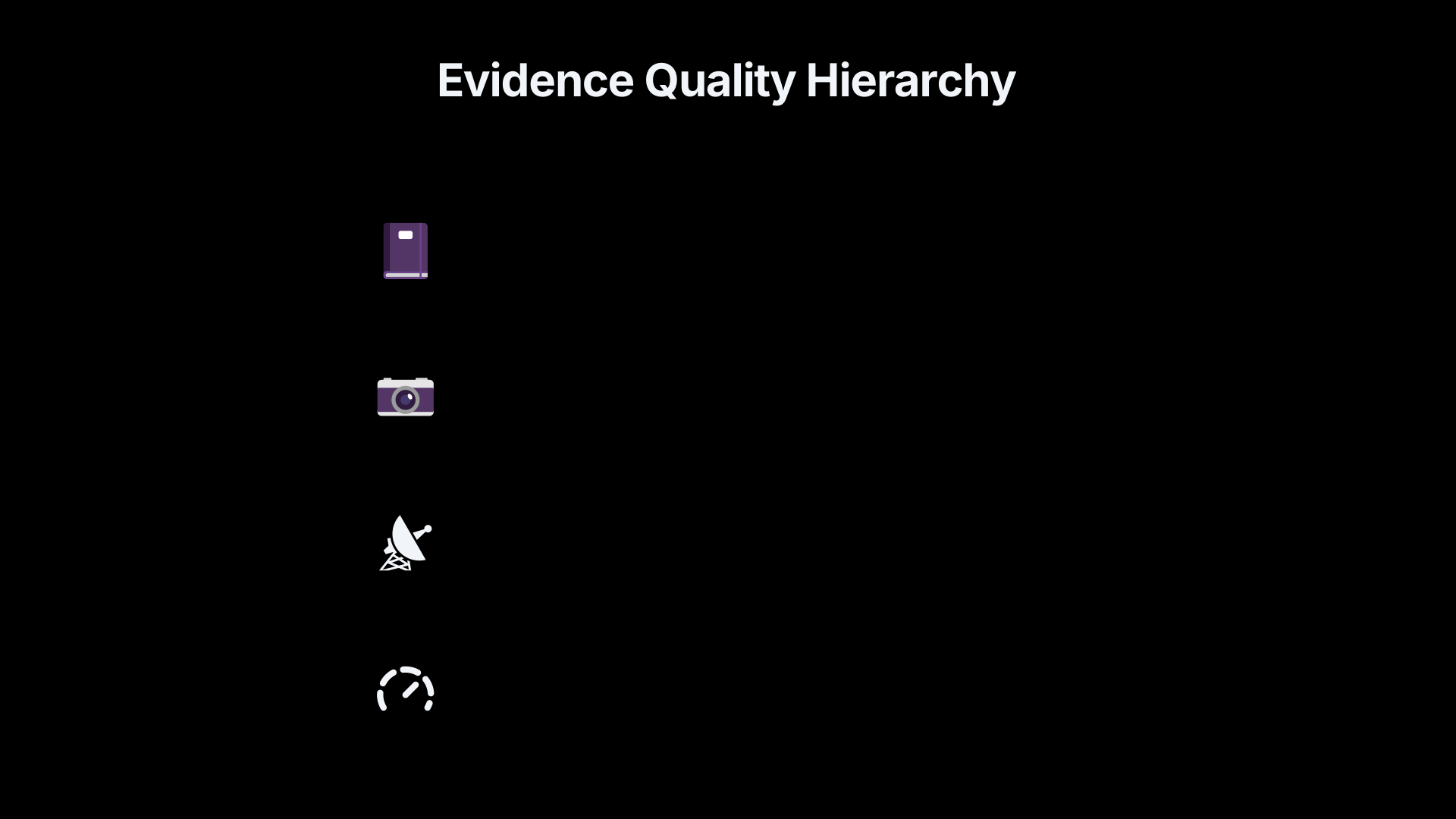
For a UFO database or catalogue, that implies a hierarchy of evidential value:
- Narrative-only reports can help track public perception, reporting waves, location clusters and witness descriptions, but they rarely allow strong physical conclusions.
- Single-sensor records are stronger, but still vulnerable to instrument artefacts, range uncertainty, glare, parallax, compression, tracking errors or missing calibration.
- Multi-sensor, time-synchronised cases are much more useful because one measurement can test another: optical footage can be checked against radar, infrared imagery against weather, witness direction against aircraft or satellite data.
- Well-curated cases with metadata are the strongest because analysts know not only what was recorded, but how, where, when, by what system, under what conditions, and with what uncertainty.
NASA’s report also explains why artificial intelligence and machine learning are not shortcuts around bad evidence. It says AI and machine learning can help identify rare occurrences in very large datasets, but only when the data are well-characterised and collected to strong standards. At present, the report says UAP analysis is more limited by data quality than by a shortage of analysis techniques.[NASA Science]science.nasa.govNASA Science…
That matters because it undercuts a common misconception about UFO catalogues: that enough reports will automatically reveal the truth. Machine learning can find patterns, but it can also learn the biases of the reporting system. If a database is dominated by military training ranges, urban night-time sightings, publicity-driven reporting spikes or vague civilian submissions, an algorithm may discover the structure of the archive rather than the nature of the phenomenon.
The sensor problem: why cameras and radar are not automatically decisive
NASA’s study treats sensors as essential but not magical. A camera, radar, infrared system or satellite image is only as useful as the information that accompanies it. The report states that UAP analysis is hampered by poor sensor calibration, lack of multiple measurements, lack of sensor metadata and lack of baseline data.[NASA Science]science.nasa.govNASA Science…
Sensor metadata means the supporting information needed to interpret the measurement: sensor type, settings, pointing direction, time of acquisition, noise characteristics, platform motion, calibration state and other contextual details. Without it, a recorded object may look fast, close or unusual when the underlying problem is actually distance ambiguity, camera motion, glare, compression, atmospheric distortion or an artefact of the instrument.
The All-domain Anomaly Resolution Office, or AARO, has made a similar point from the defence side. Its FY2023 annual report says many unresolved cases result from gaps in domain awareness, insufficient data from radar and electro-optical or infrared sensors, sensor artefacts such as infrared flare, and optical effects such as parallax. It also says better data quality will probably resolve many unidentified cases to ordinary phenomena.[AARO]aaro.milSource details in endnotes.
NASA’s final report gives one concrete example of the kind of case that remains weak without context: the “Middle East Object”, footage from an MQ-9 showing an apparent silver, orb-like object. The report notes that, due to limited data, the object remains unidentified. The point is not that the object is extraordinary; it is that the available record is not rich enough to identify it confidently.[NASA Science]science.nasa.govNASA Science…
This is why scientific UAP data standards must ask boring but decisive questions: Was the sensor calibrated? What was its field of view? What was the range to the target? Was the platform moving? Were there simultaneous observations? What were the local weather and lighting conditions? Were aircraft, balloons, drones or satellites in the area? A database that cannot answer those questions can still be historically useful, but it cannot do the work that many readers expect from the word “evidence”.
Baseline data: knowing the ordinary before judging the anomalous
One of NASA’s most important ideas is baseline data: records of what ordinary objects and known phenomena look like under the same observational conditions. The report says that before searching for the abnormal, analysts need systematic calibration observations of the normal. It mentions solar glint and balloons as examples of “normal” phenomena that AARO has begun studying as they appear to military sensors.[NASA Science]science.nasa.govNASA Science…
This is a major issue for UFO catalogues because many reports are labelled by what they were not recognised as, rather than by what they were tested against. A witness may not recognise a satellite train, a drone formation, a balloon, a meteor, aircraft landing lights or an atmospheric effect. A sensor operator may see something unfamiliar because the system was designed for another mission. A good scientific database therefore needs comparison libraries: what known objects look like to different sensors at different distances, angles, altitudes, speeds, weather conditions and lighting geometries.
AARO’s FY2023 report describes a sensor calibration campaign to measure known objects often reported as UAP, including hobbyist and commercial balloons, unmanned aircraft systems and natural phenomena. The resulting data are intended for models used in pilot training and algorithm development.[AARO]aaro.milSource details in endnotes.
A 2024 study of a commercial aviation sighting over the Pacific gives a useful example of why baseline reconstruction matters. Multiple pilots reported unusual lights; later analysis used Starlink satellite orbital data and aircraft ADS-B data to reconstruct what the satellites would have looked like from the cockpit. The paper argued that better space situational awareness could help warn aviators and reduce misidentification of newly launched satellite trains.[arXiv]arxiv.orgSource details in endnotes.
For UAP databases, this means the most useful future records will not simply say “object observed”. They will also say what ordinary explanations were checked, what reference catalogues were consulted, and how strongly each explanation fits. The absence of a prosaic explanation should be treated as a documented analytic state, not as a dramatic conclusion.
NASA’s role: not the UFO police, but a standards builder
NASA’s study places the agency inside a wider government framework rather than making it the lead investigator of every UAP case. AARO remains the principal US government office for UAP resolution, while NASA’s strengths are scientific credibility, public communication, data curation, Earth observation, advanced analysis and experience with calibrated instruments.[NASA Science]science.nasa.govNASA Science…
This division of labour matters. Much UAP information connected to defence or intelligence systems may be classified, sensor-limited or collected for missions unrelated to science. NASA’s comparative advantage is not secrecy; it is transparent scientific method. NASA’s public release said the independent team recommended using the agency’s open-source resources, technological expertise, data analysis techniques, partnerships and Earth-observing assets to curate a more robust dataset for future UAP understanding.[NASA]science.nasa.govNASA Science…
NASA’s Earth-observing satellites are not presented as perfect UAP detectors. The report notes that they often lack the spatial resolution to detect relatively small UAP directly, but can be valuable for examining local Earth, oceanic and atmospheric conditions at the time and place of a reported event. Commercial remote-sensing satellites, with higher resolution in some cases, could complement this when coincident collection happens.[NASA Science]science.nasa.govNASA Science…
That is a subtle but useful role for UAP catalogues. A case record should not only preserve the alleged object; it should connect the event to environmental datasets. Was there lightning, cloud, temperature inversion, smoke, aurora, marine layer, high-altitude wind, unusual illumination, or known satellite activity? NASA’s report even uses images of natural atmospheric phenomena such as red sprites and von Karman vortices to show why strange-looking events can be real, striking and natural.[NASA Science]science.nasa.govNASA Science…
How better reporting could change UFO databases
NASA’s report identifies a major weakness in civilian UAP reporting: there is no standardised federal system for public civilian reports, producing sparse and incomplete data without consistent curation or vetting. It recommends that NASA assist AARO in developing a federal civilian reporting system and explore crowdsourcing tools, such as open-source smartphone apps that collect imaging data together with phone sensor metadata from multiple observers.[NASA Science]science.nasa.govNASA Science…
This would be a different kind of database from a traditional witness-submission catalogue. A scientifically useful reporting system would ask for structured information and capture device data automatically where possible. It would not rely only on a witness remembering the direction, time, elevation, motion and duration after the event. A smartphone-based system could potentially record timestamp, GPS location, compass direction, camera settings and sensor motion, although privacy, data integrity and false-positive filtering would need careful design.
NASA also pointed to the Aviation Safety Reporting System, or ASRS, which it administers for the US Federal Aviation Administration. ASRS is a confidential, voluntary and non-punitive aviation safety reporting system that captures reports and analyses safety data for the aviation community. NASA’s report says ASRS receives about 100,000 reports per year and could be better harnessed for commercial pilot UAP reporting.[NASA Science]science.nasa.govNASA Science…
The appeal of ASRS is not that pilot reports are automatically correct. It is that aviation already has a safety-reporting culture with structured submission channels, confidentiality protections and operational context. UAP reporting can be improved by borrowing from safety systems: reduce stigma, collect timely information, protect reporters from ridicule or punishment, and focus on hazard identification rather than spectacle.

What a NASA-influenced UAP record would include
A NASA-style UAP entry would look less like a dramatic sighting story and more like an observational packet. It would still include human testimony, but the testimony would sit inside a wider evidence structure.
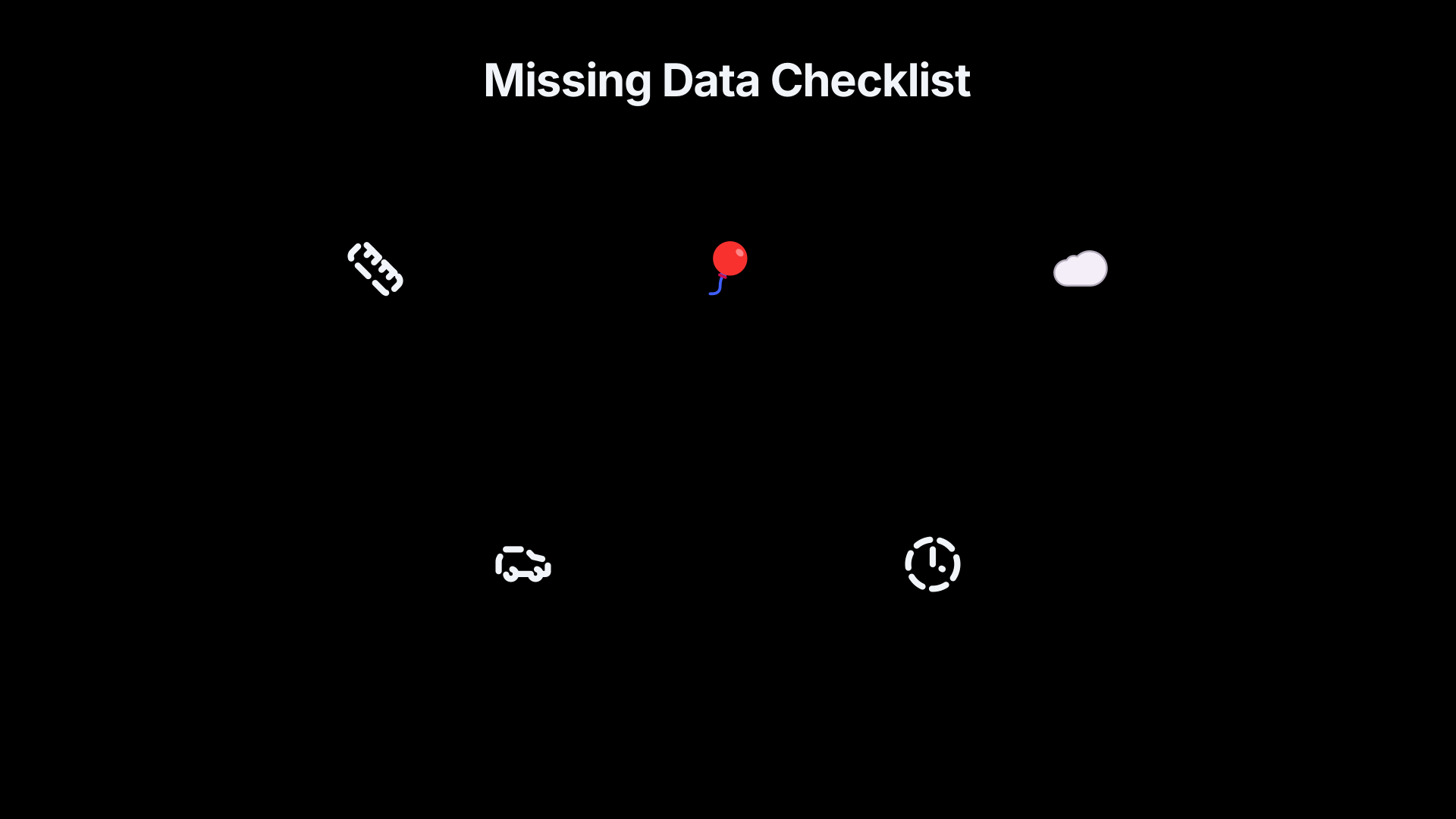
A strong record would include:
- Time and location precision: exact timestamp, timezone, observer location, viewing direction, elevation angle and duration.
- Instrument details: device type, sensor model, settings, resolution, frame rate, calibration state and known limitations.
- Platform context: whether the observer was stationary, in a car, on a ship, in an aircraft or using a moving sensor platform.
- Environmental context: weather, visibility, cloud, wind, atmospheric effects, lightning, astronomical conditions and local light pollution.
- Air and space traffic checks: aircraft tracks, drone activity where available, satellite passes, balloon launches, rocket activity and meteor data.
- Multi-observer links: whether other witnesses or sensors recorded the event from different positions.
- Analysis status: what explanations were tested, what data are missing, what remains unresolved, and how confident analysts are.
The most important change is that uncertainty becomes part of the record. Instead of a binary choice between “explained” and “mysterious”, a scientific catalogue can distinguish cases that are probably aircraft, probably satellites, unresolved because of insufficient data, unresolved despite good data, or genuinely interesting because they appear to exceed known performance after distance and sensor issues have been constrained.
Why sighting counts can mislead
NASA’s approach also challenges the way UFO databases are often discussed in public. A database with tens of thousands of entries can look more persuasive than a smaller curated archive, but sighting counts are not evidence counts. They are shaped by reporting culture, population density, media attention, aircraft traffic, satellite visibility, weather, smartphone use and the design of the reporting form.
Research using NUFORC data illustrates this caution. A 2023 environmental analysis of public UAP sightings used NUFORC reports to examine how local environmental and sky-viewing conditions relate to reports. Such work shows the value of large public datasets, but it also treats the reports as observations of reporting behaviour and environmental association, not as a simple inventory of anomalous objects.[PMC]pmc.ncbi.nlm.nih.govSource details in endnotes.
AARO’s reporting also shows why counts need context. Its FY2023 annual report said it had received 291 UAP reports for the covered period, with most reports still reflecting a collection bias towards restricted military airspace, although FAA reporting from commercial pilots had broadened the geographic distribution. The same report says AARO had 801 total reports as of 30 April 2023, but also emphasises that many cases remain unresolved because of insufficient data.[AARO]aaro.milSource details in endnotes.
The lesson for UFO catalogues is direct: a good database should show where reports come from, who is likely to report, what sensors were available, what areas are overrepresented, and what kinds of events are easier or harder to capture. Without that, a map of sightings may partly be a map of people, flight routes, military sensors, publicity and database access.
The practical standard: make reports testable
NASA’s UAP study does not settle the UFO question. Its value is that it gives databases and catalogues a better yardstick. A report is stronger when another analyst can test it against independent data. It is weaker when the original observation cannot be reconstructed, the sensor cannot be characterised, the range is unknown, or normal comparison objects were never checked.
For UAP databases, the scientific direction is clear. Preserve original reports, but do not treat every entry as equal. Separate raw witness submissions from curated cases. Record missing data explicitly. Link cases to environmental, aviation and space-object datasets. Use confidence levels rather than sensational labels. Prioritise multi-sensor and multi-observer cases. Build baseline libraries of ordinary objects. Make metadata as important as the sighting description.
That approach may reduce the number of dramatic “unknowns”, because many entries will become explainable or too incomplete to support strong claims. But it would increase the value of the remaining cases. In the long run, NASA’s contribution to UAP research may be less about finding a spectacular object than about changing what a serious UFO database is expected to prove.
Amazon book picks
Further Reading
Books and field guides related to Why NASA Wants Better UAP Data. Use these as the next step if you want deeper reading beyond the article.

UFOs : Generals, Pilots, and Government Officials Go on the R...
Provides credible UAP case context while NASA’s data-quality approach explains what such cases still need scientifically.
The Signal and the Noise
Supports the NASA UAP theme that raw observations need context, calibration and methods to separate signal from noise.
The UFO Experience
Directly complements NASA’s focus on improving the quality of observations and evidence before drawing conclusions.
The Demon-Haunted World
Rating: 4.5/5 from 43 Google Books ratings
Strongly fits NASA’s emphasis on evidence standards, testability and careful scientific reasoning about extraordinary claims.
eBay marketplace picks
Marketplace Samples
Example marketplace items related to this page. Use the search link to explore similar finds on eBay.

Endnotes
1.
Source: science.nasa.gov
Link:https://science.nasa.gov/wp-content/uploads/2023/09/uap-independent-study-team-final-report.pdf
Source snippet
NASA Science...
2.
Source: nasa.gov
Title: update nasa shares uap independent study report names director
Link:https://www.nasa.gov/news-release/update-nasa-shares-uap-independent-study-report-names-director/
Source snippet
UPDATE: NASA Shares UAP Independent Study Report14 Sept 2023 — We found that NASA can help the whole-of-government UAP effort through...
3.
Source: science.nasa.gov
Link:https://science.nasa.gov/uap/
Source snippet
NASA ScienceUAPJune 16, 2022 — 9 Jun 2022 — The UAP Independent Study shall report on the following questions: What types of scientific d...
Published: June 16, 2022
4.
Source: nuforc.org
Title: Data Bank | NUFORC
Link:https://nuforc.org/databank/
5.
Source: pmc.ncbi.nlm.nih.gov
Link:https://pmc.ncbi.nlm.nih.gov/articles/PMC10721628/
6.
Source: aaro.mil
Link:https://www.aaro.mil/Portals/136/PDFs/UNCLASSIFIED-FY23_Consolidated_Annual_Report_on_UAP-Oct_25_2023_1236.pdf
7.
Source: arxiv.org
Link:https://arxiv.org/abs/2403.08155
8.
Source: asrs.arc.nasa.gov
Link:https://asrs.arc.nasa.gov/
9.
Source: science.nasa.gov
Link:https://science.nasa.gov/uap/faqs/
10.
Source: nasa.gov
Title: to release discuss unidentified anomalous phenomena report
Link:https://www.nasa.gov/news-release/nasa-to-release-discuss-unidentified-anomalous-phenomena-report/
11.
Source: nasa.gov
Title: public participation in machine learning bolsters extraterrestrial research
Link:https://www.nasa.gov/directorates/stmd/prizes-challenges-crowdsourcing-program/public-participation-in-machine-learning-bolsters-extraterrestrial-research/
12.
Source: space.com
Title: nasa ufo uap study team first results revealed
Link:https://www.space.com/nasa-ufo-uap-study-team-first-results-revealed
13.
Source: space.com
Title: nasa names head of uap research
Link:https://www.space.com/nasa-names-head-of-uap-research
14.
Source: nature.com
Link:https://www.nature.com/articles/d41586-023-02893-y
15.
Source: nature.com
Link:https://www.nature.com/articles/s41599-024-04182-z
16.
Source: arxiv.org
Link:https://arxiv.org/pdf/2403.15368
17.
Source: arxiv.org
Link:https://arxiv.org/html/2411.02401v1
18.
Source: arxiv.org
Link:https://arxiv.org/html/2506.00125v1
Additional References
19.
Source: youtube.com
Title: Replay! NASA’s Release of the Unidentified Anomalous Phenomena Report
Link:https://www.youtube.com/watch?v=nuBMnluJfs0
Source snippet
UAP Independent Study Event Post-Meeting Media Teleconference (May 31, 2023)...
Published: May 31, 2023
20.
Source: youtube.com
Title: Public Meeting on Unidentified Anomalous Phenomena (Official NASA Broadcast)
Link:https://www.youtube.com/watch?v=bQo08JRY0iM
Source snippet
Unidentified Anomalous Phenomena Independent Study Report...
21.
Source: youtube.com
Title: UAP Independent Study Event Post-Meeting Media Teleconference (
Link:https://www.youtube.com/watch?v=C3uXUfgSadU
Source snippet
NASA releases independent report on UAPS...
Published: May 31, 2023
22.
Source: youtube.com
Title: Unidentified Anomalous Phenomena Independent Study Report
Link:https://www.youtube.com/watch?v=TQcqOW39ksk
Source snippet
Replay! NASA's Release of the Unidentified Anomalous Phenomena Report...
23.
Source: facebook.com
Link:https://www.facebook.com/thesocialctv/posts/nasa-has-released-a-report-detailing-how-it-tracks-unidentified-anomalous-phenom/850192826467495/
24.
Source: researchgate.net
Link:https://www.researchgate.net/publication/391817538_Initial_results_from_the_first_field_expedition_of_UAPx_to_study_unidentified_anomalous_phenomena
25.
Source: facebook.com
Link:https://www.facebook.com/NewsNationNow/posts/a-video-sharing-platform-run-by-[enigma
26.
Source: aiaa.org
Link:https://aiaa.org/wp-content/uploads/2025/08/AIAA-UAPIOC-Opinion-Paper-UAP-Occupational-Safety-Reporting_ForPublication_kb.pdf
27.
Source: facebook.com
Link:https://www.facebook.com/cnnnews18/posts/if-you-have-ever-wondered-what-the-pentagon-actually-knows-about-unidentified-an/1601269648709339/
28.
Source: science.gc.ca
Link:https://science.gc.ca/site/science/en/office-chief-science-advisor/sky-canada-project/management-public-reporting-unidentified-aerial-phenomena-canada
Topic Tree
Follow this branch
Parent topic
UFO ArchivesRelated pages 14
- AARO Why AARO Cases Remain Unresolved
- Archives Finding Original UFO Records in Archives
- Blue Book What Project Blue Book Records Still Reveal
- Clusters Why UFO Sightings Cluster on the Map
- Duplicates How One UFO Sighting Becomes Many Records
- Enigma Can a UFO App Fix Old Data Problems?
- GEIPAN How France Classifies Public UAP Cases
- Misidentifications Why Ordinary Objects Fill UFO Databases
- +6 more in sidebar