Within Public vs Official
Why UFO report counts never match
Public sighting totals and official UAP case counts measure different reporting pipelines, so direct comparisons can mislead readers.
On this page
- What each count actually measures
- How self selection and institutional filters change totals
- How to compare numbers without overclaiming
Page outline Jump by section
Introduction
Public UFO sighting totals and official UAP case counts often appear wildly different not because one is “true” and the other “false,” but because they measure different kinds of events in different reporting systems with distinct purposes, criteria, and pipelines. Large civilian databases record tens of thousands of self‑submitted eyewitness accounts, whereas government UAP records typically catalogue only a few hundred formally processed cases drawn from official channels and narrow mission priorities. Understanding why these counts never match helps a reader avoid misleading comparisons and misinterpretations, and clarifies what each set of numbers actually represents.
What Each Count Actually Measures
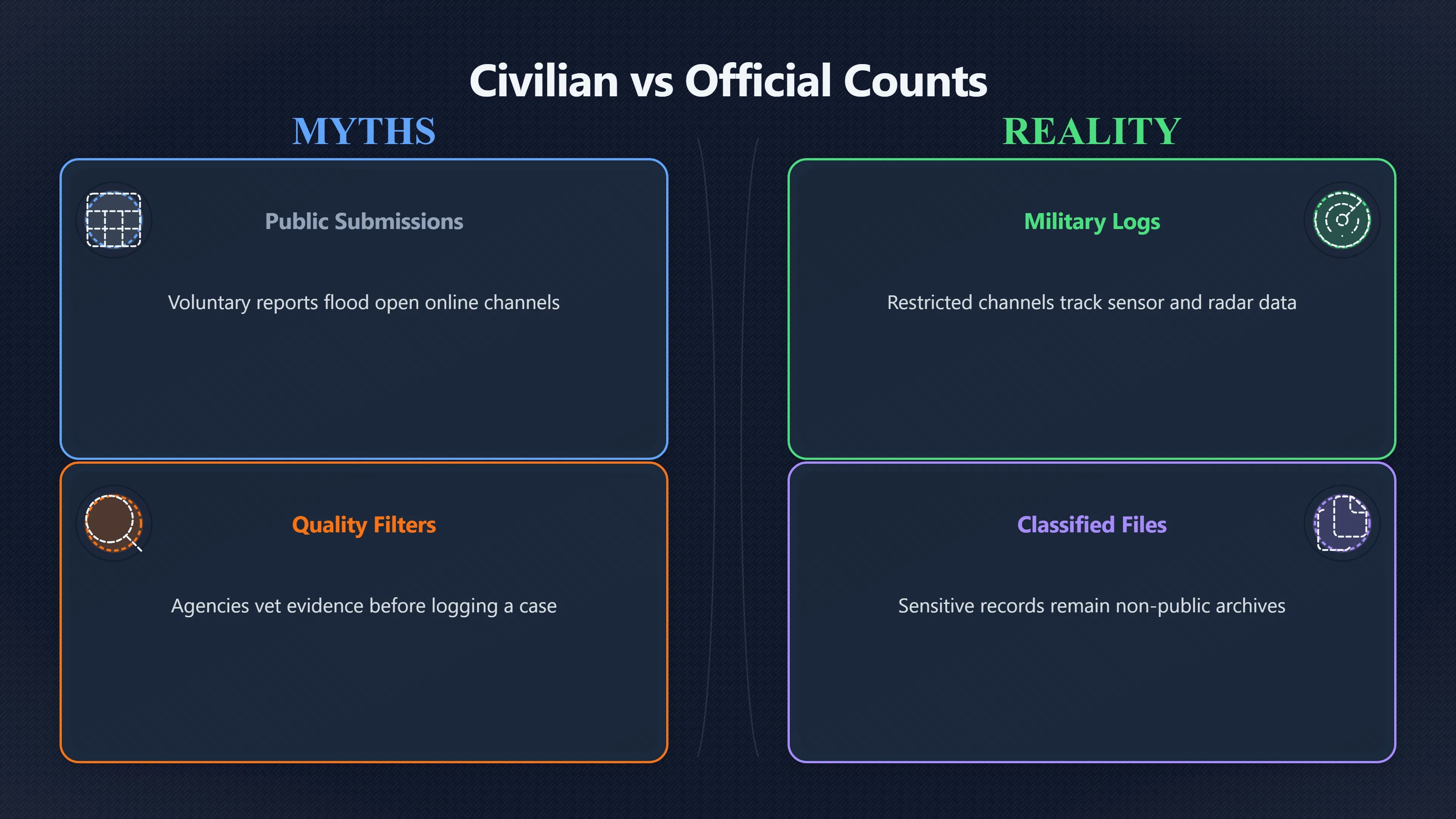
Civilian sighting totals — such as those in the National UFO Reporting Center archive — are built from voluntary reports from the public submitted via online forms, hotlines and other open channels. Over decades, this has yielded many tens of thousands of submitted narratives, each reflecting a witness’s perception of something unusual in the sky, whether or not that object was ever sensor‑tracked or physically corroborated. These tallies include brief notes, single‑witness accounts, and submissions lacking precise localisation or confirming data; many duplicate observations from different witnesses also exist in the collection.[UAPedia]uapedia.aiUnlocking New Realities NUFORC & MUFON: Civilian Data SourcesUnlocking New RealitiesNUFORC & MUFON: Civilian Data Sources - UAPediaNovember 7, 2025… - Unlocking New Realities
Official UAP case counts kept by government bodies — such as the U.S. Department of Defence’s All‑domain Anomaly Resolution Office (AARO) or historical military reporting systems — represent a much narrower subset of events. These are instances that have been recorded through structured institutional reporting channels (e.g., military reports, aviation safety systems, radar logs), vetted for procedural completeness, and logged into controlled archives. A notable example is the U.S. intelligence reports to Congress that covered around 144 or 510 UAP incidents documented from military sensors and formal mechanisms over specific multi‑year periods.[PMC]pmc.ncbi.nlm.nih.govPMCAn environmental analysis of public UAP sightings and sky view potentialDecember 14, 2023…
The difference in scope is fundamental: civilian totals count raw submissions, whereas official numbers count processed, verified or actionable cases — often with accompanying sensor data or testimonial traceability.
How Self‑Selection and Institutional Filters Change Totals
The civilian reporting environment is inherently self‑selecting. Members of the public report based on interest, perception, and motivation; high media attention or cultural events often spur spikes in submissions. Civil databases accept any report fitting their criteria and make it part of the public record, regardless of evidence quality. This generates large yearly totals (e.g., several thousand in some NUFORC estimates) and long historical series.[AnythingCounter]anythingcounter.comSource details in endnotes.
Government reporting is governed by institutional filters:
- Restricted reporting pathways: Official systems often require specific roles, training, or procedural channels. For example, military personnel and aviation professionals must report through command structures rather than public forms. Many commercial pilots and air traffic controllers are still encouraged to use civilian reporting channels for UAP sightings because the FAA does not maintain its own central UFO/UAP catalogue.[Forbes]forbes.comThe FAA Does Not Track UFO Sightings By Commercial Airline Pilots—But Here’s Who DoesJune 26, 2021…
- Quality and corroboration criteria: Agencies often prioritise reports with corroborative evidence (e.g., multi‑sensor data, radar tracks, cross‑checked witness statements) over anecdotal reports. Cases lacking detailed metadata or which cannot be verified are less likely to be counted in official tallies.
- Classified material: Many official reports remain non‑public or classified, particularly those relating to national security or sensitive sensor platforms. This means that the published official total may only represent a fraction of all internally logged cases.
- Administrative overhead and processing thresholds: Government systems may require administrative verification, de‑duplication, and formal investigation to treat an event as a “case” at all, whereas public databases often publish immediately after basic filtering. This reduces official counts compared with public totals.
These filters systematically reduce the number of events that appear in official tallies relative to the much broader sea of civilian submissions.
How to Compare Numbers Without Overclaiming
Because the two count systems reflect different reporting pipelines, direct numerical comparisons can mislead:
- Terminology matters: A “report” in a public UFO database is not equivalent to an “official UAP case” — the former has minimal vetting, the latter often has formal investigation attached.
- Different denominators: Civil databases measure self‑reported sightings; official counts measure cases that have entered a procedural reporting and (sometimes) investigation framework.
- Contextualise before you cite: Saying “there are 100,000 UFO sightings vs 500 official UAP cases” makes little sense without explaining the reporting mechanisms behind those numbers. One is a catalogue of public perceptions, the other is a constrained set filtered through institutional criteria.
A more useful comparison frames the numbers by methodology and purpose rather than bare totals: what triggers reporting, what level of evidence is required, and what each dataset is used for. This avoids overclaiming based on sheer count differences.
By recognising that public counts and official case totals reflect separate parts of the broader reporting ecosystem, a reader can better interpret what large civilian sighting numbers signify (public interest, perception patterns, reporting hotspots) and what official tallies indicate (incidents reaching formal documentation and investigation thresholds).
Amazon book picks
Further Reading
Books and field guides related to Why UFO report counts never match. Use these as the next step if you want deeper reading beyond the article.

UFOs : Generals, Pilots, and Government Officials Go on the R...
Excellent fit for comparing public and official UFO reporting systems.
UFOs and Government
Explains how official case counts differ from public reporting totals.
The Report on Unidentified Flying Objects
Shows how official investigative counts and classifications were produced.
eBay marketplace picks
Marketplace Samples
Example marketplace items related to this page. Use the search link to explore similar finds on eBay.




Endnotes
1.
Source: uapedia.ai
Title: Unlocking New Realities NUFORC & [MUFON]({{ ‘mufon/’ | relative_url }}): Civilian Data Sources
Link:https://www.uapedia.ai/wiki/nuforc-mufon-civilian-data-sources/
Source snippet
Unlocking New RealitiesNUFORC & MUFON: Civilian Data Sources - UAPediaNovember 7, 2025...
Published: November 7, 2025
2.
Source: pmc.ncbi.nlm.nih.gov
Title: PMCAn environmental analysis of public UAP sightings and sky view potential
Link:https://pmc.ncbi.nlm.nih.gov/articles/PMC10721628/
Source snippet
December 14, 2023...
Published: December 14, 2023
3.
Source: anythingcounter.com
Link:https://anythingcounter.com/ufo-sightings-per-day
4.
Source: forbes.com
Link:https://www.forbes.com/sites/suzannerowankelleher/2021/06/26/faa-ufo-uap-sightings-pilots/
Source snippet
The FAA Does Not Track UFO Sightings By Commercial Airline Pilots—But Here’s Who DoesJune 26, 2021...
Published: June 26, 2021
5.
Source: archives.gov
Link:https://www.archives.gov/research/topics/uaps/faqs
Source snippet
April 24, 2025 — UNIDENTIFIED ANOMALOUS PHENOMENA RECORDS COLLECTION: FREQUENTLY ASKED QUESTIONS The National Archives and Records Admini...
Published: April 24, 2025
Additional References
6.
Source: cnbc.com
Link:https://www.cnbc.com/2021/06/25/ufo-report-government-cant-explain-143-of-144-mysterious-flying-objects-blames-limited-data.html
Source snippet
UFO report: Government can't explain 143 of 144 mysterious flying objects, blames limited dataJune 25, 2021 — UFO REPORT: GOVERNMENT CAN'...
Published: June 25, 2021
7.
Source: ufodatalive.com
Link:https://www.ufodatalive.com/
Source snippet
UFO Sightings Database, UAP Tracker & Disclosure TimelineGLOBAL SIGHTING OVERVIEW The United States leads globally in documented sighting...
8.
Source: science.gc.ca
Link:https://science.gc.ca/site/science/en/office-chief-science-advisor/sky-canada-project/management-public-reporting-unidentified-aerial-phenomena-canada
9.
Source: space.com
Link:https://www.space.com/ufo-government-report-transparency-better-data-science
10.
Source: science.nasa.gov
Title: Trump’s direction for whole-of-government transparency and will alw
Link:https://science.nasa.gov/uap/faqs/
Source snippet
FAQs - NASA ScienceMay 8, 2026 — UAP FAQS NASA UNIDENTIFIED ANOMALOUS PHENOMENA STUDY Frequently Asked Questions < Back to UAP NASA appl...
Published: May 8, 2026
11.
Source: narcap.org
Link:https://www.narcap.org/faa-reporting-recommendation
Source snippet
Platte, John-Michael Guttierez, Ted Roe, Ryan Graves, 2023<br/> — National Aviation Reporting Center on Anomalous PhenomenaJune 14, 2023...
Published: June 14, 2023
12.
Source: science.gc.ca
Link:https://science.gc.ca/site/science/en/office-chief-science-advisor/sky-canada-project/preview-sky-canada-report-ocsa
Source snippet
January 15, 2025 — PREVIEW: SKY CANADA REPORT FROM THE OFFICE OF THE CHIEF SCIENCE ADVISOR OF CANADA Management of public reporting of Un...
Published: January 15, 2025
13.
Source: washingtonpost.com
Title: Most reported UFO sightings are ‘unremarkable,’ Pentagon review finds
Link:https://www.washingtonpost.com/national-security/2023/01/12/ufo-sightings-pentagon-review/?itid=lk_inline_manual_19
Source snippet
The Washington PostJanuary 12, 2023 — MOST UFO REPORTS ‘UNREMARKABLE,’ PENTAGON SAYS, BUT ANALYSIS GOES ON More than half of 366 recent s...
Published: January 12, 2023
14.
Source: opb.org
Title: Image: Deputy Director of Naval Intelligence Scott Bray, left,
Link:https://www.opb.org/article/2022/05/17/ufo-database-400-reported-incidents-government/
Source snippet
The military’s UFO database now has info from about 400 reported incidents - OPBMay 18, 2022 — THE MILITARY’S UFO DATABASE NOW HAS INFO F...
Published: May 18, 2022
15.
Source: uapsightings.org
Title: Announcing the Launch of the UAP Sightings Reporting System
Link:https://uapsightings.org/announcing-the-launch-of-the-uap-sightings-reporting-system/
Source snippet
UAP Sightings Reporting SystemJanuary 4, 2024 — ANNOUNCING THE LAUNCH OF THE UAP SIGHTINGS REPORTING SYSTEM We are very proud to announce...
Published: January 4, 2024
Topic Tree