Within Duplicates
What Happens When UFO Rows Are Counted Once
Counting linked incidents instead of rows gives a more realistic picture of how often unusual sightings were actually reported.
On this page
- Report counts versus event counts
- Primary records and linked incident groups
- What changes when duplicates are collapsed
Page outline Jump by section
Introduction
Counting UFO database rows and counting UFO events are not the same thing. A single sighting can generate multiple records when different witnesses submit reports, investigators create separate case files, newspapers publish summaries, and later catalogues import those sources into new databases. When researchers switch from report-level counting to event-level counting, the total number of apparent UFO incidents usually falls, sometimes substantially, even though the underlying source material remains unchanged.
 This distinction matters because large catalogue totals are often quoted as evidence for the scale of the phenomenon. A database may contain tens of thousands of records, yet a meaningful question is how many distinct incidents those records actually describe. Event-level counting is an attempt to preserve every source while preventing the same occurrence from being counted repeatedly. UFOCAT, one of the largest historical cataloguing projects, explicitly includes mechanisms for grouping records that refer to the same event rather than treating every entry as an independent sighting.[Center for UFO Studies]cufos.orgUFOCAT Codebook 2023Center for UFO StudiesUFOCAT 2023June 6, 2024 — First, it provides the essential information by which records referring to the same event…
Report Counts Versus Event Counts
A report count measures how many entries exist in a database. An event count measures how many separate occurrences researchers believe those entries represent.
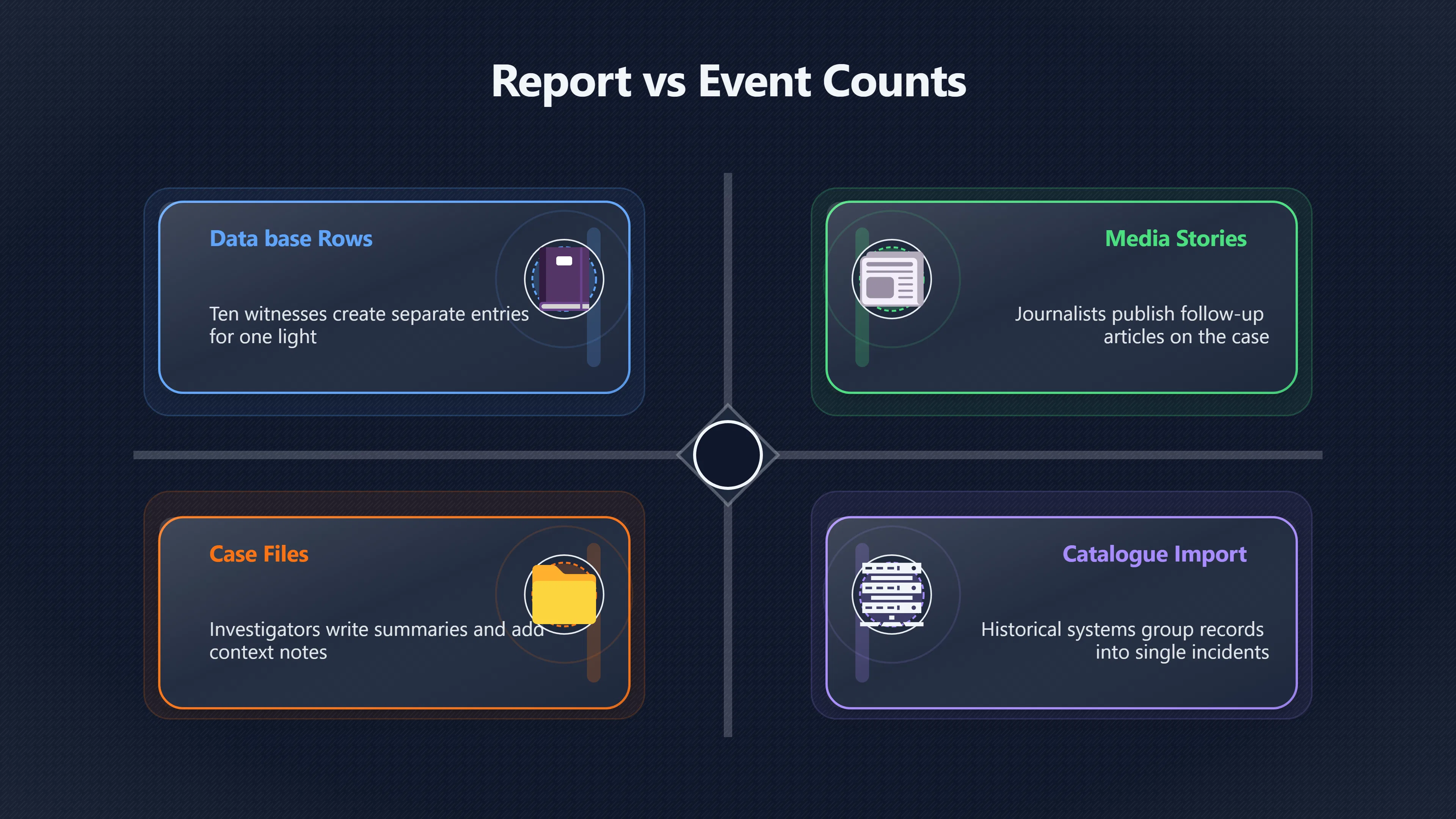
The difference becomes clear in a widely witnessed incident. Imagine an unusual light seen over a city. Ten witnesses submit separate accounts. A local investigator writes a case summary. A newspaper publishes a story. Years later, a historical catalogue imports both the witness reports and the newspaper account. Depending on database structure, that one incident could appear as a dozen or more rows.
From a records-management perspective, all of those rows may be valuable. Different witnesses provide different observations, and later investigators may add corrections or context. The problem appears when users export the database and assume that twelve rows automatically mean twelve separate UFO events.
This is why raw totals can be misleading. A database containing 100,000 records does not necessarily document 100,000 independent incidents. It documents 100,000 stored records, some of which may refer to the same underlying occurrence.
Primary Records and Linked Incident Groups
UFOCAT was designed with this problem in mind. Its codebook explains that certain fields help researchers identify records referring to the same event and group them into related blocks. The system distinguishes between source records and what it calls primary entries, allowing analysts to trace multiple references back to a common incident.[Center for UFO Studies]cufos.orgUFOCAT Codebook 2023Center for UFO StudiesUFOCAT 2023June 6, 2024 — First, it provides the essential information by which records referring to the same event…
This approach reflects a practical compromise. Researchers do not want to delete duplicate-looking reports because those reports often contain unique details. Instead, they preserve individual records while creating links between them.
In practice, an event group might contain:
- Multiple witness statements from the same location and time.
- Newspaper accounts derived from those witnesses.
- Investigator summaries created later.
- References in books or catalogues.
- Updated versions of the same case.
Rather than collapsing all material into a single row, the database keeps the records but assigns relationships between them. Researchers can then count either records or incidents depending on the purpose of the analysis.
The UFOCAT codebook explicitly notes that fields related to source identification help records referring to the same event be grouped together and allow primary entries to be recognised.[Center for UFO Studies]cufos.orgUFOCAT Codebook 2023Center for UFO StudiesUFOCAT 2023June 6, 2024 — First, it provides the essential information by which records referring to the same event…
What Changes When Duplicates Are Collapsed
Event-level counting changes both totals and interpretation.
Large waves often become smaller
Many famous UFO waves generated extensive media coverage. Once a case becomes public, additional witnesses frequently come forward, journalists produce follow-up stories, and investigators create new files.
At the report level, a major wave can appear dramatically larger because every related document increases the database total. Event-level counting reduces that inflation by treating linked records as parts of a single occurrence.
The result is not necessarily fewer witnesses. Instead, it is fewer counted incidents.
Geographic patterns can shift
Raw report totals sometimes make particular cities, states or countries appear unusually active. Yet some of that activity may reflect reporting culture rather than event frequency.
Areas with active UFO organisations, local investigators or enthusiastic media coverage often generate more paperwork per sighting. Event-level counting can reduce this effect because heavily documented incidents no longer receive extra weight simply for producing more records.
This distinction is especially relevant in modern databases such as NUFORC, where reports may arrive from multiple channels and at different times. The system’s large public archive is valuable, but analysts still face the task of determining whether multiple entries describe one event or several.[ada-nuforc-analysis.github.io]ada-nuforc-analysis.github.ioNUFOR C Report Analysis What kind of data do we have?The NUFORC checks each reports for fakes or hoax and comments them accordingly. The reports are classified by their occurred date…Rea…

Trend lines become less dramatic
Historical analyses sometimes show sudden spikes in UFO reports. Some spikes reflect genuine increases in reporting activity, but others can be amplified by duplicate records, retrospective submissions, or repeated circulation of notable cases.
Researchers working with large datasets increasingly perform cleaning and standardisation before analysing trends. Recent independent efforts to process NUFORC and merged UFO datasets have highlighted the importance of removing reporting artefacts before drawing conclusions about long-term growth patterns.[Reddit]reddit.comi analyzed 79621 declassified ufo reports with aiI analyzed 79621 declassified UFO reports with AIMay 10, 2026 — Im interested in your thoughts on the fact that the NUFORC dataset…[Reddit]reddit.comMUFON/Open, Kaggle scrapes, and others). Each sighting has…Read more…
Why Researchers Usually Keep the Duplicate Records
At first glance, deleting duplicates seems like the obvious solution. In practice, most serious catalogue builders avoid doing that.
The reason is that apparently duplicate reports often contain important differences:
- One witness may provide a precise time.
- Another may describe object movement.
- A newspaper may preserve details later lost from witness files.
- An investigator may correct a location or date.
Removing all but one version can destroy provenance and make it impossible to reconstruct how a case was documented over time.
UFOCAT’s structure reflects this concern. The catalogue was designed not merely as a list of sightings but as a reference system connecting witnesses, events and sources, even when those relationships are not perfectly clear.[Center for UFO Studies]cufos.orgUFOCAT Codebook 2023Center for UFO StudiesUFOCAT 2023June 6, 2024 — First, it provides the essential information by which records referring to the same event…
For that reason, many researchers prefer a two-layer model:
- Preserve every original report.
- Create incident groups that link related records.
This allows both archival completeness and more realistic event statistics.
The Difficult Cases
Event-level counting sounds straightforward until researchers encounter ambiguous records.
Common problems include:
- Witnesses reporting the same object from different towns.
- Reports submitted weeks or months apart.
- Cases with approximate dates or times.
- Conflicting descriptions of shape, colour or duration.
- Historical reports based on secondary sources.
Two records may look identical yet describe different events. Conversely, two reports may appear unrelated while actually referring to the same occurrence.
Because of these uncertainties, event grouping is often probabilistic rather than absolute. Researchers compare dates, locations, witness descriptions and source histories to decide whether records should be linked.
The process resembles duplicate detection in other large reporting systems. Studies in fields such as software defect tracking and adverse-event monitoring show that duplicate records frequently contain inconsistent details even when they refer to the same underlying event. That makes human judgement and careful linkage methods important when constructing event-level counts.[arXiv]arxiv.orgarXiv Rediscovery Datasets: Connecting Duplicate ReportsRediscovery Datasets: Connecting Duplicate ReportsMarch 18, 2017…
A More Realistic Picture of UFO Totals
Event-level counting does not prove or disprove any UFO claim. Its purpose is narrower and more practical: to prevent record inflation.
A catalogue may still contain exactly the same witness statements, investigation notes and source references after duplicate handling. What changes is the interpretation of the totals. Instead of saying that a database contains a certain number of UFO reports and treating that figure as the number of sightings, researchers can distinguish between stored records and distinct incidents.
That distinction produces a more realistic measure of how often unusual aerial events were actually reported. It also makes comparisons between databases more meaningful, because differences in record-keeping practices no longer automatically translate into differences in apparent UFO activity. When incident grouping is done carefully, large catalogues become less a count of paperwork and more a count of events.
Amazon book picks
Further Reading
Books and field guides related to What Happens When UFO Rows Are Counted Once. Use these as the next step if you want deeper reading beyond the article.
The UFO Experience
Provides case-evaluation context for why a report is not automatically a separate event.
UFOs
Gives strong UFO evidence context while the page handles how such reports should be counted.
How to Lie with Statistics
Perfectly supports the counting problem: rows, reports, and events can produce misleading totals.
The Signal and the Noise
Helps readers distinguish meaningful event signals from noisy reporting data.
eBay marketplace picks
Marketplace Samples
Example marketplace items related to this page. Use the search link to explore similar finds on eBay.


Endnotes
1.
Source: ada-nuforc-analysis.github.io
Title: NUFOR C Report Analysis What kind of data do we have?
Link:https://ada-nuforc-analysis.github.io/
Source snippet
The NUFORC checks each reports for fakes or hoax and comments them accordingly. The reports are classified by their occurred date...Rea...
2.
Source: nuforc.org
Title: 929 new ufo reports posted
Link:https://nuforc.org/929-new-ufo-reports-posted/
Source snippet
929 New UFO Reports Posted | NUFORC9 Nov 2024 — We have added 929 new reports to our online Data Bank. The reports range from recen...
3.
Source: reddit.com
Title: i analyzed 79621 declassified ufo reports with ai
Link:https://www.reddit.com/r/ufo/comments/1t9cikz/i_analyzed_79621_declassified_ufo_reports_with_ai/
Source snippet
I analyzed 79621 declassified UFO reports with AIMay 10, 2026 — Im interested in your thoughts on the fact that the NUFORC dataset...
Published: May 10, 2026
4.
Source: reddit.com
Link:https://www.reddit.com/r/UFOs/comments/1oz3i0h/im_releasing_a_cleaned_enriched_ufo_dataset_327k/
Source snippet
[MUFON]({{ 'mufon/' | relative_url }})/Open, Kaggle scrapes, and others). Each sighting has...Read more...
5.
Source: arxiv.org
Title: arXiv Rediscovery Datasets: Connecting Duplicate Reports
Link:https://arxiv.org/abs/1703.06337
Source snippet
Rediscovery Datasets: Connecting Duplicate ReportsMarch 18, 2017...
Published: March 18, 2017
6.
Source: archive.org
Link:https://archive.org/download/UFO_Commentary_vol_2_no_4/UFO_Commentary_vol_2_no_4.pdf
7.
Source: nuforc.org
Link:https://nuforc.org/ndx/?id=loc
Source snippet
NUFORC Reports by LocationLOCATION, REPORT COUNT. USA - Unspecified, 120. USA - Alaska, 676. USA - Alabama, 1529. USA - Arkansas, 1367. U...
8.
Source: cufos.org
Title: UFOCAT Codebook 2023
Link:https://cufos.org/PDFs/UFOCAT%20Codebook%202023.pdf
Source snippet
Center for UFO StudiesUFOCAT 2023June 6, 2024 — First, it provides the essential information by which records referring to the same event...
Published: June 6, 2024
9.
Source: cufos.org
Link:https://cufos.org/PDFs/CUFOS_Associate_Newsletter/AN1_2.pdf
Source snippet
Center for UFO StudiesASSOCIATE NEWSLETTERThe UFOCAT Codebook. By Ogvid SQIIRd&Fi. (Second Edition) 1978. A guide to the interpretation o...
Additional References
10.
Source: nicap.org
Link:https://www.nicap.org/books/Behavioral_Scientist/UFO_Phenomena_and_Behavioral_Scientist.pdf
Source snippet
UFO Phenomena and the Behavioral ScientistI just hope that this book will help the time come sooner when they will not only understand th...
11.
Source: kaggle.com
Link:https://www.kaggle.com/datasets/thedevastator/uncovering-mysterious-unexplained-ufo-sightings
Source snippet
UFO Sightings (Location & Time)All reports come directly from the NUFORC site's public database. With this dataset you can uncover everyt...
12.
Source: facebook.com
Title: since its founding in 1974 nuforc says it has processed over 170000 reports whic
Link:https://www.facebook.com/KCAU9News/posts/since-its-founding-in-1974-nuforc-says-it-has-processed-over-170000-reports-whic/762875129180682/
Source snippet
Since its founding in 1974, NUFORC says it has processed...Since its founding in 1974, NUFORC says it has processed over 170000 reports...
13.
Source: youtube.com
Link:https://www.youtube.com/watch?v=ur0QX1eGCQI
Source snippet
Governments Using AI To Decode Massive UFO Databases | WION Podcast - YouTube Governments Using AI To Decode Massive UFO Databases | WION...
14.
Source: academia.edu
Link:https://www.academia.edu/44630124/A_SEARCH_FOR_POSSIBLE_CAUSAL_ASSOCIATIONS_BETWEEN_UFOs_and_PERTURBATIONS_IN_RECORDED_GEOPHYSICAL_DATA
Source snippet
A SEARCH FOR POSSIBLE CAUSAL ASSOCIATIONS...29 Nov 2024 — The number of witnesses to UFOCAT type 5 and largest number for any one month...
15.
Source: researchgate.net
Title: 352352112 A Preliminary Analysis of Historical UFO Report Data
Link:https://www.researchgate.net/publication/352352112_A_Preliminary_Analysis_of_Historical_UFO_Report_Data
Source snippet
(PDF) A Preliminary Analysis of Historical UFO Report Data14 Jun 2021 — PDF | On Jan 1, 2021, Mark Carlotto published A Preliminary Analy...
16.
Source: cs.ubc.ca
Link:https://www.cs.ubc.ca/~tmm/courses/547-17F/projects/hayley-theodore/report.pdf
Source snippet
Want to Believe: A Visualization of UFO Siting Reportsby TSH Guillou — In this work we present an interactive visualization tool for exam...
17.
Source: youtu.be
Link:https://youtu.be/MR1VCguoeaE
Source snippet
"Spectral methods for time series analysis [https://youtu.be/onrdJFlXbMg](https://youtu.be/onrdJFlXbMg) [https://youtu.be/BokqiGJhqhA](https://youtu.be/BokqiGJhqhA) [https://youtu.be/frQ4m77OLGs..."](https://youtu.be/frQ4m77OLGs...")...
18.
Source: pubmed.ncbi.nlm.nih.gov
Link:https://pubmed.ncbi.nlm.nih.gov/40467832/
Source snippet
Evaluation of Duplicate Adverse Event Reports...by S Janiczak · 2025 · Cited by 9 — Compared to non-duplicate reports, duplicates were m...
19.
Source: newspaceeconomy.ca
Title: ufocat the ufo sightings catalog by cufos
Link:https://newspaceeconomy.ca/2025/07/30/ufocat-the-ufo-sightings-catalog-by-cufos/
Source snippet
duplicate entries may exist when multiple observers describe the same phenomenon. The quality and completeness of individual records vary...
Topic Tree