Within Reliability
Are UFO Spikes Events or Reporting Surges?
A spike in UFO reports may reflect when people file sightings, not when unusual events actually happened.
On this page
- Why event date and report date differ
- How media and daylight can shape reporting
- What timing fields a database should preserve
Page outline Jump by section
Introduction
When analysing large catalogues of UFO reports, one pattern that often attracts attention is a spike—a period when many sightings appear to cluster in time. But in UFO databases, a rise in the number of reports does not necessarily mean more unusual sky events actually occurred at that moment. A fundamental distinction in any catalogue between event time (when the sighting actually happened) and report time (when it was filed or entered) profoundly affects how we interpret spikes in the data. Misunderstanding this can lead researchers or the public to misread reporting behaviour as evidence of anomalous phenomena.

Why Event Dates and Report Dates Can Diverge
A UFO database often has at least two relevant time fields:
- Event/Occurrence Date – the date (and sometimes time) the witness says the sighting happened.
- Report/Submission Date – the date the witness completed and submitted the report to the database.
These can diverge for several reasons:
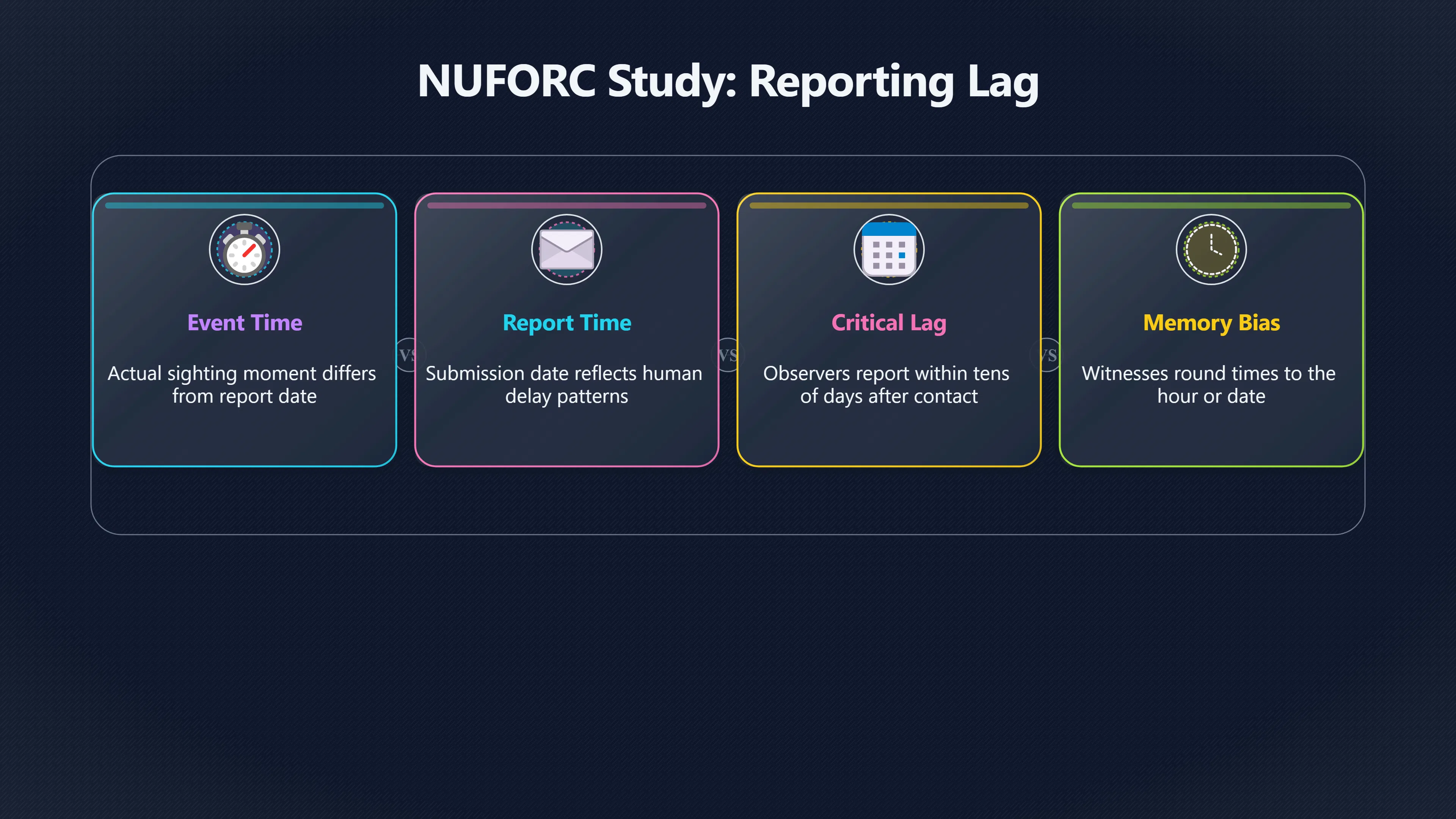
Reporting Lag: Many witnesses do not submit their sightings immediately. A statistical study of 80,000+ UFO reports from the National UFO Reporting Center (NUFORC) database found that the time lag between sighting and reporting varies widely and shows behavioural patterns among reporters, including a detectable tendency to report within a certain window of time after the sighting rather than immediately. The research identified a sort of “critical reporting lag” around tens of days after the contact, suggesting non‑random delays in when people choose to report what they saw.[ScienceDirect]sciencedirect.comScienceDirect On the dynamics of reporting data: A case study of UFO sightingsOn the dynamics of reporting data: A case study of UFO sightings - ScienceDirectOctober 1, 2022…
Date Rounding and Memory Biases: Human memory and reporting habits shape dates in catalogues. The same study noted that observers often prefer “round” times and dates in their accounts—such as on the hour or on round calendar dates—rather than the exact minute they recall. This indicates some entries are shaped by recall bias rather than precise event timing.[ScienceDirect]sciencedirect.comScienceDirect On the dynamics of reporting data: A case study of UFO sightingsOn the dynamics of reporting data: A case study of UFO sightings - ScienceDirectOctober 1, 2022…
Data Publication Delay: Even after submission, some datasets may not be uploaded or posted until later, leading to artificial clustering on publication dates (for instance, when a backlog is processed), which further separates public “report time” from event time.
When researchers plot report frequency by report date, these lags and biases can create apparent spikes that are actually driven by reporting behaviour rather than clusters of genuine sky phenomena.
How Media Coverage and Social Factors Shape Reporting
Human behaviour around reporting is highly sensitive to external triggers:
Media Influence: Sightings and reporting rates often increase around periods of intense media coverage. A study focusing on UFO report dynamics noted that the number of new report submissions shows sensitivity to broadcasting events: when UFO news or discussions are prominent in media, people are more likely to notice and then submit reports.[ScienceDirect]sciencedirect.comScienceDirect On the dynamics of reporting data: A case study of UFO sightingsOn the dynamics of reporting data: A case study of UFO sightings - ScienceDirectOctober 1, 2022…
This pattern isn’t unique to UFO reports. Epidemiology studies, for example, show that disease reports peak when awareness campaigns run—even if the underlying incidence doesn’t change—because more people seek diagnosis or file reports. The same mechanism applies to UFO data: heightened publicity primes observers to look at the sky and then to report what they see, inflating counts around the period of media attention.
Daylight and Leisure Time: In addition to media, basic social patterns influence reporting. Analyses of public UFO sightings show that most reports cluster during evening and nighttime hours—when people are free from work and more likely to look up at the sky—and during weekends and summer months, when outdoor activity is more common. These patterns track human visibility and leisure behaviour rather than fluctuations in actual aerial phenomena.[New Space Economy]newspaceeconomy.caNew Space Economy The UAP Phenomenon: A Statistical InquiryNew Space EconomyThe UAP Phenomenon: A Statistical Inquiry - New Space EconomyMay 22, 2026…

Practical Implications for Data Quality
Awareness of event time versus report time has direct consequences for how UFO databases should be used:
1. Always Check Both Time Fields: A database that includes only “submission date” without a separate “event date” will inevitably reflect the rhythms of reporting behaviour. Researchers seeking to detect genuine patterns in occurrences need both. Studies that blend or ignore these fields risk conflating human behaviour with actual events.
2. Adjust for Reporting Lag: Sophisticated analyses can model the distribution of reporting delays and attempt to “back‑shift” report counts toward likely event dates. Without such adjustments, short‑term spikes in counts might be misinterpreted.
3. Use External Anchors: When possible, anchor sightings to independent data—such as instrumental records, radar tracks, or astronomical events—to validate the event timing. Reported clusters without external corroboration are inherently less reliable as evidence of actual phenomena.
Takeaway
A spike in UFO reports often reflects reporting behaviour as much as, or more than, a true increase in aerial events. Distinguishing between when a sighting happened and when it was reported is essential for responsible interpretation of UFO databases. Without this nuance, analyses can mistake social, cognitive and administrative rhythms for physical phenomena, leading to misleading conclusions about patterns in the sky.
Amazon book picks
Further Reading
Books and field guides related to Are UFO Spikes Events or Reporting Surges?. Use these as the next step if you want deeper reading beyond the article.
The UFO Experience
Discusses UFO reports as investigable cases, supporting distinctions between observation, report, and interpretation.
The Signal and the Noise
Helps readers think about signal, noise, timing artefacts, and misleading spikes in large datasets.
Calling Bullshit
Fits pages about interpreting database spikes, dashboards, and apparent patterns cautiously.
How to Lie with Statistics
Useful for understanding how report spikes can be misread when counting and timing fields are confused.
eBay marketplace picks
Marketplace Samples
Example marketplace items related to this page. Use the search link to explore similar finds on eBay.




Endnotes
1.
Source: sciencedirect.com
Title: ScienceDirect On the dynamics of reporting data: A case study of UFO sightings
Link:https://www.sciencedirect.com/science/article/abs/pii/S0378437122005295
Source snippet
On the dynamics of reporting data: A case study of UFO sightings - ScienceDirectOctober 1, 2022...
Published: October 1, 2022
2.
Source: sciencedirect.com
Title: On the dynamics of reporting data: A case study of UFO sightings
Link:https://www.sciencedirect.com/science/article/pii/S0378437122005295
Source snippet
October 1, 2022 — PHYSICA A: STATISTICAL MECHANICS AND ITS APPLICATIONS Volume 603, 1 October 2022, 127807 ON THE DYNAMICS O...
Published: October 1, 2022
3.
Source: newspaceeconomy.ca
Title: New Space Economy The UAP Phenomenon: A Statistical Inquiry
Link:https://newspaceeconomy.ca/2025/09/24/the-uap-phenomenon-a-statistical-inquiry/
Source snippet
New Space EconomyThe UAP Phenomenon: A Statistical Inquiry - New Space EconomyMay 22, 2026...
Published: May 22, 2026
Additional References
4.
Source: nature.com
Link:https://www.nature.com/articles/s41598-023-49527-x
Source snippet
December 14, 2023 — An environmental analysis of public UAP sightings and sky view potential Download PDF Download PDF * Article * Open a...
Published: December 14, 2023
5.
Source: ada-nuforc-analysis.github.io
Link:https://ada-nuforc-analysis.github.io/UFO.html
Source snippet
UFOANALYSIS¶ TIME OF OCCURRENCE¶ CAN THE REPORTS BE EXPLAINED?¶ A reports submission splits into three parts, 'Occurred' when the UFO sig...
6.
Source: complex.pfi.uem.br
Link:https://complex.pfi.uem.br/publication/2022/on-the-dynamics-of-reporting-data-a-case-study-of-ufo-sightings/
Source snippet
J. Antonio, A. S. Itami, F. F. Dalmedico, F. S. Mendes, Physica A 603, 127807 (2022). PDF Cite DOI Image ABSTRACT There are a...
7.
Source: astronomy.com
Title: But the public is growing increasingly confused by ordinary object
Link:https://www.astronomy.com/science/reports-of-rising-ufo-sightings-are-greatly-exaggerated/
Source snippet
Reports of rising UFO sightings are greatly exaggeratedOctober 2, 2020 — REPORTS OF RISING UFO SIGHTINGS ARE GREATLY EXAGGERATED The pand...
Published: October 2, 2020
8.
Source: journalofscientificexploration.org
Title: Modeling the Law of Times | Journal of Scientific Exploration
Link:https://journalofscientificexploration.org/index.php/jse/article/view/797
Source snippet
29 No. 2, Research Articles Vol. 29 No. 2 MODELING THE LAW OF TIMES Research Articles Published 2015-06-06 * Julio Plaza del Olmo Julio P...
Published: June 6, 2015
9.
Source: ovniteca.net
Title: dynamics reporting data case study ufo sightings
Link:https://www.ovniteca.net/bibliografia/dynamics-reporting-data-case-study-ufo-sightings
Source snippet
On the dynamics of reporting data: A case study of UFO sightings | OvnitecaOvniteca Historia y actualidad de los ovnis ON THE DYNAMICS OF...
10.
Source: philpapers.org
Title: Julio Plaza del Olmo, Modeling the Law of Times
Link:https://philpapers.org/rec/OLMMTL
Source snippet
MODELING THE LAW OF TIMES Julio Plaza del Olmo Journal of Scientific Exploration 29 (2) (2015) Copy B IB T_{E}X ABSTRACT The La...
11.
Source: cbsnews.com
Title: UF O reports spiked over the summer
Link:https://www.cbsnews.com/news/ufo-reports-spiked-over-the-summer/
Source snippet
UFO reports spiked over the summer - CBS NewsSeptember 19, 2011 — UFO REPORTS SPIKED OVER THE SUMMER By Benjamin Radford September 19, 20...
Published: September 19, 2011
12.
Source: youtube.com
Title: Let’s Talk About the New UFO Files Released by The Government
Link:http://www.youtube.com/watch?v=K4SiqjS28ZE
Source snippet
"Ufo sightings" data analysis time series UFO Data Mining, Part 1: Time Series Models Cache Lack Stats...
13.
Source: youtube.com
Link:http://www.youtube.com/watch?v=qMp6jlxC238
Source snippet
I Analyzed 173,747 UFO Reports… Here’s What I Found...
Topic Tree